
1-805-484-2992
Quotes - Engineering - SalesWhat a gasketed plate exchanger is in stainless
A gasketed plate-and-frame exchanger is a stack of thin pressed stainless plates hung on a carrying bar between a fixed head and a movable follower, pulled together by tie bolts. Each plate carries an elastomer gasket that seals the edge and routes the two fluids into alternate channels, so the hot stream and the cold stream each touch one face of every plate. The pressed chevron pattern turns the flow at every ridge, which is why a plate unit reaches a 2–5°F approach in a frame you can walk around.
In stainless the plate is a 316L pressing 0.5–0.6 mm thick on industrial frames and typically 0.4–0.5 mm on sanitary units; the thin wall is possible because the plates support one another and the gasket, not the metal, carries the seal. The frame is a separate decision: painted carbon steel for a process or utility room, stainless clad or solid stainless where the unit is washed down or sits on a food floor.
This construction suits liquid-to-liquid duty with a tight approach and clean or lightly fouling fluids: tower water isolation, process cooling, pasteurizing, wort cooling, glycol chilling, heat recovery between two streams. It does not suit steam at full pressure, vacuum condensing, or anything with particles larger than the channel gap.
Plates are 316L as the standard pressing, titanium where tower water or brine carries high chlorides, and 304L only on soft water duties with no chloride history. See Material & Construction for the grade comparison.
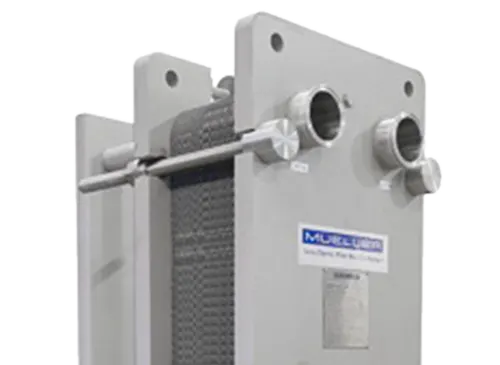
Typically several times the heat transfer coefficient of a shell and tube on the same water, in a frame that opens with a wrench and grows by adding plates.
316L or titanium plates, NBR, EPDM or FKM gaskets, 150 psig frames as standard
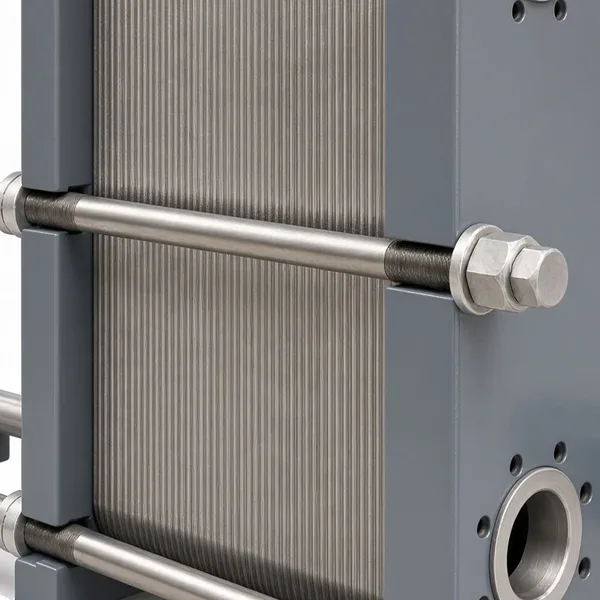
Why the plate pack belongs in 316L
- Molybdenum resists pitting where the gasket groove traps water
- Dual-certified 316/316L sheet takes the deep chevron press
- Same plate pattern pressed in titanium for high-chloride water
- Thin 0.5–0.6 mm wall keeps the stainless conductivity penalty small
- Plates and gaskets replaced one at a time without new piping
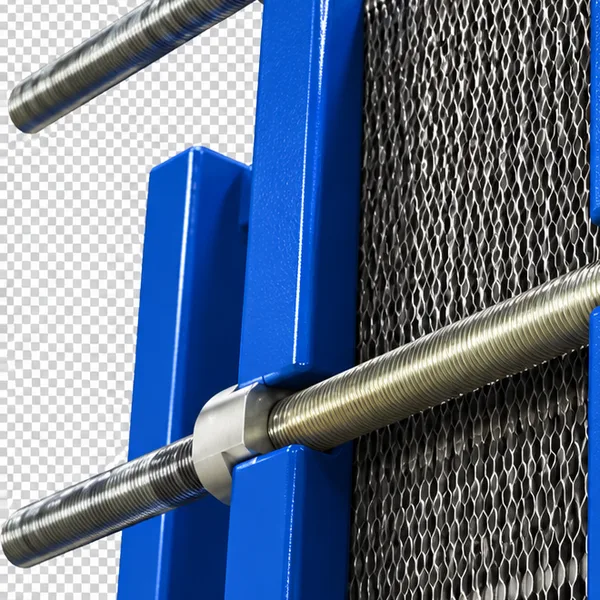
What the gasket and frame decide
- NBR to about 230°F for water, glycol and mineral oil
- EPDM to about 275–300°F for hot water, caustic and steam flush
- FKM to about 350°F for oils, acids and solvent carriers
- Painted carbon steel frame indoors, stainless clad on wash-down floors
- Frame sized with spare plate slots for the next duty increase
What you can specify




Standard build and the options behind it
Most plate exchangers we supply start from the figures below; the right column lists what moves when the fluid, temperature or site asks for it. Send the chloride content and the top process temperature with the duty and we settle plate grade and gasket compound before sizing.
Standard build
- Plate material: 316L, 0.5–0.6 mm, dual-certified 316/316L sheet
- Gasket: NBR or EPDM, clip-on, one compound per unit
- Frame: Carbon steel, epoxy painted, 150 psig design
- Connections: Studded ports or flanged, 1 in. to 12 in.
- Approach: 2–5°F on water-to-water at full flow
- Capacity reserve: Frame length for 20–30% more plates
Options on request
- Plate material: Titanium Grade 2 for seawater, brine, high-chloride tower water
- Gasket: FKM for oils, acids and 350°F service; glued where specified
- Frame: Stainless clad or solid 304L, 300 psig design, 3-A layout
- Connections: Tri-clamp to 4 in., lined ports, double-gasketed port rings
- Plate pattern: Wide-gap plates for fibers and solids to about 1/4 in.
- Documentation: ASME U stamp, PED or CRN registration, MTRs, hydrotest report
Choosing a stainless plate exchanger
How the plate pattern sets the pressure drop
The chevron angle on a plate is the lever between heat transfer and pressure drop. A steep chevron gives the highest coefficient and the tightest approach but eats pressure drop; a shallow chevron passes the same flow with a fraction of the loss and a wider approach. A mixed pack of both lets us land on a target pressure drop of 5–10 psi while holding the approach, which is why we ask for allowable pressure drop and not just flow.
- Steep chevron: tight approach, high pressure drop, best for heat recovery
- Shallow chevron: low pressure drop, wider approach, best for high flows
- Mixed pack: a thermal and hydraulic fit in one frame
- Channel velocity above about 1 ft/s helps keep plates clean on water
316L, titanium or 304L for the plates
The plate is the thinnest wetted stainless on this site, so pitting that a 1/16 in. tube wall would survive for years opens a plate in months. We press 316L as the default because its 2–3% molybdenum holds against chlorides to about 1,000 ppm at ambient temperature and near-neutral pH, which covers most city water, glycol and process liquids. Tower water that cycles past that, seawater, brine and any chloride stream running hot go to titanium plates in the same frame. 304L plates are a soft-water choice only; with any chloride history they are the wrong economy.
The mistake: picking the gasket by temperature alone
The common failure we see is a plate pack whose gasket matched the process temperature and not the cleaning chemistry. A food plant ran EPDM on a product at 180°F without trouble, then added a hot, concentrated nitric acid step beyond the compound's rating; within a season the gaskets had hardened, cracked at the corners and the plates began to weep at the port rings. The fix was a compound rated for the whole CIP recipe, at a cost that would have been minor had it been specified at the start. Tell us every fluid the plates will see, including the cleaning cycle.
- List the CIP chemicals and their temperatures with the process fluids
- Mineral oil or citrus oil on either side rules out EPDM
- Steam flushing above 300°F rules out NBR and most EPDM
Industrial frame or sanitary frame
A painted carbon steel frame does the work in a mechanical room or a process area that stays dry. On a food or beverage floor the frame gets hosed with the equipment, the carbon steel rusts at the paint chips and the tie bolts seize; a stainless clad frame with stainless tie bolts is the right build there, and solid stainless when the plant's hygiene standard calls for it. The sanitary frame also carries tri-clamp ports and a pack that drains when the follower is backed off.
Gasket and plate questions
The carrying bar and tie bolts on a new frame are cut to a maximum plate count, and we normally quote a frame with room for 20–30% more plates than the duty needs today. Adding plates raises the surface and the flow capacity in proportion. The port size does not grow, so a frame fills before its ports choke only if the original ports were sized for the future flow; tell us the planned growth and we size both.
A standard chevron plate has a channel gap of a few millimeters and the gasket corners act as a strainer, so anything above about 1 mm bridges and blocks the first channels. Wide-gap plates pass soft solids and fibers to roughly 1/4 in. on one side while the other side runs a normal pattern. Hard or larger particles belong in a tube-in-tube or a shell and tube with a removable bundle, not a plate pack.
Low-pressure steam to about 15 psig, condensing at 250°F, is within the range of an EPDM-gasketed unit sized for the condensate load, and it is used that way on hot water sets. Higher steam pressures push the gasket past its temperature limit and the thermal cycling loosens the seal. For 50 psig steam and above we recommend a stainless shell and tube or a brazed plate, which has no gasket to age.
The plates are the main cost driver in a plate exchanger, and titanium sheet costs several times what 316L does, so the titanium pack is priced well above a 316L pack in the same frame. Titanium also conducts about 12 Btu/h-ft-F against 9.4 for stainless, so plate count does not grow. Against a 316L pack that can pit within a few seasons on 2,000 ppm tower water, the titanium pack is the cheaper exchanger over any reasonable service life.
Related
Plate & Frame
Industrial
Process cooling, glycol loops, quench water and oil coolers on 316L plate packs with painted frames, sized to a stated pressure drop.
+ Learn More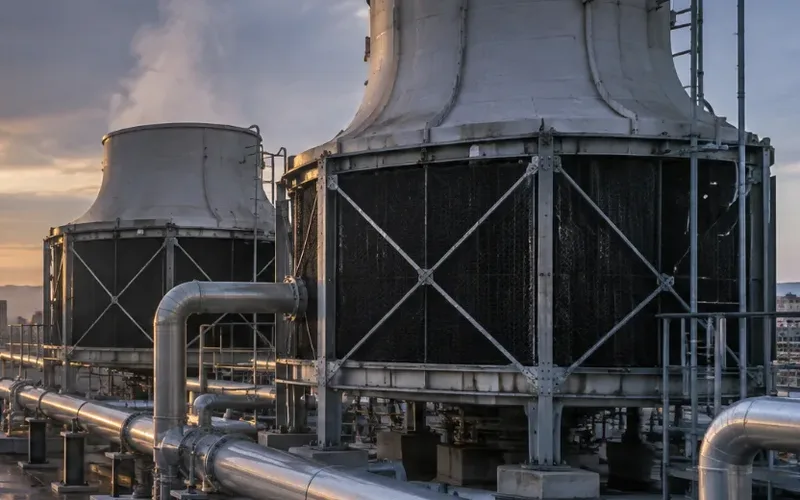
Plate & Frame
Cooling Tower Isolation
Plate-and-frame isolation units between an open cooling tower and a closed loop, with the plate grade set by the basin chloride at full cycles, not the makeup water.
+ Learn More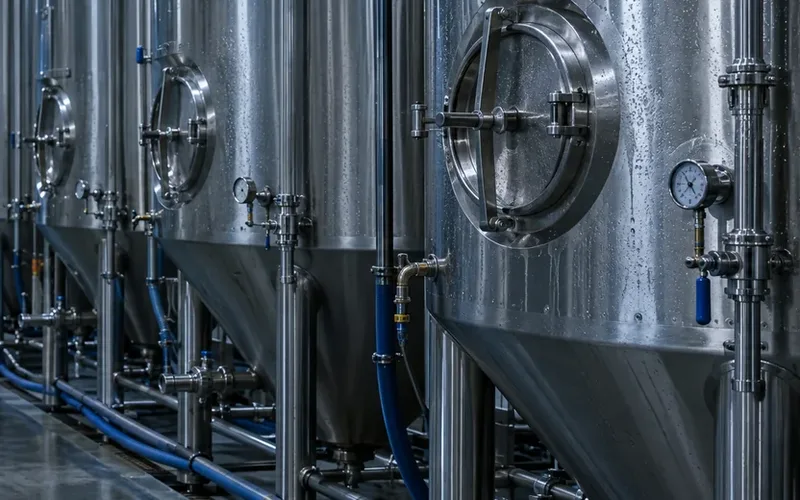
Plate & Frame
Brewing & Distilling
Two-stage wort coolers, liquor and mash heaters and stillage coolers for production breweries and distilleries, on 316L plates with wide-gap options for grain.
+ Learn More