
1-805-484-2992
Quotes - Engineering - SalesA tube bundle in the grade the fluid needs
A shell and tube heat exchanger passes one fluid through a bundle of tubes and the other through the shell around them, and in stainless it is the construction that covers the widest spread of pressure, temperature and chemistry of anything we build. We supply shells and bundles in 304L and 316L as standard, straight-tube or U-tube, fixed or removable, single or double tubesheet, with 2205 duplex, 6-moly or titanium tubes when chlorides or specific acids rule 316L out.
It suits the engineer who needs a code-stamped vessel instead of a gasketed pack: tower water carrying grit, steam at 100 psig, process liquid above the typical 275–300°F limit of an EPDM gasket, a viscous fluid that will not pass a 3 mm plate channel, and sanitary product that has to drain and survive a 250°F SIP cycle. It also suits the plant that rods tubes on a schedule, because a straight-tube bundle is the one surface a crew can brush clean from the end.
Stainless changes the shell and tubesheet as much as the tubes. A carbon steel shell on 316L tubes is an honest industrial answer when the shell fluid is clean steam or treated water; an all-316L unit is the answer when both fluids attack carbon steel or the product side must stay free of iron. The pages under this hub take each of those duties in turn.
304L shells and 316L tubes are the usual pairing; 2205 duplex, 6-moly or titanium tubes go in where hot chlorides, brine or specific acids would attack 316L. See Material & Construction for the grade comparison.
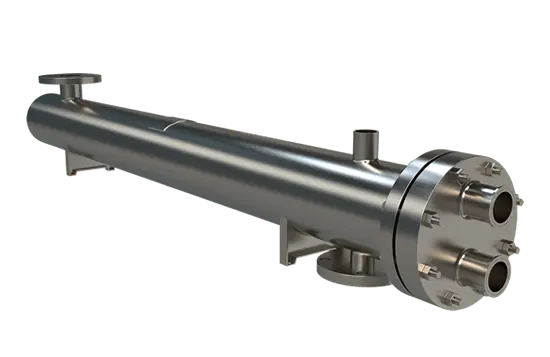
From 150 psig tower water to electropolished WFI, the stainless shell and tube is the build we size when a gasket, a braze joint or a plate gap will not hold up.
304L, 316L, duplex and titanium bundles, straight or U-tube, fixed or removable.
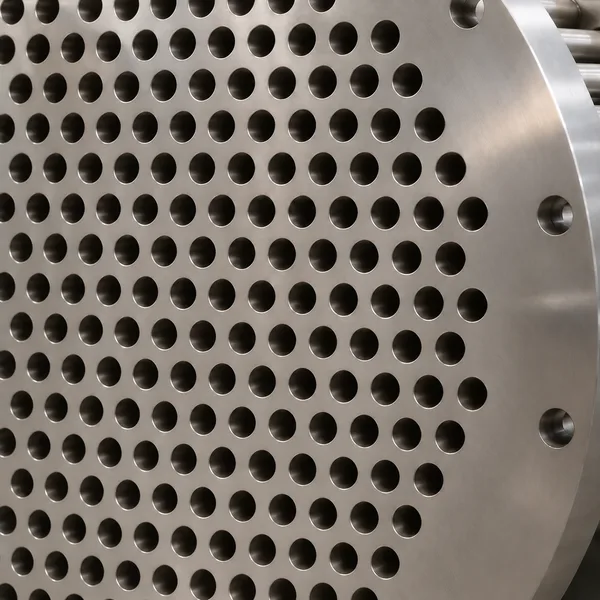
Why stainless tubes
- 316L typically to about 1,000 ppm chloride at ambient, 304 to 200
- Dual-certified 304/304L and 316/316L tube with MTRs on request
- 2205 duplex tubes above 140°F where chlorides risk cracking
- Titanium tubes for seawater and brine, in a titanium-clad tubesheet
- Expanded or seal-welded tube joints, chosen for the duty
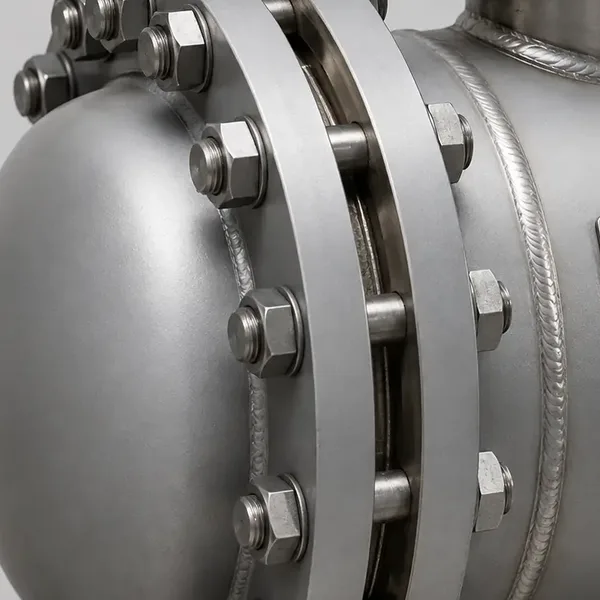
Why this construction
- 150 psig at 350°F shell as standard, 300 psig and higher to order
- U-tube takes thermal expansion with no bellows on the shell
- Removable bundle lets both sides be cleaned and inspected
- Double tubesheet vents a tube-joint leak to atmosphere
- ASME Section VIII and TEMA class R, C or B where specified
You specify




What a standard stainless build looks like
These are the figures a stainless shell and tube arrives with unless the duty says otherwise. Every one of them can move; the pressure rating, grade and tube joint are the three that change price the most.
| Feature | Standard build |
| Shell | 304L or 316L pipe or rolled plate; carbon steel where the shell fluid allows it |
| Tubes | 3/4 in. or 1 in. OD 316L, 5/8 in. in compact units, dual-certified |
| Tubesheet | 316L, tubes expanded and seal-welded; double tubesheet where specified |
| Bundle | Straight-tube fixed, straight-tube removable with floating head, or U-tube |
| Design rating | 150 psig at 350°F; 300 psig and higher to order |
| Expansion | U-tube, or an expansion joint on a fixed tubesheet above a 100–150°F differential |
| Connections | 150 lb flanges on industrial units; tri-clamp to 4 in. on sanitary, flanged above |
| Code | ASME Section VIII Div 1 and TEMA R, C or B as specified; CRN and PED where required |
| Documentation | MTRs, hydrotest record and passivation certificate on request |
Choosing the stainless shell and tube
Fixed tubesheet, removable bundle or U-tube
A fixed tubesheet unit is the tightest and cheapest of the three: tubes welded to sheets welded to the shell, nothing to unbolt, nothing to leak past a gasket. Its weakness is thermal growth. Once the shell and tubes run more than about 100–150°F apart, the tubes push on the sheets and the shell needs an expansion joint, which is where many fixed units on steam go wrong.
A U-tube bundle takes that growth in the bend and needs no joint, so it is the default for steam and for anything with a big temperature swing; the price is that the inside of the U cannot be rodded, so the tube side carries the clean fluid. A removable straight-tube bundle with a floating head costs the most and gives up a little surface, but both sides can be pulled, brushed and inspected, which is what tower water and fouling process liquids need.
Which grade goes on which side
Put the grade where the chemistry is. The tube wall touches both fluids, so it is picked for the worse of the two: 316L for anything with chlorides past a couple hundred ppm, 304L for clean steam, condensate, glycol and soft water. The shell sees only the shell fluid, so a carbon steel shell on stainless tubes is a sound answer when that fluid is steam or treated closed-loop water, and a wasted one when it is river or tower water.
- 304L shell and tubes: clean utilities, glycol, deionized water below 140°F
- 316L tubes, carbon steel shell: tower or well water in the tubes, steam or treated water in the shell
- All 316L: both fluids corrosive, or product contact that must be iron-free
- 2205 duplex tubes: chlorides above 140°F, or where tube-wall strength lets you thin the wall
- Titanium tubes: seawater and brine at normal cooling temperatures
The mistake: no room to pull the bundle
The removable bundle that cannot be removed is the shell and tube failure we see most. Pull clearance equals bundle length, measured from the stationary head along the axis, clear of the next vessel, the wall and the pipe rack. A 12 ft bundle in a 14 ft bay with a column at one end gets cleaned once, badly, with a hose, and after that the plant lives with the fouling. If the space is not there, say so before sizing: a U-tube with the dirty fluid in the shell, two shorter units in series, or a larger shell with a shorter bundle all solve it, and none can be bolted on afterward.
Velocity, fouling and the surface it costs
Stainless conducts at about 9.4 Btu/h-ft-F against roughly 230 for copper, so a stainless bundle carries more tubes than a copper one for the same duty, and tube-side velocity is what keeps that surface clean. We size water at 3–8 ft/s: below 3 the silt settles and a fouling allowance of 0.001–0.002 h·ft²·°F/Btu is used up in a season; above 8 the pressure drop usualy outweighs the gain. Passes, baffle cut and spacing set that velocity, and the pressure drop you allow tells us how many passes we may use.
Before you pick a shell and tube
Usually not for clean water-to-water duty, where a plate pack reaches a 2–5°F approach on a fraction of the surface. It wins on price when the duty rules the plate out: pressure above a typical plate frame rating, temperature past the gasket, solids that bridge a plate gap, or a code stamp the plant insists on. Send both fluids and we will tell you which construction the numbers favor.
When a tube-to-tubesheet joint leak must not put utility into product or product into utility. The two sheets sit a short distance apart with an open or vented gap, so a joint weep vents to atmosphere instead of mixing. Pharma and aseptic lines usually specify it, and dairy does where specified; a chilled-water-to-glycol unit does not need it and should not pay for it.
Yes, and they usually should be. The tubes see both fluids and get the higher grade; the shell sees one and gets the grade that fluid needs. 316L tubes in a 304L or carbon steel shell is a common and sensible build. Keep an eye on galvanic pairs at the tubesheet in salt water, where a titanium tube needs a titanium or titanium-clad tubesheet.
The standard 150 psig at 350°F covers most plant water, glycol and low-pressure steam. Ask for 300 psig when the shell is on a pump discharge with a dead-head risk, on 100 psig steam with a safety margin, or on a refrigerant side. Each side is rated on its own, so a 300 psig tube side with a 150 psig shell is normal and saves money over rating both high.
Related
Shell & Tube
Corrosive Service
The grade ladder for aggressive fluids: 316L, 2205 duplex, 904L and 6-moly, and titanium, with the chloride, temperature and pH limits that move a duty up a rung.
+ Learn More
Shell & Tube
Steam-to-Water
U-tube and straight-tube steam heaters in 304L and 316L for process and wash-down hot water, sized from the steam pressure and the water's chloride, not a nameplate.
+ Learn More
Shell & Tube
Liquid-to-Liquid
Water to water, glycol to water and process liquid shell and tube units, with 304L or 316L chosen per side from the chloride number and the pressure drop on hand.
+ Learn More
