
1-805-484-2992
Quotes - Engineering - SalesWhat a pillow plate does that a coil cannot
A pillow plate heat exchanger is two stainless sheets spot-welded in a grid, laser-welded around the perimeter, then inflated under hydraulic pressure until the sheets lift between the welds into a quilted channel. Steam, glycol, chilled water or refrigerant runs inside that channel while the product sits against the outside face, either submerged in a tank or held against a tank wall. The same panel is called an embossed plate, a dimple plate or a dimple jacket depending on whether it hangs loose in the liquid or is welded to a vessel.
Against a tube coil the plate wins on three counts. A flat face has no crevice under a tube where product bakes on, so it cleans like the tank wall around it. The inflated channel keeps the utility moving across the whole face instead of along one path, so the plate stays at an even temperature. And a plate usually puts more surface into a given tank footprint than a helical coil of the same volume.
In stainless the decision is 304L for dry gas banks and closed glycol loops, 316L wherever the face meets product, aggressive condensate or chloride-bearing water. We size, build and supply immersion plates, clamp-on and integral jackets, troughs, drip plates and recovery banks in sheet from 0.05 to 0.12 in., rated 100 to 150 psig for steam or glycol inside the plate.
Pillow plates are 304L where only dry gas or closed-loop glycol touches them and 316L wherever product, aggressive condensate or chloride-bearing water wets the face. Material & Construction explains how the grade is chosen.
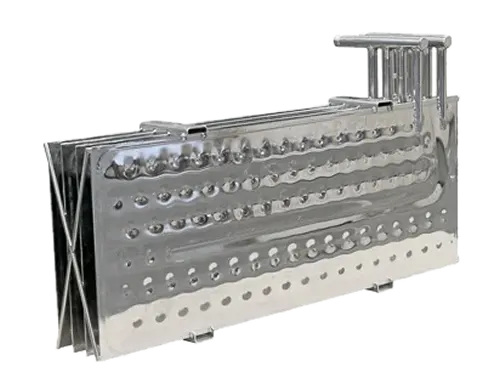
A laser-welded 316L pillow plate usually puts more heating surface into a tank, duct or jacket than a coil of the same volume, with a face that cleans like the vessel wall.
Single or double embossed, 100–150 psig, 304L or 316L sheet.
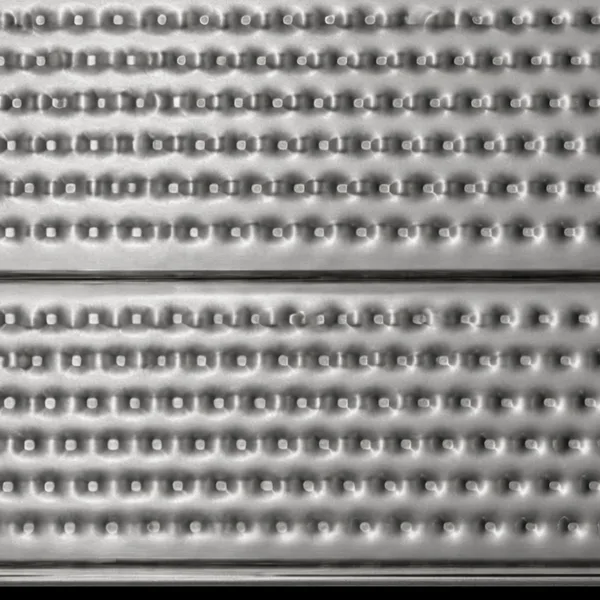
Why stainless, and which grade
- 304L for dry flue gas, air and closed glycol loops
- 316L where product, aggressive condensate or chloride water wets the face
- Dual-certified 304/304L and 316/316L sheet, MTRs where required
- Laser seams keep the heat-affected zone narrow on thin sheet
- Passivation per ASTM A967 after welding and inflation
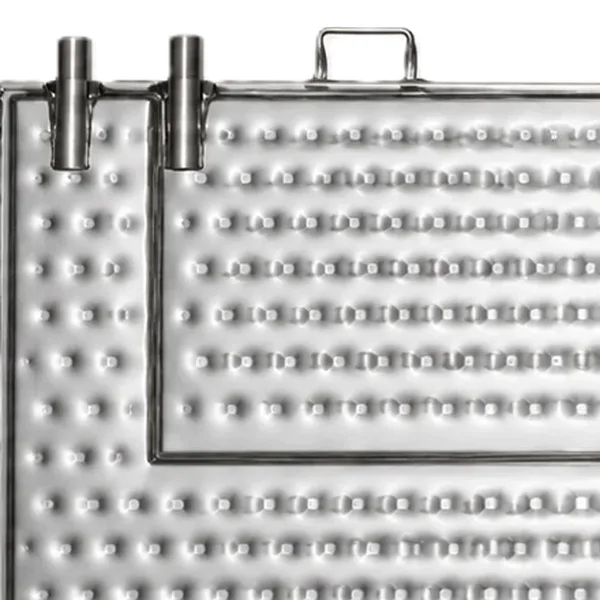
Why a plate instead of a coil
- Flat face, no crevice under a tube for product to bake onto
- More surface per cubic foot of tank than a helical coil
- Single-embossed plates bond flat to a wall or stack as a bank
- Double-embossed plates work both faces in an immersion tank
- Weld pitch and sheet gauge set the pressure rating
What you specify




Which pillow plate form fits the job
Seven forms cover nearly every stainless pillow plate request we see. Pick the row that matches where the plate will sit, then read that page for the grade, gauge and utility detail.
| FORM | WHERE IT GOES | WHY |
| Industrial immersion plate | Plant tanks, quench and rinse baths, process sumps | Double-embossed 304L or 316L panel hung in the liquid with steam or glycol inside |
| Sanitary immersion plate | Food, dairy and beverage vats on product contact | 316L with 32 µin Ra polished faces, a drainable channel and tri-clamp stubs |
| Clamp-on jacket | Existing tanks that cannot come off line to be welded | Curved single-embossed panels strapped on over heat-transfer mastic, no weld on the vessel |
| Integral dimple jacket | New tanks and vessels built with the jacket in the wall | Zones for steam, glycol or cooling water welded to the shell before the tank is finished |
| Drip elimination plate | Cold rooms and ceilings above product lines | Chilled 316L plate condenses room moisture on purpose and drains it to a gutter |
| Trough plate | Conveyed, falling or thin-film product | Plate formed into a channel so the product rides on the heated or chilled face |
| Energy recovery bank | Ducts, flues and warm-water sumps | Stacked plates recover waste heat; 304L in dry gas, 316L once condensate forms |
Specifying a stainless pillow plate
Single or double embossed
A single-embossed plate is one thick flat sheet with one thin sheet inflated against it. The flat face goes against a tank wall, a duct wall or a product trough; the inflated face carries the utility. A double-embossed plate inflates both sheets, so both faces transfer heat and the plate is meant to hang in a liquid with product on both sides.
Choose single-embossed for anything that mounts to a surface and double-embossed for anything that hangs free. A double plate bolted flat to a wall wastes half its surface and traps product behind the inflated back.
Sheet gauge and pressure rating
Sheet from 0.05 to 0.12 in. (about 18 to 11 guage) covers the standard range. Thinner sheet inflates deeper and transfers heat better; thicker sheet carries higher pressure and shrugs off forklift and agitator contact. The spot-weld pitch does the rest: a tighter grid raises the rating because each pillow spans less unsupported sheet.
- 100 psig for glycol, chilled water and low-pressure steam on 0.05 in. sheet
- 150 psig for steam to 366°F on 0.075 in. and heavier sheet
- Higher ratings on thicker sheet and tighter weld pitch, by request
- Hydrostatic test at 1.3 times design pressure, certificate on request
- Refrigerant plates designed to the refrigerant's own pressure, not the steam rating
Grade choice: 304L or 316L
304L has about 18% chromium and 8% nickel with no molybdenum, which is plenty for a flue-gas bank, an air duct or a closed glycol loop with inhibitor. It is not enough for a plate wetted by product, by condensate that carries dissolved gases, or by any water with chlorides above about 200 ppm. 316L adds 2 to 3% molybdenum and takes the chloride limit to about 1,000 ppm at ambient temperature and near-neutral pH.
Every one of those limits falls as the face gets hotter, and a steam plate at 338°F sits well above the roughly 140°F where chloride stress corrosion cracking of 304 and 316 becomes a risk. A steam-heated plate in a brine or salty rinse tank is usually reviewed for 2205 duplex, not 316L.
The mistake: condensate left in the plate
Most steam-plate failures we are asked about are not corrosion. They are plates piped with the steam inlet at the bottom or the condensate outlet above the lowest channel, so condensate pools, the steam slams into it and water hammer bulges the pillows until spot welds let go. Put the inlet at the top, the outlet at the lowest point, a trap sized for the start-up load, and a vacuum breaker so the plate does not hold condensate when the steam valve closes.
Before you choose a plate form
Yes. Embossed plate is the fabrication term for a sheet pressed or inflated into a pattern; pillow plate describes the quilted look after inflation; dimple plate and dimple jacket are the tank-builder's names for the same panel welded to a vessel wall. We use all four here because buyers do, and they describe one product in 304L or 316L.
Start from the duty: each gpm of water raised 1°F needs about 500 Btu/h, so a 50 gpm make-up stream heated 60°F needs about 1,500,000 Btu/h. Steam on one side and stirred water on the other gives a high overall coefficient; still liquid with a viscous product gives a low one. Send the fluids, temperatures and whether the tank is agitated and we will return the plate area.
It can, as a flooded or direct-expansion evaporator plate in 304L or 316L, and it is a common build for ice banks and cold-wall tanks. The plate is then designed to the refrigerant's pressure and tested accordingly, with the weld pitch tightened for ammonia or CO2 ratings. Tell us the refrigerant and the evaporating temperature rather than asking for the standard steam rating.
Usually not for long. Tower water at 4 to 6 cycles can reach 600 to 900 ppm chloride from a 150 ppm makeup, well past the roughly 200 ppm where 304 begins to pit under deposits. If tower water is on either face, specify 316L and keep the plate clean; above about 1,000 ppm or where the water is warm, review 2205 duplex.
Related
Embossed Plate
Jacketed Tanks
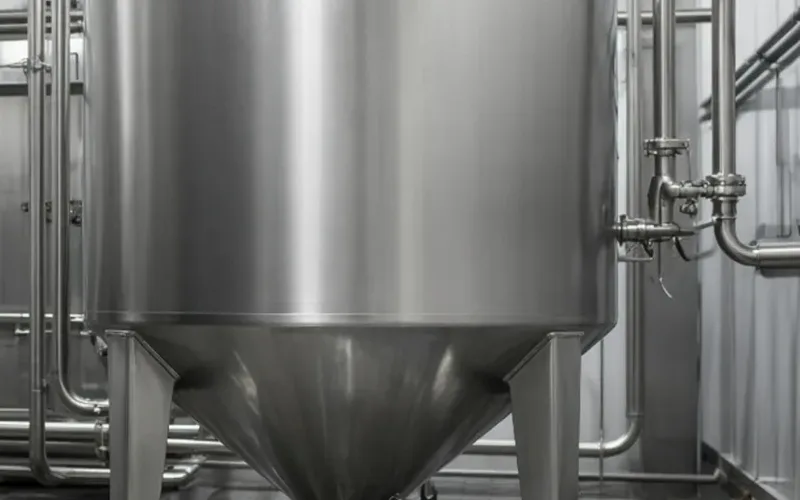
New stainless tanks with the dimple jacket laser-welded to the shell: zoned for steam, glycol or cooling water, rated to 150 psig, sized to the batch.
+ Learn More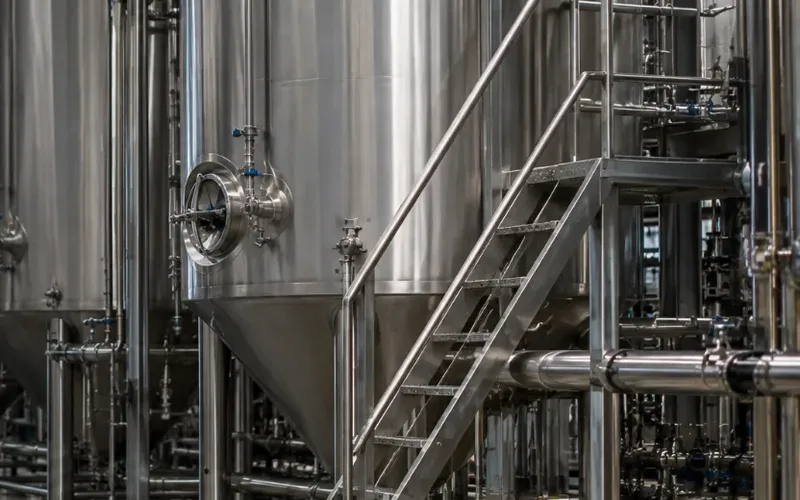
Embossed Plate
Clamp On
Retrofit heating or cooling on a stainless tank you already own: curved pillow plates, straps and heat-transfer mastic, with no weld and no code re-rating.
+ Learn More
Embossed Plate
Energy Recovery Banks
Banks of single-embossed plates on spacers recover heat from exhaust gas, dryer air and warm waste water, with the grade set by whether the plate runs wet or dry.
+ Learn More