
1-805-484-2992
Quotes - Engineering - SalesHeating or chilling product as it moves along a channel
A trough heat exchanger is a single-embossed pillow plate formed into a U or V channel. The thick flat sheet is the inside of the trough and the product face; the inflated sheet is outside, carrying steam, hot water or glycol. Product travels along the channel pushed by a screw, carried by a belt, or flowing as a thin film, exchanging heat with the floor and walls the whole way. It is the plate form for product that cannot be pumped through a tube and will not sit still in a tank.
Conveyed, falling and thin-film product
The duties are varied: tempering chocolate or confectionery mass on a cooling trough, holding a sauce or a paste at temperature between process steps, keeping a tallow, wax or resin molten on its way to a filler, drying or warming granular solids in a heated screw conveyor trough, and chilling a falling film of a hot liquid that would foam in a pumped exchanger. In each case the product sees only the smooth inner face, with no tubes crossing the channel and no dead corners where it packs.
The product face decides the grade. Foods, sauces, brines and most chemical pastes need 316L because they carry salt, acid or the chloride sanitizer used to clean the trough. Dry granular product on a steam-heated trough is comfortable in 304L. Because the product face is the heavy flat sheet, we run it at 0.075 to 0.12 in. for screw conveyors and scraped troughs, where the flights or blades ride on the plate.
Trough plates are 316L on the product face for foods, chemicals and wet solids, and 304L where dry granular product rides on a steam-heated channel. See Material & Construction for the grade comparison.
What a trough build includes
- Single-embossed plate formed into a U, V or flat-bottom channel to the conveyor drawing
- Product face 0.075–0.12 in. where flights, paddles or scrapers bear on it
- Heating zones along the length, each with its own inlet and outlet
- Steam to 150 psig, hot water or glycol to 100 psig in the inflated side
- Flanged or clamped end plates and a hinged or bolted cover where the process is enclosed
- Product face polished to 32 µin Ra and drainable end-to-end on food duties
- Support feet or a stand with the trough sloped as the process requires
product face under a screw conveyorA 0.12 in. product face is specified for long wear life under screw flights and scraper blades while the thin inflated sheet behind it carries the steam.
What to send us for a trough
A trough is designed around the conveyor or the flow it serves, so the mechanical layout comes first and the heat duty second. The two are quoted together.
- Product: solid, paste or liquid, its consistency, melting or setting point, and corrosiveness
- How it moves: screw, belt, vibratory, gravity film, and the throughput in lb/h or gpm
- Inlet and outlet temperatures required, and whether the duty is heating, holding or chilling
- Channel shape and dimensions, or the conveyor make and model it must fit
- Utility: steam pressure, hot water or glycol temperature and flow
- Cleaning: CIP, hose-down or dry cleaning, and the sanitizer in use
- Whether the trough must be covered, vented or run under a slight vacuum
Call and talk it through with an engineer: 1-805-484-2992
A U-shaped vessel whose walls are pillow plate, so a screw or paddle moves solids along the heated or cooled surface and the product is conditioned as it travels. It suits powders, pellets and pastes that will not pump.
Designing the trough around the product
Heat transfer in a trough happens through the product layer lying on the face, so the layer thickness sets the duty more than anything else. A thin falling film of liquid or a shallow bed of granules turned by a screw exchanges heat quickly; a deep, still mass of paste exchanges heat only at the bottom and insulates itself above. We size on the contact area the product actually touches and the depth it runs at, not on the full developed surface of the plate, and we tell you when a deeper bed will need a longer trough or a scraper to turn it.
Zoning along the lenght lets one trough do two jobs. A confectionery or sauce line often heats on the first section to keep the product flowing, then chills on the last section to set it before the depositor, with the two zones on separate utilities and a short unheated gap between them. On a screw conveyor drying a wet solid, the zones step the temperature up along the length so the product does not case-harden at the inlet. Each zone has its own inlet, outlet and control, and on steam its own trap at the lowest dimple.
The product face is the thick sheet, and in a conveyor trough it is a wear surface. Screw flights with a small clearance, paddles and scraper blades all rub it, so we specify 0.075 in. as a minimum under any moving element and 0.12 in. where the product is abrasive or the flights are set close. Thermal performance drops a little with the heavier sheet; wear life goes up a lot. The inflated sheet on the outside stays thin because nothing touches it.
Steam in the trough gives the fastest response but a face near 300°F, which scorches sugar, protein and fat on contact. Hot water or glycol holds the face within a few degrees of the setpoint and is the normal choice for food and for any product with a narrow working temperature. Chilling troughs run glycol or chilled water; a chilled face below the product's dew point or set point will build a skin of product on the plate, and a scraped or vibrated trough prevents it.
The grade follows the product and the cleaning. 316L is the default on any food, sauce, brine, pharmaceutical or chemical product, and on any trough that is washed with chlorinated sanitizer. A 304L trough on a dry granular product heated by steam is a sound economy; the same trough washed down with hypochlorite at the end of each shift is not, and shows pitting along the floor of the channel where the rinse pools before it drains. Slope the trough to a drain and rinse the sanitizer off with water.
Size on the product layer that touches the face, not on the plate area.
A deep bed of paste insulates itself above the first inch; a scraper or a thinner layer does more than a bigger plate.
Request a QuoteTrough questions
Yes, when we have the conveyor's trough drawing or the screw diameter, pitch, length and the clearance it runs at. The new trough matches the flange pattern and the screw clearance, and the heating zones are placed between the hanger bearings so nothing is drilled through a dimpled pocket. The drive end and discharge chute stay as they are.
On hot water or glycol, within a few degrees from inlet to outlet of a zone, because the fluid drops little temperature across a short channel. On steam the face is at saturation temperature everywhere the steam reaches, which is even but hot. Long troughs are split into zones so the first section can run warmer to start the product moving and later sections hold it, with each zone on its own control.
Only if the trough is scraped, vibrated or the product is kept moving over the face by the screw. A chilled face below the product's set point grows a layer of solid that insulates the plate within minutes on a static film. Chocolate and fat tempering troughs work because the mass is in motion and the face temperature is held just below the set point; tell us the set point and we pick the glycol temperature to suit.
Related
Embossed Plate
Jacketed Tanks
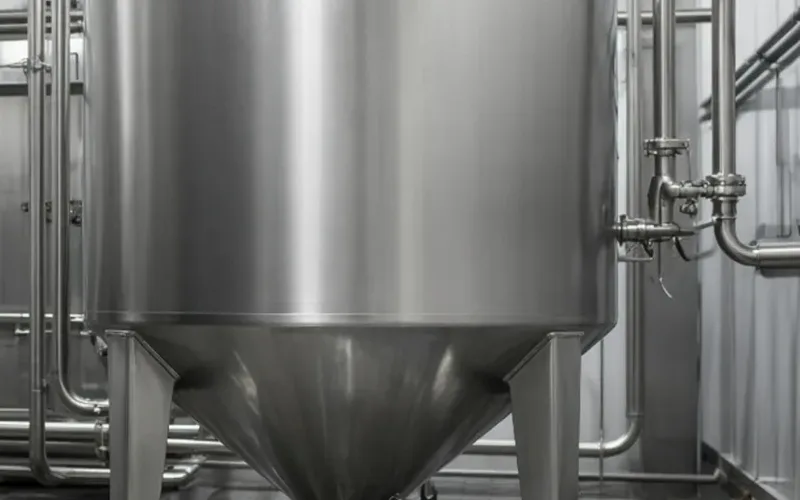
New stainless tanks with the dimple jacket laser-welded to the shell: zoned for steam, glycol or cooling water, rated to 150 psig, sized to the batch.
+ Learn More
Embossed Plate
Drip Elimination
Pillow plates run below the room dew point pull moisture out of the air over product lines and in cold rooms, with a gutter and drain so nothing reaches the floor.
+ Learn More
Embossed Plate
Energy Recovery Banks
Banks of single-embossed plates on spacers recover heat from exhaust gas, dryer air and warm waste water, with the grade set by whether the plate runs wet or dry.
+ Learn More
