
1-805-484-2992
Quotes - Engineering - SalesFibrous and abrasive
Slurries that bridge, settle and wear
A slurry fails a heat exchanger in one of three ways, and each calls for a different fix. Fibers bridge: a strand of pulp, husk, hair or shredded vegetable lies across a narrow passage, the next strand lands on it, and in an hour a plate channel or a 5/8 in. tube is a mat. Solids settle: a dense mineral or starch slurry drops its load wherever the velocity falls, in a header, a dead end or the bottom of a wide tube. Solids wear: sand, crystals, bone and grit cut the oxide film off the wall and take metal with it, fastest at bends and at any step in the bore.
The tube-in-tube construction removes the first failure entirely, because there is no passage narrower than the inner tube and no header for a mat to form in. It controls the second by holding one velocity from inlet to outlet. The third is a matter of wall thickness, velocity and grade, and that is where the stainless selection is made. A fruit pomace at pH 3.5 and an ore slurry in 2,000 ppm chloride water both arrive looking like slurries, and they get different tubes.
This page is about choosing between them.
Fibrous food slurries run in 316L; mineral, brine and process slurries above about 1,000 ppm chloride move to 2205 duplex for its pitting resistance and strength. Material & Construction explains how the grade is chosen.
Open bore for the fiber, duplex for the chloride
A 1-1/2 in. 316L tube passes pulp that mats a plate channel; a brine or mineral slurry at 2,000 ppm chloride pits 316L and goes to 2205 duplex, which also brings twice the yield strength to an abrasive duty.
The slurry side
Fibrous food slurries, pomace, spent grain, vegetable trimmings and pulp washes, are mildly acidic, carry 5–20% solids by weight and behave as non-Newtonian liquids whose viscosity falls as they move. They foul by matting, not by scale, and clean with hot caustic. Starch and protein slurries foul by cooking onto a hot wall, so the wall temperature matters more than the velocity.
Industrial slurries are the harder case. Mineral and ore slurries, filter backwash, crystallizer feeds and gypsum streams carry hard particles in water that is often brine: 1,000–5,000 ppm chloride is routine, and the particles keep the surface bare so that pitting starts on fresh metal. Here chemistry and wear act together, and a grade that would survive either one alone fails on the pair.
The stainless tube for it
For food fiber the product tube is 316L, 1–2 in. bore, smooth rather than corrugated because corrugation gives a strand something to hook on. Velocity is held at 3–5 ft/s to keep the fiber moving and the bends are long radius. Ends are tri-clamp to 4 in. and the unit drains fully for CIP; 32 µin Ra on the product tube is enough for most of these duties.
For abrasive brine slurries the tube goes to 2205 duplex at a heavier wall, run at 3–4 ft/s to limit wear, with the annulus in 304L or 316L depending on the utility water. Where chloride is above 5,000 ppm at temperature, 6-moly is the next step. Hairpin returns are the first thing to wear, so they are built as replaceable sections and inspected on a schedule rather than waiting for a leak.
What to send for a slurry duty
The word slurry on its own does not size anything. Tell us what the solid is and what the water around it contains, and the grade and bore follow directly.
- The solid: fiber, soft particle or hard grit, with a size or screen analysis
- Solids concentration by weight and whether it settles when the pump stops
- Liquid chemistry: pH, chloride in ppm, sulfate or sulfide if present
- Operating temperature range and the hottest point in the loop
- Flow rate and the duty, or the inlet and required outlet temperatures
- How the line is cleaned, and whether it is rodded, flushed or CIP
Call and talk it through with an engineer: 1-805-484-2992
Before you choose a slurry exchanger
Wide-gap plates pass fibers and particulates to about 1/4 in. and are worth considering for a thin, uniform pulp where plate surface is a real saving. Long fibers, mixed sizes and anything that mats at a restriction still favor the tube-in-tube unit, because a plate port is a restriction by definition and a gasket groove is a place for fiber to lodge. If the plant has ever cleared a plate pack with a hose, the answer is already known.
Because the attack is pitting, not uniform loss, and a thicker wall only delays a pit by the time it takes to grow through. 2205 duplex has a PREN of about 35 against 24–25 for 316L and resists pitting to roughly 3,000–5,000 ppm chloride, and it is highly resistant to chloride stress corrosion cracking where 316L can crack above about 140°F. Its yield strength is a bonus on abrasive wear, not the reason for the choice.
Food fiber units are cleaned in place with hot caustic and an acid rinse, drained between runs, and occasionally rodded from the end covers, which is why straight runs with removable return bends are specified. Mineral slurry units are flushed with clean water on shutdown so solids do not settle and set, and the returns are opened for inspection. A unit that cannot be opened at the ends is the wrong unit for either duty.
No. The annulus has an inlet and an outlet nozzle at right angles to the flow, and solids settle at both; fiber collects on the inner tube's support points. The product belongs in the inner tube, where the path is straight and the bore is constant, and the clean utility takes the annulus. The one exception is a very dilute, fine slurry with no settling tendency, and even then we would rather not.
Related
Tube-in-Tube
Aseptic Applications
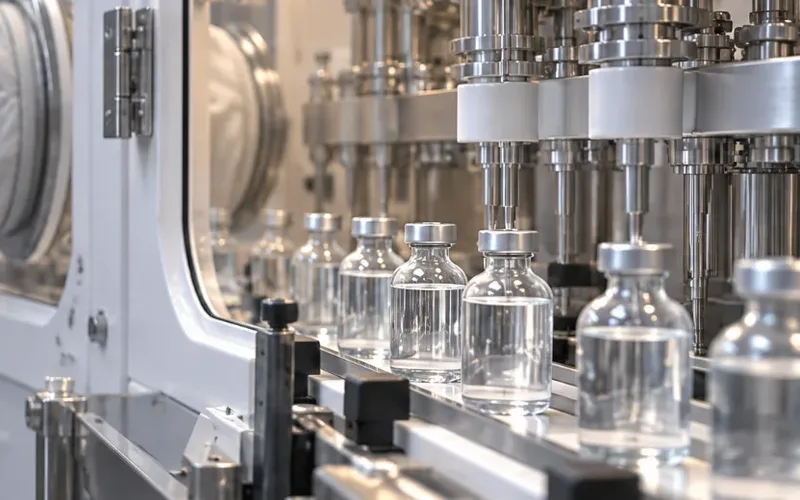
Sterilizing a product at 250–285°F asks more of the stainless than any pasteurizer does. Grade, finish, welds and layout for an aseptic line.
+ Learn More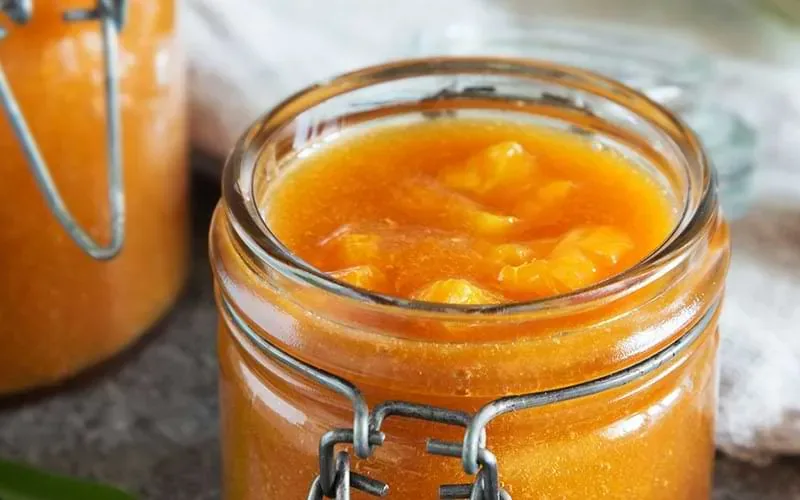
Tube-in-Tube
Puddings & Purees
Thick products move in laminar flow and scorch on a hot wall. How a corrugated 316L tube and a hot-water utility get a pudding or puree through without burn-on.
+ Learn More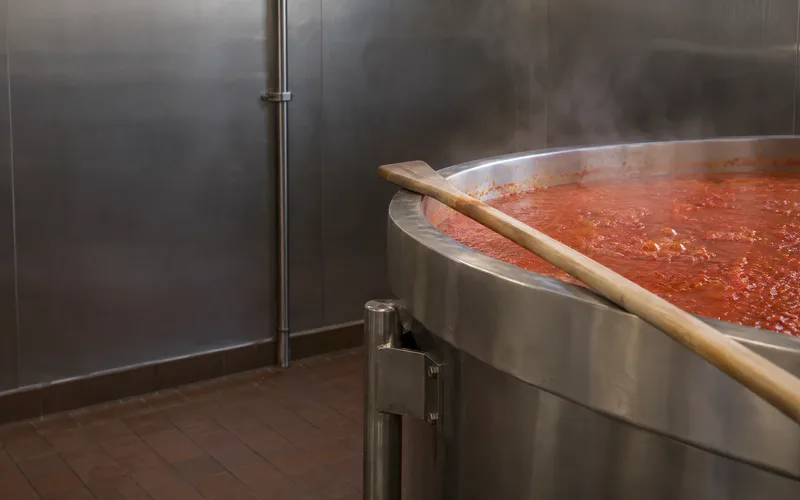
Tube-in-Tube
Sauce and Condiments
Ketchup, mustard, soy sauce, salsa and brines each pit stainless differently. The chloride-at-temperature math behind choosing 316L or duplex for a sauce line.
+ Learn More