
1-805-484-2992
Quotes - Engineering - SalesFruit juice
Pasteurizing juice that still has its pulp in it
Not-from-concentrate orange juice, apple juice with cloud, mango and guava nectar, pineapple and passion fruit juices all carry pulp, fiber and cell fragments that a plate pasteurizer either strains out or clogs on. Pulp is what the consumer pays for in a premium juice, so the processor wants it heated and cooled in place, and a tube-in-tube unit does that: a 1 to 2 in. 316L bore passes the pulp, a corrugated wall keeps it from settling, and a regeneration section returns most of the heat to the incoming juice. Pasteurization is 185–200°F for 15–30 seconds on most juices, hotter for the enzyme-inactivation step on citrus.
The acid question comes up on every juice quote and the answer surprises people. Citric and malic acids at juice concentrations, pH 3.0–4.0, are organic acids that 304 and 316 both tolerate well at pasteurization temperature; a 304 tube would not fail on the juice. What it fails on is the rest of the plant: the chlorinated water that rinses the line, the acid-sanitizer cycle, the sulfite added to some tropical juices, and the pulp itself, which scours the passive film and exposes fresh metal to all of the above. 316L is specified for that environment rather than for the fruit.
The pulp, meanwhile, sets the bore and the velocity.
Juice pasteurizers run 316L product tubes: the fruit acid itself is mild on stainless, but pulp scours the surface and chlorinated water finds any crevice. See Material & Construction for the grade comparison.
The juice is mild; the plant around it is not
Citric acid at pH 3 does little to 316L at 200°F; chlorinated rinse water, sulfite and a pulp stream that keeps the surface bare are what pit a lesser grade. The tube is 316L for the plant and 1 to 2 in. for the pulp.
What the juice does
Citrus juice carries pulp cells and juice sacs up to about 1/4 in., apple juice carries fine cloud and some fiber, tropical purees run thick with 10–20% insoluble solids and behave like a light puree. All are shear-sensitive to a degree: pulp broken up by a centrifugal pump or a tight bend ends up as a cloud rather than a visible pulp, which changes the product the customer bought. Flow in the tube is kept moderate, 3–5 ft/s on thin juices and lower on nectars.
Fouling on juice is pectin and sugar rather than protein, and it burns onto a wall above about 220°F; the hot-water heated designs that keep the wall near the juice temperature run far longer between cleanings, while steam-heated ones can foul in a shift. The second fouling is scale from the hard water on the utility side, which belongs to the annulus and not the juice.
The 316L unit for it
The product tube is corrugated 316L, 1 to 2 in. bore for juices and up to 3 in. for thick nectars, finished to 32 µin Ra, with full-bore tri-clamp ends and a sloped, drainable layout. Multi-tube sections can be used on clarified or deaerated juice with no pulp, where the extra surface per foot shortens the unit, but never on the pulpy stream, because a juice sac bridges a small tube at the tubesheet. Product-side rating is 150 psig.
Regeneration is standard: raw juice in the inner tube against pasteurized juice in the annulus recovers more than half of the heating duty, which on a large citrus line is the biggest single saving in the plant. The annulus for the final heating and cooling sections is 304L on hot water and chilled water. The cooler takes the juice to about 35°F for cold-fill, where viscosity rises and the velocity is kept up to hold the pulp in suspension.
What to send for a juice pasteurizer
The juice type sets the acid and the pulp; the plant's water and sanitizer set the grade; the fill temperature sets the cooler. With these we can return heater, regenerator and cooler as one unit.
- Juice type and pulp or insoluble solids content, with the largest pulp size
- Flow rate, inlet temperature, pasteurization temperature and hold time
- Fill temperature: hot-fill, cold-fill or aseptic
- Any sulfite, preservative or added salt, and the juice pH
- Hot water or steam available, and chilled water or glycol temperature
- Rinse water chloride and the sanitizer used in CIP
- Whether regeneration is wanted, and the available space for it
Call and talk it through with an engineer: 1-805-484-2992
Questions on juice and acid
Not at juice concentrations. Citric acid at 1–2% and pH 3 is a weak, complexing organic acid that leaves the passive film on 316L intact at 200°F, and 304 tolerates it too. The chloride that comes with chlorinated water, some sanitizers and any added salt is the agent that pits stainless, and it is the reason the product tube is 316L even though the juice alone would not demand it.
Yes, if the unit is built for the pulpy one. A single corrugated tube at full bore handles clarified juice with a slightly lower coefficient than a multi-tube section would, and the plant gains a line it can switch between products without re-piping. The reverse does not work; a multi-tube section sized for clarified juice plugs at the tubesheet the first time pulp is run through it.
On a juice line with a pasteurization temperature near 200°F and a cold-fill near 35°F, a tube-in-tube regenerator typically recovers more than half of the heating duty, and tight designs go further at the cost of length. The pasteurized juice gives it's heat to the raw juice across a 316L tube wall with the pasteurized side held at the higher pressure, so a leak can only run from clean to raw.
Because the exchanger is where pulp is counted, before and after. The breakage usually happens at the pump, at a reducer or in a tight return bend upstream, and the corrugated tube is only the last place the pulp passed. We specify long-radius returns, full-bore fittings and a positive displacement pump for pulpy juices so that the exchanger itself adds no shear beyond what the corrugation needs.
Related
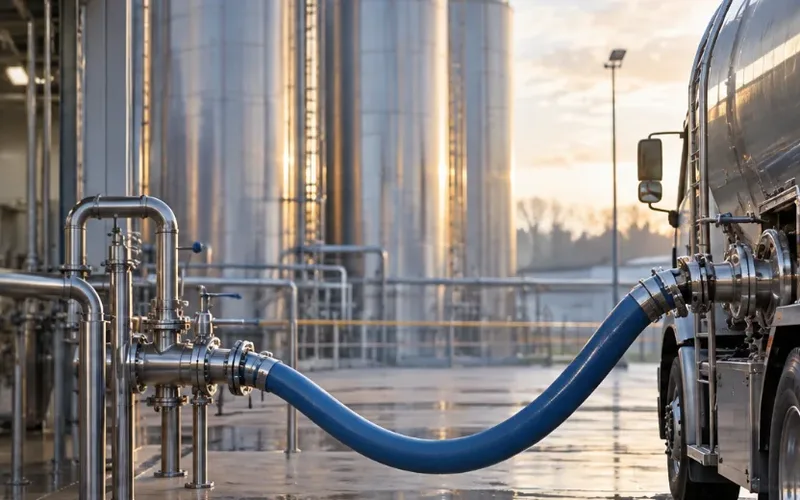
Tube-in-Tube
Dairy Products
Where a plate pasteurizer stops and a tubular one starts in a dairy: viscosity, shear, protein fouling and the 316L finish and layout that 3-A expects.
+ Learn More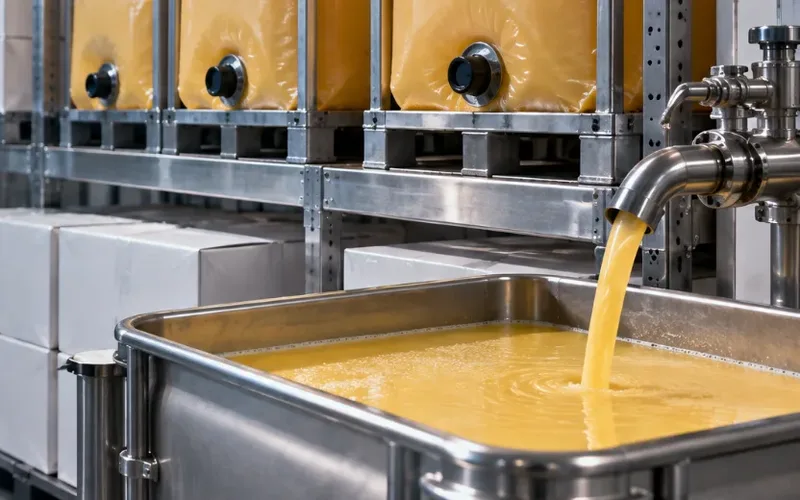
Tube-in-Tube
Liquid Egg
Whole egg, yolk and white each coagulate at a different temperature, and all foul a hot wall. The 316L tubular design that pasteurizes egg without cooking it.
+ Learn More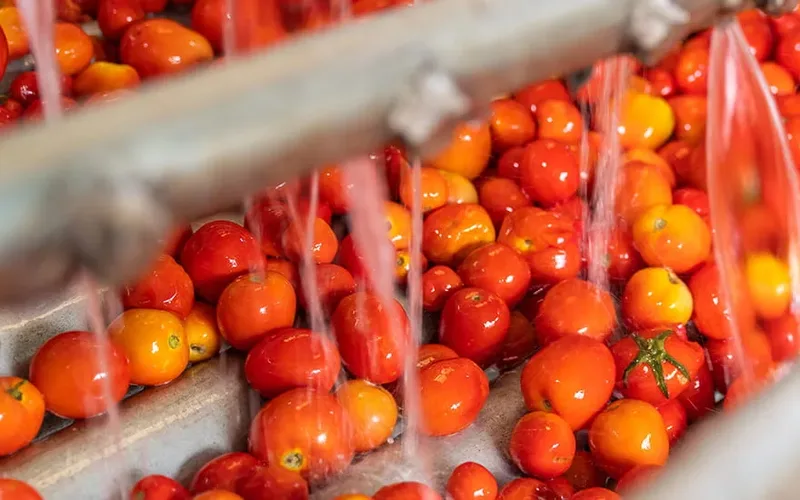
Tube-in-Tube
Diced Tomatoes
Tomato dice is soft, acidic and firmed with calcium chloride. Why that combination calls for a 3 in. full-bore 316L tube run slowly, and what crushes the dice.
+ Learn More
