
1-805-484-2992
Quotes - Engineering - SalesThe utility build: ASME, TEMA and a mill finish
Where stainless pays and where it does not
An industrial shell and tube is bought for pressure, temperature and the ability to be opened with a wrench. It carries 150 lb raised-face flanges, a mill finish inside and out, lifting lugs, drain and vent couplings, and an ASME Section VIII Division 1 stamp when the plant's insurer or piping code calls for one. TEMA class C covers most commercial and plant utility work; class R goes on refinery and petrochemical service where the owner's spec asks for the heavier corrosion allowance and the longer tube-wall life.
Stainless enters the build on the side that needs it, not everywhere. An oil cooler on tower water wants 316L tubes because the tube wall can see 600–900 ppm chloride after the tower has cycled, but its shell sees only oil and can stay carbon steel for much less. A glycol loop with inhibitor can run 304L tubes. A jacket-water cooler on river water with silt wants a removable bundle so the tube side can be rodded, and the grade follows the chloride number from the water analysis.
Industrial units pair 316L tubes with a carbon steel or 304L shell for most plant water, going all-316L or duplex only when the shell fluid attacks steel. The Material & Construction page compares the grades.
The trade is between a carbon steel shell that costs less and a stainless shell that can be opened in ten years without a pile of scale on the floor. We quote both when the shell fluid allows it, and we say which one we would buy.
Shell & Tube Construction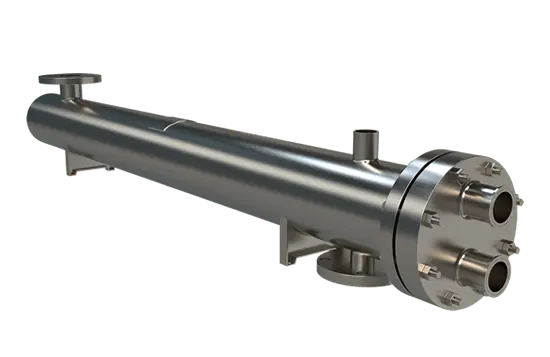
Conditions an industrial unit is built around
Typical values for plant and process service; your water analysis and utility conditions replace them on the quote.
| Condition | Typical value |
| Shell design | 150 psig at 350°F standard; 300 psig to order |
| Tube design | 150 or 300 psig, rated separately from the shell |
| Tube size | 3/4 in. OD 316L on water, 1 in. on viscous or fouling liquids |
| Tube velocity | 3–8 ft/s water; low end for erosion, high end against silt |
| Fouling allowance | 0.001–0.002 h·ft²·°F/Btu on tower, river and well water |
| Shell material | Carbon steel on steam, oil, air or treated loops; 304L or 316L otherwise |
| Connections | 150 lb ANSI flanges; 300 lb on a 300 psig side |
| Code | ASME Section VIII Div 1 and TEMA C or R as specified; CRN where required |
| Finish | Mill finish, pickled; paint on a carbon steel shell |
The three-letter code that names a shell-and-tube exchanger's front head, shell and rear head, such as a fixed tubesheet or a pull-through floating head, so buyer and fabricator describe the same construction, cleaning access and expansion allowance without a drawing.
Specifying the industrial stainless shell and tube
When carbon steel shell and stainless tubes is enough
The shell only ever meets the shell fluid. If that fluid is saturated steam, compressor oil, thermal oil, dry air or a closed glycol loop with a maintained inhibitor, carbon steel shell plate does the job for decades and the money goes into the tubes instead. This is the standard build for steam heaters, oil coolers, aftercoolers and engine jacket-water coolers accross process plants, and the 316L tube bundle inside it is what keeps the tower water from eating the unit.
The pairing stops making sense when the shell fluid is itself the corrosive one, when the plant cannot tolerate rust flakes downstream, or when the unit sits outdoors in a coastal yard where the shell exterior pits from the outside in. In those cases the price gap between a painted steel shell and a 304L one is smaller than the cost of the first retube.
When the whole unit has to be stainless
All-stainless construction is the right call when both fluids attack steel, when the tube side and shell side are swapped at turnaround, or when the process stream is a product that must not pick up iron: deionized water for a rinse loop, a solvent, a reagent make-down. Then the shell, bonnets, tubesheets and baffles all go 304L or 316L and the gaskets go to a grade that matches the fluid.
- 316L shell and tubes: brackish, seawater-adjacent or chemically treated cooling water in the shell
- 304L shell, 316L tubes: clean shell fluid, chloride water in the tubes, iron-free appearance wanted
- 2205 duplex tubes: chloride water above 140°F where 316L could crack
- Titanium tubes in a 316L shell: seawater or brine, with a titanium or Ti-clad tubesheet
The mistake: 304 tubes on tower water
A plant orders a 304 bundle because the makeup water tests at 150 ppm chloride and 304 is typically good to about 200. The tower runs at 4–6 cycles of concentration, the basin sits at 600–900 ppm by midsummer, and the bundle can show pits at the inlet tube ends within months. The fix was free at the quote stage: ask for the cycled chloride, not the makeup, and put 316L in the tubes. If the water also runs warm, past about 140°F on the tube wall, go to 2205 duplex, because 316L under tensile stress in warm chlorides can crack even when it does not pit.
Flanges, nozzles and the pressure drop budget
Nozzle size sets velocity at the inlet, and an undersized tube-side inlet is where an impingement plate or a sleeved first row has to be added later. Give us the allowable pressure drop on each side; 5–10 psi on water is a normal budget and lets us pick two or four passes. A plant that specifies 2 psi gets a single-pass unit with low velocity and the fouling that goes with it, so the pressure drop number is worth a conversation before the quote.
Questions on industrial duty
Often the jurisdiction or the plant's insurer answers that for you, and many states register any vessel above 15 psig. Where it is optional, the stamp adds a documented design, a witnessed hydrotest and a nameplate, and a modest cost. We build to ASME Section VIII Division 1 as specified; tell us whether the shell, the tubes or both need to be stamped.
TEMA C is the commercial class and fits most plant utility exchangers: water, glycol, oil, steam at ordinary pressures. TEMA R is for refinery and petrochemical duty and brings thicker tubesheets, larger corrosion allowances and heavier baffles. TEMA B is the chemical-process class between them. Writing R on a plant water cooler buys weight you will not use.
Yes, but be clear about why. A painted carbon steel shell on 316L tubes does the thermal job as well as a stainless one; the stainless shell buys corrosion life on the outside in a wet or coastal yard and no paint upkeep. If the reason is appearance in a visible utility room, a 304L shell is a modest upcharge. If the reason is the fluid, it is not optional.
On cycled tower water at 3 ft/s, plan on a seasonal rodding; at 6 ft/s with a sidestream filter it can stretch to a turnaround. A fouling allowance of 0.001–0.002 buys the time between cleanings, not freedom from them. Keep the dirty water in the tubes of a removable bundle so the crew can brush it from the end without pulling the shell apart.
Related
Shell & Tube
Sanitary
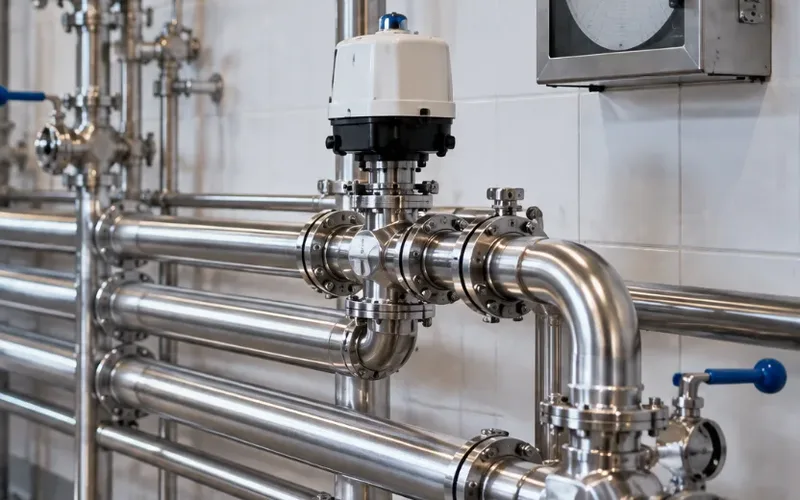
Shell and tube units whose product side is 316L, polished to 32 µin Ra, tri-clamped and sloped to drain, with a double tubesheet when the line cannot risk a leak.
+ Learn More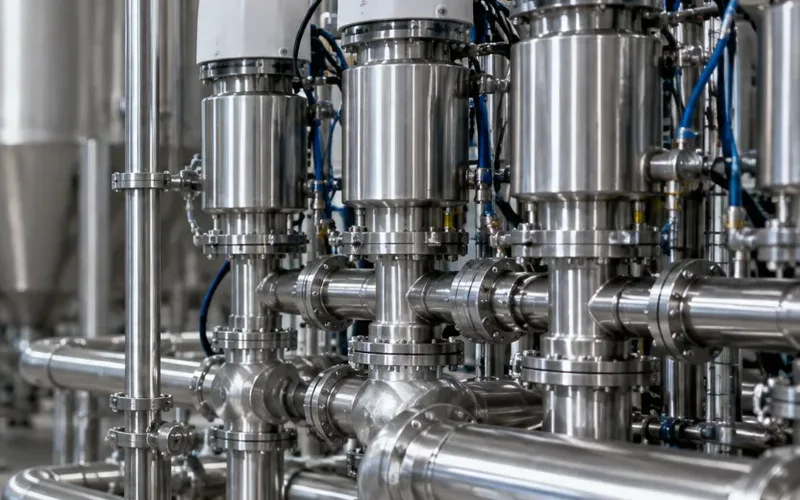
Shell & Tube
3A Sanitary
Shell and tube units built to the 3-A tubular standard: 300-series product contact, 32 µin Ra, radiused corners, no exposed threads and a drawn-in drain path.
+ Learn More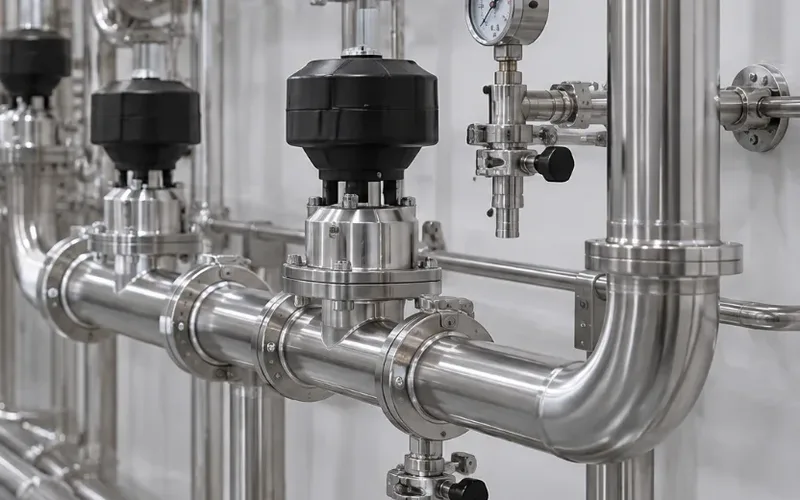
Shell & Tube
Pharmaceutical
WFI and purified water shell and tube units in electropolished 316L with a vented double tubesheet, BPE surface designations and full material traceability.
+ Learn More