
1-805-484-2992
Quotes - Engineering - SalesHeating a process liquid with a liquid utility
Hot water, glycol and thermal oil behave differently in the shell
A fluid heater is a shell-and-tube exchanger whose hot side is a liquid rather than steam: a 180–200°F hot water loop, a 30–50% glycol circuit from a heat-recovery source, or thermal oil at 400–550°F from a fired heater. The product goes through the tubes so it can be cleaned and so the metal it touches is the grade you specified; the utility fills the shell. Compared with steam, a liquid utility gives a lower wall temperature, which is why plants pick it for anything that scorches, polymerizes or crystallizes against a hot wall.
The stainless question is only on the product side. Lube and hydraulic oils, fuel oils and clean solvents are happy in 304L tubes. Chlorinated process water, sugar syrups with sulfite carryover and mild acid streams call for 316L, a hot chloride stream above 140°F moves to 2205 duplex to resist cracking, and brines and pickling liquors go up the corrosive service ladder. The utility side rarely needs more than 304L; inhibited glycol and treated hot water are benign, and sound thermal oil is noncorrosive.
Product-side tubes in 316L for chlorides and mild acids, 304L for oils and neutral liquids; the hot water or oil shell is 304L or carbon steel as the plant prefers. Material & Construction explains how the grade is chosen.
Sizing turns on the product's viscosity at the inlet temperature, not at the outlet. A 300 SSU oil arriving at 60°F and leaving at 150°F spends most of its tube length in laminar flow, so the heater that looked small on an average-property calculation falls short. We run the design at the cold-end viscosity and the hot-end film temperature together.
Shell & Tube Construction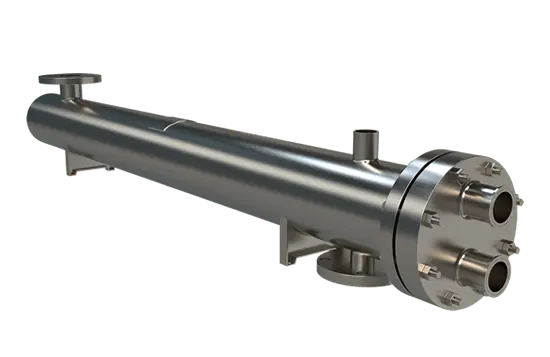
Heater conditions by utility
The utility sets the shell design; the product sets the tube grade. Both appear on the quote request.
| Condition | Typical value |
| Hot water utility | 180–200°F supply, 20–40°F drop across the shell; 150 psig at 350°F standard shell |
| Glycol utility | 30–50% propylene or ethylene glycol; lower specific heat and higher viscosity than water, so about 5–10% more flow for the same duty |
| Thermal oil utility | 400–550°F; shell designed for the oil temperature, not the 350°F standard; U-tube or expansion joint mandatory |
| Product side | Oils, syrups, brines, acids, process water in 3/4 in. or 1 in. OD tubes; 304L or 316L by chemistry |
| Product viscosity | Design at inlet viscosity; 300 SSU and above is laminar in a single pass and gets multipass or turbulators |
| Wall temperature limit | Set by the product: sugar solutions and polymers hold the film under about 250°F; mineral oils tolerate more |
| Fouling allowance | 0.001–0.002 h·ft²·°F/Btu on the product side; 0.001 on treated water or glycol |
| Construction | Fixed tubesheet with expansion joint for water and glycol; U-tube for thermal oil |
The temperature of the thin layer of fluid touching the heated tube wall, hotter than the bulk stream. It decides whether a thermal oil degrades, a food product burns on or a viscous liquid fouls, so a heater is sized to keep it within the fluid's own limit.
Choosing the heater build for the utility and the product
Hot water and glycol: the gentle utilities
A hot water or glycol shell runs well under the 350°F standard rating, the approach is wide, and the design is governed by product-side film coefficient and pressure drop. The thing to get right is the utility flow: propylene glycol at 50% carries about 10% less heat per gallon than water and is several times as viscous at 40°F, so a heater sized on water properties and then fed glycol comes up short on both duty and pressure drop. Tell us the glycol type and concentration and we size to it.
Thermal oil: high temperature, low coefficient
Thermal oil gives 400–550°F without the pressure of steam at those temperatures, but it has a poor shell-side coefficient, about a quarter of water's, so the bundle is baffled tighter and runs longer for the same duty. The shell is designed for the oil's temperature and the tubes expand far more than the shell at startup; a U-tube bundle takes that without an expansion joint, which is why nearly every thermal oil heater we build is a U-tube.
Keep the oil's film temperature below the maker's maximum film rating, typically 50°F above its rated maximum bulk temperature. That means moderate shell-side velocity, no dead zones behind the baffles, and no half-closed oil valve throttling the flow while the fired heater runs full.
- U-tube bundle in 316L or 304L tubes, 304L or carbon steel shell
- Shell design temperature at the oil supply temperature plus margin
- Vent and drain on the oil side for filling and draining the loop
- Flanged oil connections; welded where the plant forbids flanges above 400°F
The product side decides the grade
Oils, fuels and most nonchlorinated solvents rarely attack stainless and go in 304L tubes unless the plant standardizes on 316L. Aqueous streams are where the choice matters: anything with chlorides above about 200 ppm, mild organic or phosphoric acids, and any product later cleaned with a chlorinated sanitizer belongs in 316L; brines and mineral acids go further up the ladder. Hot chlorinated water above 140°F crosses into chloride stress corrosion territory for 316L, and those tubes go to 2205 duplex; our corrosive service page sets out the limits.
The mistake: sizing on the warm product
A heater sized with the product's properties averaged between inlet and outlet underestimates the surface for any viscous liquid. The film coefficient at the cold end can be a fifth of the hot-end value, and the first pass does almost no work. The symptom is an outlet 20–30°F short of target with the utility side barely dropping in temperature. We size at the cold-end viscosity, add passes or turbulators to force turbulence, and check the hot-end wall temperature against the product's limit.
Questions on heating with water, glycol and oil
Steam gives the highest coefficient and the smallest exchanger, but at 15 psig the wall sits near 250°F whatever the product wants. Syrups caramelize, polymer solutions gel, and heat-sensitive chemicals degrade against that wall. A hot water or glycol loop limits the wall temperature to the utility supply, and thermal oil reaches 500°F without the roughly 665 psig steam would need to get there.
It can when the product is very viscous and the utility is clean water: the baffled shell side gives a higher coefficient for a thick liquid than the tubes do. The trade is cleanability, since the shell side of a fixed-tubesheet unit can not be reached; a removable bundle restores it. We also keep the corrosive fluid in the tubes so only the tubes need the higher grade.
Brines run from 3% (about 18,000 ppm chloride) to saturation, far past the typical 1,000 ppm guidance for 316L at ambient. A dilute brine kept cool may suit 6-moly; concentrated or heated brine usually goes to titanium Grade 2, or Grade 7/12 above about 160°F with crevices. The utility side stays in 304L, and the tubesheet matches the tube alloy so the joint does not become the crevice that fails first.
We set the utility supply temperature or the utility flow so that the hot-end wall stays below the limit you give us, then size the surface at that reduced driving force. A thermal oil heater can be designed with the oil in the tubes and the product in the shell to spread the heat flux, and a tempered-water loop can be interposed where the oil temperature is simply too high for the product.
Related
Shell & Tube
Steam-to-Water
U-tube and straight-tube steam heaters in 304L and 316L for process and wash-down hot water, sized from the steam pressure and the water's chloride, not a nameplate.
+ Learn More
Shell & Tube
Condensers
Shell-side condensers in stainless for steam, solvent and process vapors, with the tube grade set by the coolant's chloride content and the shell grade by the vapor.
+ Learn More
Shell & Tube
Process Cooling
Shell-and-tube coolers for product streams, lube and hydraulic oil, with the water side in a grade that outlasts the cooling tower's chloride cycle.
+ Learn More