
1-805-484-2992
Quotes - Engineering - SalesTwo liquids, one wall, and which side gets the stainless
The commonest shell and tube duty there is
A liquid to liquid exchanger is the plainest thing a shell and tube does: one stream gives up heat through the tube wall to another, no phase change, no vacuum, no steam trap. Water to water for a closed loop cooled by a tower, glycol to water on a chiller or a free-cooling coil, process liquid to tower water at a jacketed reactor, oil to water at a gearbox or a hydraulic power unit. The sizing is a matter of flows, four temperatures, the fouling allowance and the pressure drop each pump can spare; a 1°F rise on 1 gpm is about 500 Btu/h, and the rest follows from that.
The stainless decision is per side. The tube wall meets both fluids, so it is picked for the worse one; the shell and bonnets meet only the shell fluid. A closed glycol loop with its inhibitor is kind to 304L. A tower loop that can cycle to 600–900 ppm chloride is not, and wants 316L tubes. A process liquid with acid or salt wants 316L on its own side and may want duplex. Putting 316L everywhere is the easy answer and the expensive one; putting it only where the chemistry is costs less and performs the same.
Water-to-water duty runs 304L on treated loops and 316L tubes wherever tower, well or city water with chlorides past 200 ppm is in the circuit. Material & Construction explains how the grade is chosen.
The counterflow shell and tube also gives up something to a plate on close approaches, and this page is honest about where that line sits.
Shell & Tube Construction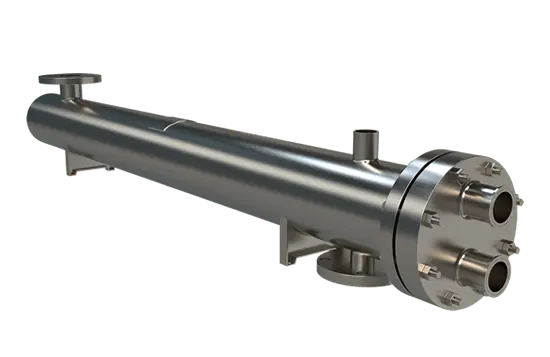
How a liquid to liquid unit is sized
Typical values for water, glycol and process liquid duty; the four temperatures and the two flows on your sheet replace the defaults.
| Condition | Typical value |
| Hot side | Process liquid, closed-loop water, glycol or oil in the shell or tubes per fouling |
| Cold side | Tower, well, city or chilled water; 316L tubes above 200 ppm chloride |
| Approach | 10°F routine; 5°F with surface added; below that a plate unit is cheaper |
| Tube velocity | 3–8 ft/s on water, lower on glycol above 30% by volume |
| Pressure drop | 5–10 psi water side; set by passes and tube count |
| Fouling allowance | 0.001–0.002 h·ft²·°F/Btu per side on untreated water, less on a closed loop |
| Glycol correction | Viscosity and specific heat corrected at the mean temperature, 30–50% solutions |
| Rating | 150 psig at 350°F each side; 300 psig on a pump discharge where asked |
| Materials | 304L shell; 304L or 316L tubes by chloride; 2205 duplex on hot salt streams |
The smallest temperature difference between the two liquids anywhere in the exchanger, usually at one end. The tighter the approach, the more surface the unit needs, and a temperature cross between the streams calls for shells in series or a true counterflow pass.
Getting the liquid to liquid selection right
Which fluid goes in the tubes
The dirty, high-pressure or corrosive fluid goes in the tubes. Tube-side is easier to clean with a brush, carries the higher design pressure for less wall, and confines the corrosive fluid to a tube wall of the better grade while the shell stays in a cheaper one. The clean, viscous or low-pressure fluid goes shell-side, where baffles turn its low velocity into usable heat transfer. Tower water in the tubes of a 316L bundle with a treated loop in a 304L shell is the standard water to water layout for that reason.
Grade per side, not per unit
Ask for the chloride, pH and temperature of each fluid as it actually runs, not the makeup. A city water at 50 ppm chloride is fine on 304L tubes; the same city water used as tower makeup and cycled five times is not. A glycol loop is kind to stainless until the inhibitor is exhausted and the glycol goes acidic, which is why we size 316L tubes for glycol loops nobody tests. Where a process liquid carries salt and runs hot, the 140°F chloride-cracking threshold of 304 and 316 is the number to watch, and 2205 duplex tubes are the step up.
- Closed loop with inhibitor, both sides: 304L throughout
- Tower, well or untreated city water on one side: 316L tubes, 304L shell
- Dilute salt-bearing process liquid: 2205 tubes; brine or seawater: titanium
- Oil to water: 304L tubes, carbon steel or 304L shell on the oil
The mistake: a 2°F approach on a shell and tube
Someone needs 95°F tower water to make 97°F loop water and asks for a shell and tube. The approach can be met, but the surface it takes is large, the shell is long, and the price surprises everyone. A counterflow gasketed plate reaches 2–5°F approach on a fraction of the surface and is the honest answer for close-approach water to water duty with clean fluids. The shell and tube earns the job when the approach is 10°F or more, when the pressure is above a plate frame, when the fluid carries solids, or when a code stamp and a brushable bundle matter more than the last few degrees.
Glycol and what it does to the size
A 30% propylene glycol solution carries about 4–5% less heat per gallon than water and is two to three times as viscous at 40°F, so the same duty needs more flow or more surface, and the shell-side film coefficient drops. At 50% the heat penalty roughly doubles, to about 10%. Tell us the glycol type and concentration, not just the word glycol, and whether it runs on the cold side in winter, because the viscosity at the lowest operating temperature sets the tube count.
Water to water and glycol questions
Not always. Two treated closed loops can run in a carbon steel shell on copper or 304L tubes. Stainless enters when one side is untreated: tower, well, river or city water with chlorides, oxygen and biology, where a copper tube erodes at velocity and a steel shell scales. Put 316L tubes on that side, and let the shell be whatever the clean side allows.
Each added pass raises tube velocity, and pressure drop rises roughly with the cube of the pass count, so 5 to 10 psi on a water side normally allows two or four passes for good velocity. A budget of 2 psi forces a single pass, low velocity and a bundle that fouls early; a budget of 20 psi buys little and costs pump energy for life. Tell us what each pump has left after the piping, and we will spend it on passes.
A single-pass shell with single-pass tubes is true counterflow. Once the tube side goes to two or more passes, part of the length runs co-current and the mean temperature difference drops by a correction factor; at a tight approach that factor falls fast and the unit grows. We check the factor on every multipass selection and will tell you when the duty wants a single pass or a plate instead.
Oils, syrups and glycol-rich solutions go shell-side so the baffles make turbulence the fluid cannot make itself, and the tube spacing and baffle cut are opened to hold pressure drop. Above a few hundred centipoise the shell and tube loses to a tube-in-tube with a scraped or corrugated inner tube; below that it does well, with the tube count set by the viscosity at the coldest point.
A brazed plate is smaller and cheaper on clean water to water or glycol duty and is typically rated 435–650 psig. It cannot be opened, so a fluid with solids or scale ends it; a shell and tube can be rodded or the bundle pulled. Choose the shell and tube when one liquid is untreated, fibrous or fouling, and the brazed plate when both are clean and the space is tight.
Related
Shell & Tube
Corrosive Service
The grade ladder for aggressive fluids: 316L, 2205 duplex, 904L and 6-moly, and titanium, with the chloride, temperature and pH limits that move a duty up a rung.
+ Learn More
Shell & Tube
Clean-in-Place
A shell-and-tube CIP solution heater in 316L: the grade, the finish and the steam side chosen for hot caustic, acid and chlorinated sanitizer cycles.
+ Learn More
Shell & Tube
Steam-to-Water
U-tube and straight-tube steam heaters in 304L and 316L for process and wash-down hot water, sized from the steam pressure and the water's chloride, not a nameplate.
+ Learn More
