
1-805-484-2992
Quotes - Engineering - SalesWhat a CIP heater is asked to survive
Three chemistries in one circuit, and only one of them is kind
A CIP heater brings the cleaning solution from the tank to its working temperature and holds it there through the circuit: caustic at 1–3% and 160–185°F, a nitric or phosphoric acid step at 0.5–1.5% and 130–150°F, and a sanitizer that is often chlorinated or peracetic, followed by rinse water. The usual build is a shell-and-tube with steam in the shell at 15–50 psig and the solution in the tubes at a velocity that keeps the solids from a dirty wash moving.
Caustic at those strengths is harmless to 304L or 316L. The acid step is tolerable in either. The sanitizer is the problem: sodium hypochlorite at 100–200 ppm free chlorine is a chloride-and-oxidizer mix that raises the pitting risk on 304 and can pit 316L if it sits in a warm heater between cycles. That single step is why the solution side is 316L and why the circuit is written so the sanitizer is cold, brief and rinsed out, not heated and not left standing.
316L on the solution side because the sanitizer step carries chlorides; the steam shell is 304L, and a heater shared with product duty is finished and certified as the product requires. Material & Construction explains how the grade is chosen.
A dedicated CIP heater often does not need a 32 µin Ra polish or a 3-A mark on its own account; check the plant's solution-contact standard. Where the same exchanger doubles as the product heater, which many plants do to save a skid, the finish, the drainability and the certification follow the product and the CIP solutions are simply another fluid it has to tolerate.
Shell & Tube Construction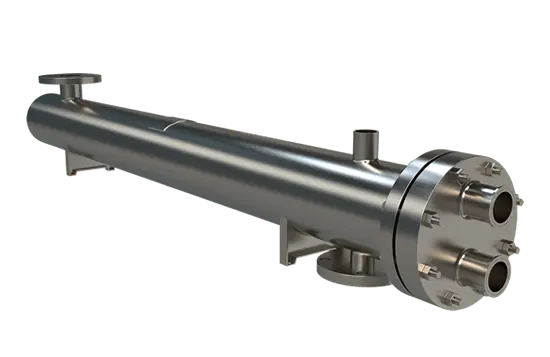
CIP heater conditions
The solution side is sized for the caustic step, which carries the heat load; the grade is chosen for the sanitizer step, which carries the chloride.
| Condition | Typical value |
| Caustic wash | 1–3% sodium hydroxide at 160–185°F; 304L or 316L |
| Acid wash | 0.5–1.5% nitric or phosphoric at 130–150°F; 304L adequate, 316L specified for the circuit |
| Sanitizer | Hypochlorite at 100–200 ppm free chlorine, cold, short contact; or peracetic acid, which is kinder to stainless; 316L |
| Steam supply | 15–50 psig in the shell, condensing at 250–298°F; 150 psig at 350°F shell rating standard |
| Solution flow | Set by the circuit's return-line velocity, commonly 5 ft/s in the supply header; tube velocity 3–8 ft/s |
| Solution-side pressure | 150 psig standard; most CIP supply pumps deliver well under 100 psig |
| Tubes | 3/4 in. OD 316L, straight, in a fixed tubesheet so the tubes can be inspected from the heads |
| Connections | Tri-clamp to 4 in. on a sanitary skid; flanged on an industrial CIP set |
| Finish and certification | Mill finish for a dedicated CIP heater where the plant allows; 32 µin Ra, drainable and 3-A as specified when the unit also heats product |
The colored oxide left on stainless beside a weld where hot metal met air. The chromium-depleted layer under it pits first in chlorinated cleaning solutions, so heat tint is removed by pickling or polishing and the surface passivated before the unit goes into service.
Building the heater for the cleaning chemistry
Caustic and acid: load the duty, not the grade
The caustic step is where the heat goes. Raising a 500 gpm circuit from 60°F to 180°F at the start of a wash is a large transient duty, and the heater is sized for that ramp rather than the small steady loss once the circuit is hot. Neither caustic nor the dilute acid step moves the grade: 304L would carry both. The acid step does set one detail, which is that any carbon steel on the solution side, a flange, a gasket retainer, a plug, rusts on the first acid cycle and seeds iron into the circuit.
Chlorinated sanitizer: the step that writes the specification
Free chlorine from hypochlorite attacks stainless by the same chloride mechanism as seawater, made worse by the oxidizing power of the hypochlorite itself. At 100–200 ppm, cold, for a 10–20 minute contact followed by a rinse, 316L typically holds without trouble. Heated to the caustic wash temperature, or left standing in the heater overnight, the same solution can pit 316L at the tube-to-tubesheet crevice and along the bottom of horizontal tubes where it evaporates to a higher concentration.
Where the plant insists on a hot chlorinated step, we quote the solution side in 2205 duplex, or steer the plant toward peracetic acid, which sanitizes without adding chloride at all.
- Sanitizer dosed after the heater, or run with the steam off
- Rinse to low chloride before the circuit stops
- Heater drained and dry between campaigns
- Chlorine verified at the heater, not at the dosing pump
Steam side: 304L shell, condensate handled
The shell sees steam and condensate and runs in 304L; a carbon steel shell is acceptible to many plants but puts iron into the condensate return. A CIP heater cycles between cold idle and full steam several times a day, so the shell-to-tube differential is large and sudden: a fixed-tubesheet unit of this length gets an expansion joint, or the bundle is a U-tube. The condensate trap is sized for the startup load, when the heater condenses at its maximum rate, not for the steady state.
The mistake: a heater that was never drained
The CIP heater that fails is the one where the last step of the last cycle before a shutdown was the sanitizer, the circuit stopped full, and the steam shell was still warm. Two days later the lower tubes have a line of pits where the hypochlorite concentrated as the water evaporated, and the first caustic wash of the restart shows chloride and iron in the return. The remedy is a rinse-and-drain step written into the recipe and a heater with a true low-point drain, which is a layout detail we check on every quote.
Questions on the CIP solution side
If the sanitizer is peracetic acid or hot water and the rinse water is low in chloride, 304L carries the caustic and acid steps without difficulty. Most plants still specify 316L because sanitizer chemistry changes over the life of the heater and a switch to hypochlorite later is common. The price difference on the tubes is small compared with replacing a pitted 304L bundle.
It can, and on a small plant it often does, but then it is a product-contact unit and must be built as one. That means the product's finish, drainability and certification: 32 µin Ra tubes (finer where ASME BPE is specified), tri-clamp heads, a fully drainable layout and 3-A or ASME BPE as specified, and it must also tolerate the CIP solutions as a second fluid. A dedicated CIP heater is simpler and cheaper; a shared one saves floor space and a pump.
It can, but a shell cannot be fully drained of caustic or sanitizer without a designed low-point drain and sloped baffles, and the baffle crevices hold chlorinated solution exactly where you do not want it. Solution in the tubes drains by gravity from the heads, lets you inspect the tubes, and keeps the shell side simple. We reverse the arrangement only when the steam pressure is high enough to favor the tubes.
Between 15 and 50 psig. At 15 psig steam condenses at 250°F, which is enough margin over a 185°F caustic wash but makes the heater larger; 50 psig condenses at 298°F, cuts the surface by roughly a third and brings the circuit up to temperature faster on a cold start. We size for the pressure available at the heater after the control valve, which is often well under the header pressure.
Related
Shell & Tube
Process Cooling
Shell-and-tube coolers for product streams, lube and hydraulic oil, with the water side in a grade that outlasts the cooling tower's chloride cycle.
+ Learn More
Shell & Tube
Corrosive Service
The grade ladder for aggressive fluids: 316L, 2205 duplex, 904L and 6-moly, and titanium, with the chloride, temperature and pH limits that move a duty up a rung.
+ Learn More
Shell & Tube
Liquid-to-Liquid
Water to water, glycol to water and process liquid shell and tube units, with 304L or 316L chosen per side from the chloride number and the pressure drop on hand.
+ Learn More