
1-805-484-2992
Quotes - Engineering - SalesSanitary is a specification, not a property of stainless
A sanitary heat exchanger is one whose product-contact surfaces can be cleaned to a verifiable standard and will not add anything to the product. The stainless does three jobs in that definition: it resists the product, which is usually mild; it resists the cleaning chemistry, which is not; and it takes a surface finish smooth enough that soil cannot anchor in it. An industrial 316L exchanger meets the first two requirements and fails the third, which is why a mill-finish bundle with threaded heads is not sanitary no matter what grade it is made of.
The constructions that serve sanitary plants are the same five we build for industry, narrowed by what can be cleaned. Shell-and-tube with product in polished straight tubes and a double tubesheet; gasketed plate-and-frame with 0.4 mm 316L plates and food-grade gaskets; tube-in-tube for products with particulates and viscosity; embossed plate jackets on process tanks; brazed plate only on the utility side or in all-stainless braze where copper and nickel are excluded. Coils serve tanks and kettles.
This page covers the sanitary markets from the metal up. The construction-specific detail lives on the type pages, and the sanitary shell-and-tube page and sanitary plate page carry the build specifics.
Product contact is 316L at 32 µin Ra for dairy and food, 20 µin Ra electropolished for pharma; utility sides run 304L; chlorinated sanitizer keeps 304 off the product side. Grade limits are set out on Material & Construction.
32 µin Ra
- Dairy, food and beverage product contact
- Mechanical polish, 0.8 µm
- 3-A as specified for the duty
20 µin Ra or better
- Pharma, biotech and WFI service
- Electropolished, 0.5 µm or finer
- ASME BPE SF designations as specified
Sanitary markets and what each demands of the surface
The product rarely attacks 316L; the cleaning cycle and the finish requirement are what separate these markets. Each group below is pitched at the grade and finish, with the construction named where it is the usual answer.
Dairy
- 316L product side at 32 µin Ra, 3-A as specified
- Plate-and-frame for raw and pasteurized milk; tube-in-tube for cultured products
- Double tubesheet where specified, so a tube-joint leak vents to atmosphere, not into the milk
- Chlorinated sanitizer tolerated cold and rinsed, never heated
Food and beverage
- Sauces, purees and liquid egg in tube-in-tube with 1–4 in. inner tubes
- Juice and sugar syrups in gasketed plate with EPDM or FKM gaskets by product
- Acidic products at pH 3–4 held in 316L; 304L on the utility side only
- Tri-clamp to 4 in., flanged above, fully drainable to a low point
- Tank jackets in embossed 316L plate on product-contact walls
Pharmaceutical and biotech
- 316L at 20 or 15 µin Ra, electropolished to ASME BPE SF designations as specified
- WFI and clean steam duty in double-tubesheet shell-and-tube
- Passivation per ASTM A967 with a certificate; no free iron on a wetted surface
- Material test reports and surface finish reports with each unit
- SIP at 250–275°F designed into the expansion allowance
Brewing and distilling
- Wort coolers and mash heaters in 316L gasketed plate or shell-and-tube
- Distillery condensers in 304L where copper contact is intentionally excluded
- Hot caustic CIP at 160–185°F and acid cycles in 316L plates
- Commercial breweries and distilleries only; sized from barrel and proof-gallon rates
Finish: Ra, polishing and electropolishing
Surface roughness is specified as Ra in microinches. 32 µin Ra, about 0.8 µm, is the common dairy and food product-contact finish and comes from mechanical polishing. Pharma asks for 20 µin Ra, about 0.5 µm, or 15 µin Ra, and electropolishing is how it is reached: an electrochemical step that removes 0.0005–0.001 in. of metal, drops the Ra by roughly half and leaves a chromium-enriched surface. Passivation is not polishing; it removes free iron per ASTM A967 and leaves the roughness unchanged.
Drainability and connections
A sanitary exchanger drains completely by gravity from its low point, with no pocket where product or rinse water can stand. On a shell-and-tube that means a slight slope and heads that drain to the outlet; on a plate unit it means the port layout and a frame set level. Connections are tri-clamp to 4 in. and flanged above that, with product-side gaskets in a food-grade elastomer. A utility side that never touches product keeps industrial fittings and a mill finish without compromising the rating.
CIP and SIP from the material side
The product side sees caustic at 160–185°F, an acid step, a sanitizer and then rinse water, several times a day. 316L carries all of that provided the chlorinated sanitizer step stays cold and short; it is the reason 304 is kept off product-contact surfaces even when the product itself is harmless. SIP at 250–275°F adds thermal cycling, and the exchanger's expansion allowance and gasket selection are checked against it. Nothing on the product side should be a material the cleaning cycle slowly removes.
Double tubesheet and the standards
A double tubesheet puts an air gap between the product tubesheet and the utility tubesheet, so a leaking tube joint weeps to atmosphere instead of into the product, and it is recommended for pharma and critical duty and used in dairy where specified. 3-A Sanitary Standards govern dairy and food contact equipment and ASME BPE governs bioprocessing; each applies where the specification calls for it, and we build to the one named rather than claiming both on every unit.
Sanitary questions from the material side
On a plant that sanitizes with hot water or peracetic acid and runs a low-chloride product, 304L will survive, and some beverage plants use it. We still recommend 316L for product contact because sanitizer chemistry changes, chlorinated rinses are common, and a pitted product surface cannot be cleaned to standard. The utility side, where the fluid is steam, glycol or treated water, stays in 304L without penalty.
32 µin Ra, about 0.8 µm, for dairy, food and beverage product contact; 20 or 15 µin Ra for pharmaceutical and biotech, usually electropolished. A finer finish than the process needs costs money on every wetted part and buys nothing in cleanability below the point where soil no longer anchors. Specify the number, the method, whether the weld zones must match it, and whether you need a profilometer report.
Somewhat. Electropolishing removes the worked surface layer and raises the chromium-to-iron ratio at the surface, which improves passivity and makes the film heal faster after a chlorinated step. It does not change the grade: an electropolished 304L surface still pits sooner than a mill-finish 316L one in the same sanitizer. Its main value is the finer Ra and the easier cleaning that comes with it.
Only in an all-stainless braze, where no copper or nickel is exposed to the product, and only for clean, low-viscosity fluids with no particulates, since the 1–3 mm channels cannot be opened for cleaning or inspection. In practice brazed plate serves sanitary plants on the utility side, chilling glycol or heating water, while the product passes through a plate-and-frame, tube-in-tube or shell-and-tube that can be verified clean.
Because a rolled tube joint is the most likely leak path in a shell-and-tube and the consequence in those plants is contaminated product or a lost batch. The double tubesheet makes that leak visible at the gap and keeps it out of the product with no instrumentation. The cost is a longer unit and a second set of tube joints, small against a recall.
Related
Shell & Tube
Sanitary
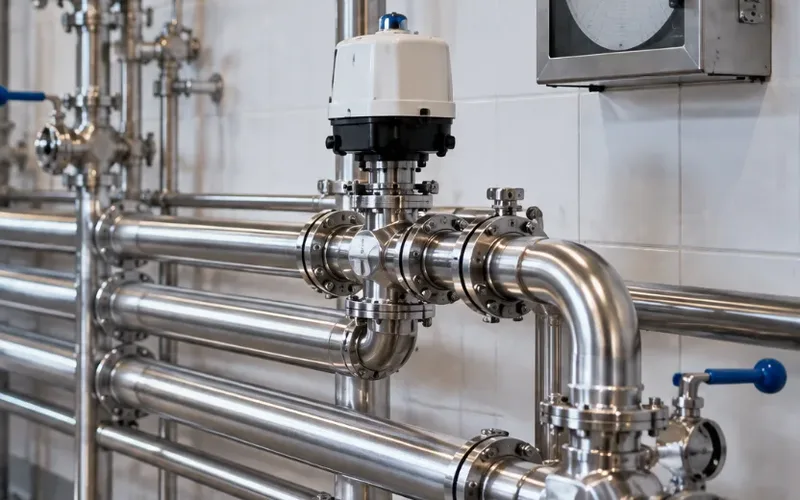
Shell and tube units who's product side is 316L, polished to 32 µin Ra, tri-clamped and sloped to drain, with a double tubesheet when the line cannot risk a leak.
+ Learn More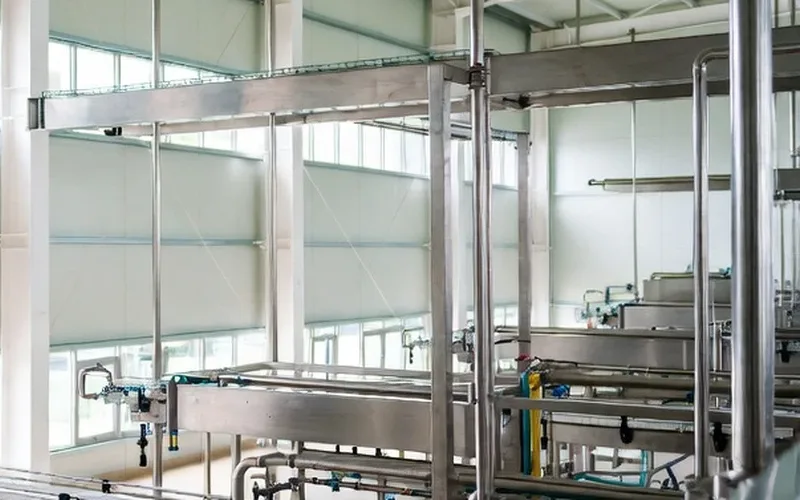
Plate & Frame
Sanitary
316L plate packs on stainless clad or solid frames with tri-clamp ports and food-contact gaskets, built to drain and to survive daily CIP.
+ Learn More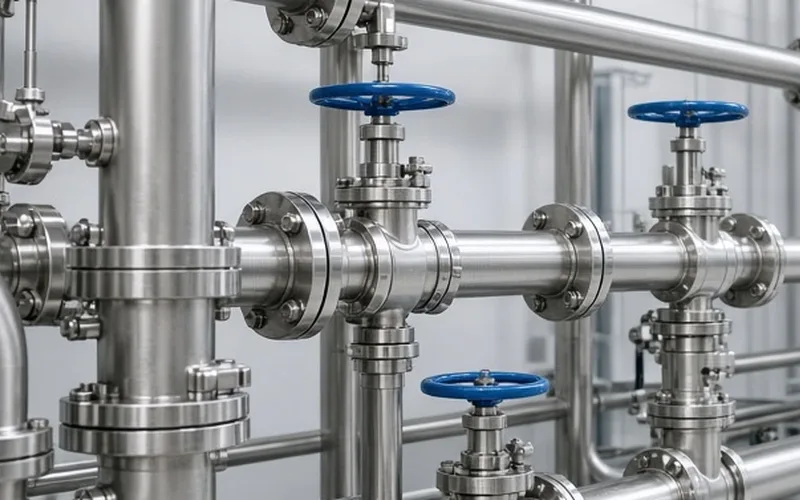
Tube-in-Tube
Tube-in-Tube
Single, multi-tube and corrugated tube-in-tube units with 316L product tubes sized to pass the solids whole, in true counterflow with regeneration where it pays.
+ Learn More