
1-805-484-2992
Quotes - Engineering - SalesCondensing a vapor against water in a stainless shell
Where the vapor goes and why the coolant stays in the tubes
A shell-and-tube condenser puts the vapor on the shell side and the coolant inside the tubes. Vapor enters at the top, condenses on the outside of the bundle, and the condensate drains to a bottom nozzle or hotwell; the noncondensable gases collect at the far end of the shell and leave through a vent. The coolant is usually tower water, chilled water or glycol, and because it rides inside straight tubes it can be rodded or brushed without opening the vapor space.
Stainless earns its place on a condenser in two ways. On the vapor side it protects condensate purity: clean steam condensate in a sanitary plant, recovered solvent going back to the process, or column reflux, none of which should carry iron or copper picked up from the exchanger. On the coolant side it survives water that pits admiralty brass and eats carbon steel, especially tower water that has been cycled up to 600–900 ppm chloride.
Steam and clean solvent condensers run 304L; 316L tubes cover tower water above 200 ppm chloride, and acid-bearing vapors move the shell to 2205 or 6-moly. Material & Construction explains how the grade is chosen.
The grade follows the fluid that attacks. Saturated steam and most solvent vapors are satisfied by 304L. Tower water in the tubes pushes the tube grade to 316L, and a vapor that carries sulfur dioxide, acetic acid or wet chlorine moves the shell and tubes to 2205 duplex, 6-moly or titanium; HCl is reviewed case by case. We size the bundle for the condensing coefficient, the subcooling you want and the vent load, then pick the grade per side.
Shell & Tube Construction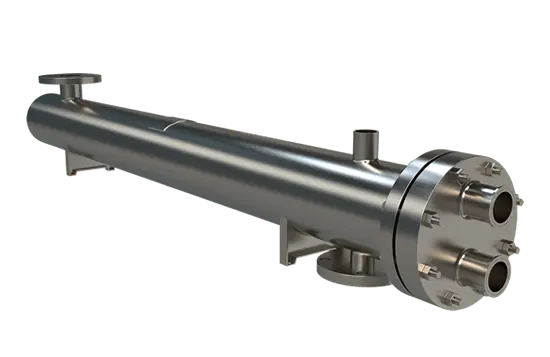
Condenser conditions we work from
These are the figures a stainless condenser selection turns on. Send what you have and we fill the rest from the vapor's properties.
| Condition | Typical value |
| Vapor side | Saturated steam, solvent vapor or process overhead; 15 psig steam condenses at 250°F, 50 psig at 298°F, 100 psig at 338°F |
| Coolant | Tower water, chilled water or 30–50% glycol in the tubes at 3–8 ft/s |
| Shell rating | 150 psig at 350°F standard; full vacuum where the vapor space runs below atmospheric |
| Tubes | 3/4 in. and 1 in. OD; 5/8 in. in compact units; 304L or 316L, titanium for seawater |
| Bundle | Fixed tubesheet with an expansion joint, or U-tube with clean coolant, when the shell-to-tube differential exceeds 100–150°F |
| Noncondensables | Vent at the cold end sized for air in-leakage and process inerts |
| Subcooling | 5–10°F typical; a flooded zone or a second pass where the process needs more |
| Fouling allowance | 0.001–0.002 h·ft²·°F/Btu on tower water; lower on clean steam |
| Code | ASME Section VIII Div 1 stamp and TEMA class as specified |
Air or process inerts that travel with a vapor but will not turn to liquid at the condenser temperature. They drift to the coldest, lowest-pressure end of the shell, blanket the tubes there and must leave through a vent, or the condensing rate falls.
Design points that decide a stainless condenser
Vent the noncondensables or lose the surface
Air and process inerts do not condense; they drift to the coldest, lowest-pressure corner of the shell and blanket the tubes there. A few percent of inerts can cut the condensing coefficient by half on the tubes they cover, and the symptom is a condenser that met duty at commissioning and slipped a month later as in-leakage crept up. The vent nozzle sits at the far end of the vapor path, at the cold end, and it needs a line, a valve and somewhere to go.
On a vacuum condenser the vent carries real flow and the ejector or vacuum pump is sized for it. On an atmospheric steam condenser a small continuous vent is usually enough. Either way we ask for the inert fraction up front so the bundle has the length to deal with it.
Grade per side: vapor, condensate and coolant
The shell, baffles and the outside of the tubes see the vapor and the condensate film. For steam, alcohol, acetone, toluene and similar solvents, 304L is enough and the choice is about keeping iron out of the condensate rather than about corrosion. The inside of the tubes sees the coolant, and that is where tower water decides the grade: 304 holds to about 200 ppm chloride, 316L to about 1,000 ppm, and 2205 duplex to 3,000–5,000 ppm at ambient temperature.
A condenser handling an acid gas, a chlorinated hydrocarbon that can hydrolyze to HCl, or a vapor with sulfur dioxide carryover needs the shell side treated as the corrosive side. Those move to 2205 duplex or 6-moly (PREN about 43–45), with HCl-bearing duty reviewed case by case outside stainless, and the condensate chemistry at the dew point, where acids concentrate, is what we review.
- 304L shell and tubes: steam, solvent recovery, clean overheads
- 316L tubes: tower water, softened water with chloride carryover
- 2205 or 6-moly shell: acid dew points, sulfur-bearing vapors
- Titanium tubes: seawater or brackish coolant at normal cooling temperatures
Vacuum service, subcooling and the condensate drain
A vapor condensed under vacuum has a large specific volume, so the inlet nozzle and the shell-side flow area are set by velocity, not by mass flow; an undersized nozzle shows up as pressure drop that raises the condensing temperature and steals LMTD. Subcooling the condensate 5–10°F below saturation is normal and comes from the bottom rows of tubes running in liquid; more than that needs a designed flooded zone or a separate subcooler.
The mistake: a condenser with no slope and no vent line
The one we see most is a horizontal shell set dead level with the vent capped because nothing seemed to come out of it. Condensate pools at the inlet end, inerts pool at the far end, and the unit delivers two-thirds of its surface. The fix is a slight slope toward the drain, a vent line routed to the vacuum system or a safe location, and a drain sized for the condensate rate at the lowest operating pressure.
Condenser questions engineers ask
Shell side for nearly every condensing duty: the large flow area suits the vapor's specific volume, the condensate drains off the tubes by gravity, and the coolant stays in the tubes where it can be cleaned. Tube-side condensing is reserved for a vapor so corrosive that you want only the tubes in the expensive alloy, or a reflux condenser mounted vertically with the vapor rising inside the tubes.
Yes, with the shell designed for external pressure, which affects the shell thickness and sometimes adds stiffening rings. Vacuum raises the specific volume of the vapor, so the inlet nozzle and baffle spacing open up, and the vent system becomes part of the design. Tell us the operating pressure, the inert load and whether the vacuum source is an ejector or a liquid-ring pump.
For saturated steam and the condensate it makes, 304L is the usual shell and tube grade, and the stainless is there to keep the condensate free of iron. The coolant decides the tubes: city or softened water is fine in 304L, tower water that cycles above about 200 ppm chloride needs 316L, and a seawater-cooled unit goes to titanium tubes with a 316L or duplex shell.
The composition, including any inerts, the condensing pressure and the corresponding dew point, the latent heat if it is not a common fluid, and whether the vapor is superheated on arrival. For mixtures we need the condensing curve or enough composition data to generate it, since a mixed vapor condenses over a temperature range and the LMTD can not be taken from the end points.
Related
Shell & Tube
Liquid-to-Liquid
Water to water, glycol to water and process liquid shell and tube units, with 304L or 316L chosen per side from the chloride number and the pressure drop on hand.
+ Learn More
Shell & Tube
Steam-to-Water
U-tube and straight-tube steam heaters in 304L and 316L for process and wash-down hot water, sized from the steam pressure and the water's chloride, not a nameplate.
+ Learn More
Shell & Tube
Fluid Heating
Shell-and-tube heaters that warm oils, syrups, brines and chemical streams with a liquid utility, built in stainless where the product touches metal.
+ Learn More