
1-805-484-2992
Quotes - Engineering - SalesHeating and cooling plant liquids with an immersion plate
An industrial pillow plate heat exchanger hangs in the tank it serves: a parts washer, a quench bath, a phosphate or rinse tank, a dip tank, a wastewater sump. Steam or glycol circulates inside the laser-welded panel and the bath takes heat straight off both faces. Nothing is pumped out to a shell and tube and back, there is no external loop to insulate, and the plate can be lifted out for cleaning with a chain hoist in an afternoon.
Steam or glycol inside the plate
The two decisions that matter are the utility inside the plate and the grade of the sheet. Steam gives the highest heat flux and the smallest plate, but every square inch of face runs near the steam temperature, 250 to 366°F, and a product that scorches, foams or deposits at that temperature will coat the plate. Hot water or glycol runs the face cooler, needs more area, and is the right pick for solvent baths, emulsions and anything with a flash point.
Grade follows the bath chemistry. A caustic parts washer or an inhibited glycol tank is comfortable in 304L. A chloride-bearing rinse, an acid pickle, or a plating line with its drag-in of salts needs 316L, and the same tank at 160°F or more is usually reviewed for 2205 duplex because 316L can crack under chloride stress above about 140°F.
Plant immersion plates run 304L in inhibited glycol or clean water baths and 316L in rinse, plating and wash tanks where chlorides or acids reach the face. The Material & Construction page compares the grades.
What the industrial build includes
- Double-embossed panels for immersion, single-embossed where one face mounts to a wall
- Sheet 0.05–0.12 in.; heavier gauge where forklifts and agitators reach the plate
- Rated 150 psig steam or 100 psig glycol, hydrostatic tested before shipment
- Threaded or flanged stubs at the top edge, condensate outlet at the lowest channel
- Hanging lugs, standoff feet and a stiffening frame on plates over about 4 ft tall
- Passivated after fabrication so the weld zones match the parent sheet
- Steam traps, vacuum breakers and glycol balancing valves specified on the drawing
steam inside a plant immersion plateAt 150 psig the plate face runs near 366°F, which heats a water bath fast and chars a solvent or emulsion bath just as fast.
What to send us for a plant immersion plate
Plate area depends on the bath more than the utility. A stirred water bath heated by steam needs a fraction of the surface that a still, viscous bath heated by 180°F water needs, so the tank and its contents decide the quote.
- What is in the tank, its concentration, pH and chloride content, and whether it is agitated
- Tank dimensions, liquid depth and where a plate can hang without fouling the parts basket
- Heat-up duty: gallons, start and hold temperatures, and how fast the bath must come up
- Steady load: parts throughput, surface losses and any continuous make-up water
- Utility available: steam pressure at the tank, or glycol supply temperature and flow
- Highest bath temperature expected, because it sets the grade as much as the chemistry does
- How the plate will be lifted for cleaning and how often the tank is dumped
Call and talk it through with an engineer: 1-805-484-2992
Two stainless sheets spot welded on a grid, seam welded at the edges and inflated with hydraulic pressure, so the utility flows through the cushions while the outer faces hang clean in a tank or bath.
Choosing between steam and glycol, single and double embossed
Steam is the default inside a plant immersion plate because it carries the most heat per square foot of face. Saturated steam at 15 psig condenses at 250°F, at 50 psig at 298°F, at 100 psig at 338°F and at 150 psig at 366°F, so a low-pressure line still drives a water bath from 60°F to 180°F quickly. The price of that heat flux is a face temperature set by the steam, not the bath: oils bake, caustics concentrate on the face as water flashes, and a plate in a dirty tank picks up scale at the waterline first.
Glycol or hot water inside the plate runs the face only a few degrees above the fluid, which is why it suits solvent degreasers, emulsion cleaners and anything that must not see 250°F steel. The plate carries more area, typically two to three times what steam needs for the same duty, and the pump has to be sized for the pressure drop through the pillow channel. For cooling, the same plate carries chilled water or glycol down to the plate's freeze protection, and a cooling plate in a chloride bath is where 304L is most often specified by mistake.
Double-embossed plates are the normal industrial immersion build. Both sheets inflate, both faces transfer heat, and the plate hangs from lugs on the top edge with a standoff from the tank wall so liquid circulates behind it. Single-embossed plates belong on a wall: the thick flat sheet is welded or clamped to the tank and only the inflated side carries utility. Stack single plates with spacers and you have a bank, which is how a large sump or a duct gets several hundred square feet of surface.
Sheet gauge is the other lever. Thin sheet inflates deeper and transfers heat better, but a 0.05 in. plate in a parts-washing tank will be dented by the first basket that swings into it. We put 0.075 in. or heavier on any plate that shares a tank with baskets, agitators or forklifts, and accept the slightly larger area that comes with it. A stiffening frame on tall plates keeps them flat when the bath is dumped and refilled hot.
The failure we are asked to replace most often is a 304L plate in a rinse tank fed with softened city water. The water tested fine; the rinse concentrated chloride from the preceding stage, the plate ran at 160°F on steam, and pits broke through at the spot welds in under a year. The replacement is 316L for a cold rinse or 2205 duplex once the bath runs hot, with the condensate outlet dropped to the lowest channel so no water stands in the plate between shifts.
Steam sets the face temperature; the bath decides whether it can stand it.
Glycol plates carry two to three times the area of a steam plate for the same duty, and that is often the right trade.
Request a QuoteQuestions from the plant floor
Yes, with a changeover manifold, and it is common on quench and phosphate tanks that heat for a shift and cool between batches. The plate is rated for the steam side, the glycol loop is isolated with double block valves so steam never reaches the chiller, and the condensate leg gets a vacuum breaker so the plate drains fully before glycol is admitted.
Leave at least the plate's inflated thickness again between the back face and the wall, and more if the tank is unstirred, so convection can pull liquid up behind the plate. A plate pushed flat against the wall loses roughly half its working surface and the trapped layer behind it overheats on steam. Standoff feet or lugs on the drawing fix the gap.
Piping. The steam inlet belongs at the top edge, the condensate outlet at the lowest point of the channel, with a trap sized for the cold start-up load, which is several times the running load. Add a vacuum breaker on the inlet so the plate does not pull condensate back when the valve closes. A plate that bangs on start-up is nearly always draining through a trap mounted above its bottom channel.
For dilute phosphoric or citric at room temperature, usually. For hydrochloric, hot sulfuric or any pickle with fluorides, no stainless plate is a safe choice and we will tell you so rather than quote one. Nitric passivation baths are fine in 304L or 316L. Send the acid, its concentration and the bath temperature and we will name the grade or say that the duty needs a different construction.
Related

Embossed Plate
Sanitary
Product-contact pillow plates in 316L with polished faces, drainable channels and tri-clamp connections, built to clean and drain with the tank they sit in.
+ Learn More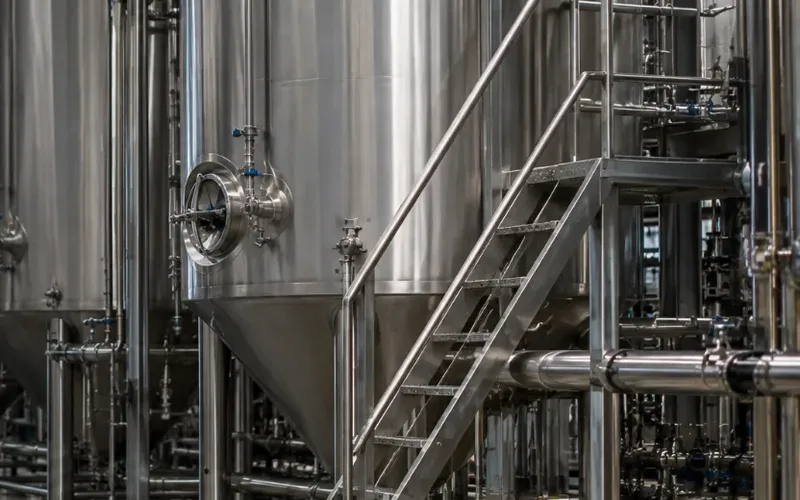
Embossed Plate
Clamp On
Retrofit heating or cooling on a stainless tank you already own: curved pillow plates, straps and heat-transfer mastic, with no weld and no code re-rating.
+ Learn More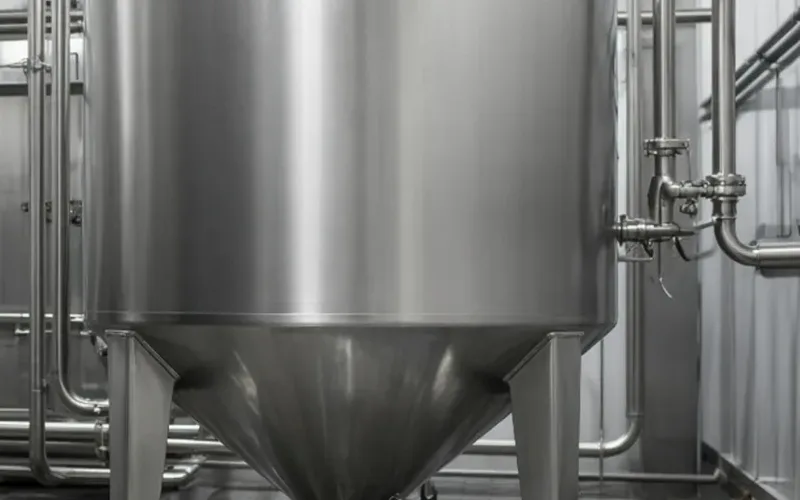
Embossed Plate
Jacketed Tanks
New stainless tanks with the dimple jacket laser-welded to the shell: zoned for steam, glycol or cooling water, rated to 150 psig, sized to the batch.
+ Learn More