
1-805-484-2992
Quotes - Engineering - SalesSteam on one side, the water you actually have on the other
Why the tube wall runs hotter than you think
A steam to hot water exchanger is the shell and tube most plants own more of than any other: 15 psig steam condensing at 250°F, or 50 psig at 298°F, in the shell around a bundle that carries plant water from 50°F to 140°F or 180°F for wash-down, process makeup, CIP supply or a building loop. The steam side is clean and forgiving. The water side is whatever the plant has, and that is where the grade decision lives.
Steam makes two demands on the stainless build that a liquid duty does not. First, the tube wall runs far hotter than the water, so a chloride water that is harmless at 70°F on 316L meets a wall above the 140°F threshold for chloride stress cracking on a 250°F steam-heated tube; the grade follows the wall temperature, not the water temperature. Second, the bundle grows with every start-up and shrinks on every shutdown, so a fixed tubesheet unit needs an expansion joint and a U-tube bundle does not. We build steam heaters as U-tubes in 304L or 316L for that reason, with a removable bundle so the shell side can be pulled and inspected.
Steam heaters take 304L tubes on soft or treated water, 316L to a few hundred ppm chloride on the hot wall, and 2205 duplex above that. See Material & Construction for the grade comparison.
What follows is how the steam pressure, the water chemistry and the condensate layout set the stainless selection.
Shell & Tube Construction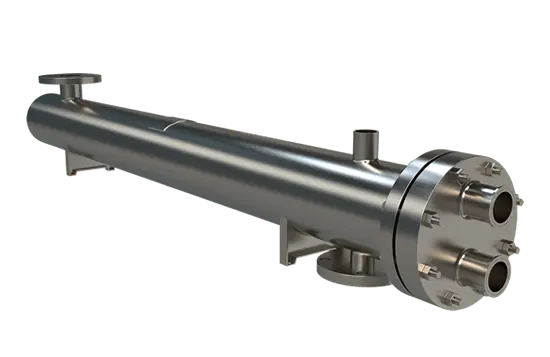
Steam heater conditions and the stainless answer
Typical values for a plant steam to water unit; the steam pressure at the control valve outlet and the water analysis set the real ones.
| Condition | Typical value |
| Steam pressure | 15 psig (250°F) and 50 psig (298°F) common; 100 psig (338°F) with a 300 psig shell |
| Steam placement | Shell side on U-tube bundles; tube side only on straight-tube units with an expansion joint |
| Water outlet | 120–180°F wash-down and process; higher with 50 psig steam |
| Tube grade | 304L on soft or treated water; 316L to a few hundred ppm chloride; 2205 duplex above that |
| Shell grade | Carbon steel or 304L on clean plant steam; 316L where the plant wants an iron-free exterior |
| Bundle | U-tube, removable, 3/4 in. tubes; straight-tube fixed with expansion joint where the tubes must be rodded straight through |
| Rating | 150 psig at 350°F standard; 300 psig shell for 100 psig steam |
| Condensate | Trap sized for start-up load; drip leg and vacuum breaker on the shell |
| Control | Steam control valve, or a condensate-side valve on units that modulate by flooding |
A steam heater whose shell backs up with condensate by design, covering part of the bundle so less tube area condenses steam. It gives smooth control at low load, but standing condensate on the hottest tubes also concentrates whatever chloride the steam carries.
Designing the stainless steam heater
Steam in the shell or in the tubes
Steam goes in the shell of a U-tube heater because the U-bend takes the thermal growth and the shell is the easy place to vent air, trap condensate and break vacuum. The water runs in the tubes at 3–8 ft/s, which keeps scale from settling, and a pulled bundle exposes the shell side, while the straight legs are brushed and the bends cleaned chemically. Steam in the tubes is the layout for a straight-tube unit where both sides must be rodded, or where the water is a tank or a flooded shell; it then needs an expansion joint on the shell or a floating head, and the condensate has to leave the bottom pass cleanly or the lower tubes sit flooded and cold.
Grade at the tube wall, not the water temperature
The water leaves at 140°F, but the tube wall under 15 psig steam runs well above 140°F, hottest near the water outlet end. If that water carries chlorides, the wall is above the cracking threshold and the tube is under hoop stress from its own pressure and bending stress from the U. On 304 tubes with a few hundred ppm chloride that can be a crack within a year or two along the bend, showing as water in the condensate. The ladder is simple: 304L for soft, treated or deionized water; 316L up to a few hundred ppm chloride on the hot wall; 2205 duplex above that. A steam heater on tower-grade makeup is not a 304 unit.
- Softened or treated boiler-makeup-grade water: 304L tubes
- City or well water up to a few hundred ppm chloride: 316L tubes
- Higher-chloride water on a steam-heated wall: 2205 duplex tubes
- Condensate side: carbon steel or 304L shell is enough for clean plant steam
The mistake: a flooded shell and a hammering heater
The heater that bangs every morning is not undersized; it is drowning. The control valve closes on a light load, the shell drops below atmospheric as the steam collapses, the trap cannot push condensate out against the vacuum, and the shell fills with water. When the valve opens again, steam hits the cold pool and the bundle takes a water-hammer blow that works the U-bends and the tube-to-tubesheet joints loose. A vacuum breaker on the shell, a trap sized for the cold start-up load, a drip leg of full pipe size and a trap set low enough to drain by gravity fix it; a bigger exchanger does not.
Sizing from the steam pressure you really have
Nameplate steam pressure is rarely what reaches the shell. Behind a modulating valve at half load the shell may sit at 5 psig and 228°F, and the surface sized for 15 psig is now short. We size to the steam pressure at the shell inlet at the worst-case load, and we add surface so the valve is not wide open at design. For water, the duty is flow times rise times roughly 500 Btu/h per gpm per degree; a 100 gpm heater taking water from 50°F to 140°F is about 4.5 million Btu/h and condenses about 4,700 lb/h of 15 psig steam, which is the number the trap and the condensate line are sized to, not the valve size.
Steam heater questions
Because a steam heater sees a temperature swing of 200°F or more every time it starts, and a fixed tubesheet bundle pushes against its own shell each time. Above a 100–150°F differential the fixed unit needs an expansion joint, which costs about what the U-tube does and adds a bellows that can fail. The U-tube takes the growth in the bend and comes out for cleaning.
Yes, when the water side is built as a sanitary product side. That means 316L tubes and heads polished to 32 µin Ra (finer where ASME BPE is specified), tri-clamp connections, a drainable layout and, where the steam is not culinary, a double tubesheet so a tube-joint leak vents to atmosphere instead of reaching the water. The shell stays an ordinary steam vessel. That build is on the sanitary and 3-A pages under this hub and is common for CIP supply water.
Fifteen psig steam at 250°F gives a 70°F terminal difference against 180°F water, which is plenty; the surface just grows as the outlet climbs. Fifty psig steam at 298°F shortens the bundle and is often what the header has anyway, but it raises the tube-wall temperature and moves a chloride water from 316L toward duplex. Give us the header pressure and the valve, and we size to what the shell will see.
Not for the steam. Clean plant steam and its condensate are mild on carbon steel, and most steam heaters run a carbon steel or 304L shell on 316L tubes. A stainless shell is worth it when the heater sits in a wash-down area where the outside gets chlorinated sanitizer, when the plant wants no paint, or when the condensate is returned to a system that cannot tolerate iron.
Related
Shell & Tube
Clean-in-Place
A shell-and-tube CIP solution heater in 316L: the grade, the finish and the steam side chosen for hot caustic, acid and chlorinated sanitizer cycles.
+ Learn More
Shell & Tube
Liquid-to-Liquid
Water to water, glycol to water and process liquid shell and tube units, with 304L or 316L chosen per side from the chloride number and the pressure drop on hand.
+ Learn More
Shell & Tube
Condensers
Shell-side condensers in stainless for steam, solvent and process vapors, with the tube grade set by the coolant's chloride content and the shell grade by the vapor.
+ Learn More
