
1-805-484-2992
Quotes - Engineering - SalesCooling a process stream without losing the bundle to the water
The water side, not the product side, usually sets the grade
A process cooler removes heat from a product, a quench stream or a lube and hydraulic oil loop and dumps it to whatever cold utility the plant has: cooling tower water at 85–95°F, chilled water at 42–45°F, or a glycol loop that may run below freezing. The product usually sits in the shell, where baffles give a viscous oil a usable coefficient, and the water runs through the tubes at 3–8 ft/s so it scours rather than deposits. Oil coolers for compressors, hydraulic power units, gearboxes and quench tanks follow the same layout.
On most coolers the product is harmless to stainless and the water is not. Open tower water concentrates its makeup chemistry four to six times, so a 150 ppm chloride makeup becomes 600–900 ppm in the basin, plus the biocide, the scale and the silt that settle under low velocity. That water puts 304 tubes at risk within months and makes 316L the floor for a tower-water cooler. Chilled water in a closed, treated loop is far gentler and a 304L bundle is normal there.
Tower water decides it: 316L tubes typically to about 1,000 ppm chloride, 2205 duplex to 3,000–5,000 ppm, titanium for seawater; the oil or product shell can stay 304L. The Material & Construction page compares the grades.
We size the cooler for the dirtiest water it will ever see, with a fouling allowance of 0.001–0.002 h·ft²·°F/Btu on the tower side, and we keep the water in the tubes where it stays out of the shell-side baffle crevices that trap deposits.
Shell & Tube Construction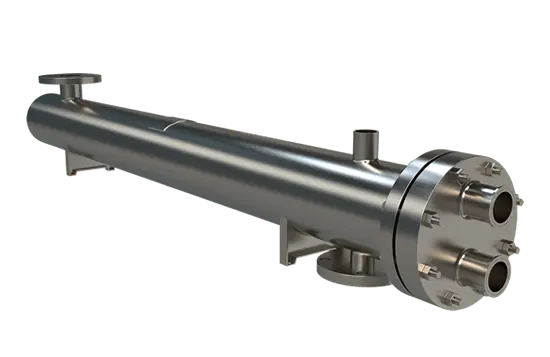
Cooling duties and the build that matches each
Three cold utilities, three different water chemistries. The rows below show what each one does to the selection.
| Condition | Typical value |
| Tower water | 85–95°F supply, 4–6 cycles of concentration, 600–900 ppm chloride from a 150 ppm makeup; 316L tubes minimum |
| Chilled water | 42–45°F supply in a closed treated loop; 304L tubes acceptable, 316L where the plant standardizes |
| Glycol | 30–50% inhibited glycol to -20°F; 304L tubes; larger surface for the lower specific heat |
| Product side | Oil, quench liquor, process water or chemical stream in the shell at 150 psig and 350°F standard |
| Tube velocity | 3–8 ft/s water in the tubes; 6 ft/s is the usual design point for tower water |
| Fouling allowance | 0.001–0.002 for tower water; 0.001 for chilled water and glycol |
| Bundle | Fixed tubesheet, straight tubes, rodded from the heads; removable bundle where the oil side sludges |
| Seawater or brackish coolant | Titanium tubes and tubesheet; 2205 duplex for brackish water up to about 3,000–5,000 ppm chloride |
How many times the dissolved solids in an open cooling tower loop exceed those in the makeup water, because evaporation removes water and leaves the salts behind. It is why tower chloride can run several times higher than the city or well water feeding it.
What goes wrong on the cold side, and how the build prevents it
Tower water: chlorides, cycles and dead legs
The chloride number that matters is the basin concentration after cycling, not the makeup analysis the utility sends. At 4–6 cycles a modest makeup lands between 600 and 900 ppm, and a tower on a dry site or on reclaimed water goes higher. 316L typically handles that range in flowing water at tower temperatures; it does not handle the same water sitting stagnant in a cooler that was valved off for the winter and never drained. The attack starts under the silt in the bottom tubes and in the tube-to-tubesheet crevice, and it is pitting, not general thinning, so a wall-thickness survey misses it.
For water that cycles past about 1,000 ppm, or a cooler that will see intermittent stagnant service, 2205 duplex tubes buy a margin to 3,000–5,000 ppm and resist chloride cracking if the product side runs hot.
- Water in the tubes at 6 ft/s or more
- Drain and dry any cooler taken out of service
- Tube-to-tubesheet joints rolled and seal-welded on duplex and titanium bundles
- A biocide program that does not rely on continuous chlorination
Oil coolers: viscosity on the shell side
Lube oil at 140–160°F and hydraulic oil at similar temperatures are easy on metallurgy and hard on heat transfer; the shell-side coefficient on an ISO 68 oil is a small fraction of the water side's. The bundle gets close baffle spacing and the oil pressure drop, typically held to 5–10 psi so the pump does not see it, becomes the limiting constraint. Oil coolers are usually 304L tubes and shell unless the water drives the tubes to 316L, and a removable bundle is worth specifying if the oil carries wear metal or varnish.
Product coolers and the grade on the warm side
When the product itself is aggressive, an acidic quench stream or a chlorinated process liquor, the shell side needs the higher grade too and the question becomes whether the whole exchanger goes to 316L or duplex. A hot chlorinated product above 140°F against 316L invites stress corrosion cracking from the product side even though the water side was chosen correctly. Those duties are set out on the corrosive service page and usually land on 2205 or 6-moly for the shell and tubes.
The mistake: 304 tubes on a 400 ppm tower
A cooler specified in 304 because the product was benign, then connected to a tower running 400 ppm chloride, is the failure we are asked to replace most often. The bundle can pit through within months, oil appears in the tower basin, and the plant discovers the chloride number for the first time. The replacement is 316L tubes, a 304L shell, and a check of the tower's cycles of concentration so the new bundle is sized for the water it will actually get.
Questions on cooling with tower, chilled and glycol water
Water at 6 ft/s inside a tube cleans itself and can be rodded from the heads without pulling the bundle; oil, which fouls slowly and benefits from baffled cross-flow, does better in the shell. Putting the chloride-bearing water in the tubes also keeps it out of the baffle holes and the back of the tubesheet, which are the crevices where pitting starts on the shell side.
At 1,200 ppm you are past the 1,000 ppm guidance for 316L, and the margin disappears entirely if the cooler ever sits full and stagnant. We would quote 2205 duplex tubes, which carry you to several thousand ppm with twice the yield strength of 316L, and keep the tube-side velocity at or above 6 ft/s. If the water is also hot, above 140°F, duplex is the grade that resists cracking as well.
Yes, and it should be built for the tower water, which is the harsher of the two. Specify 316L tubes, size the surface for the warmer tower supply and the higher fouling allowance, and make sure the chilled-water case does not drop the product below any pour point or crystallization temperature at the outlet. The two cases are sized separately and the larger surface governs.
A 50% glycol solution has a lower specific heat and a far higher viscosity at low temperature, so for the same duty the flow goes up and the tube-side coefficient comes down. Expect a cooler on cold glycol to carry 20–40% more surface than the same duty on chilled water, and tell us the glycol type and concentration rather than the pump's nameplate flow, because the properties, not the flow, drive the sizing.
Not for clean lube oil in a closed system; a fixed-tubesheet unit with water in the tubes can be rodded from the heads and the oil side stays clean for years. Specify a removable bundle when the oil carries wear metal, varnish or coolant contamination, or when the shell side will see a quench liquor that leaves deposits, because a fouled shell side on a fixed bundle cannot be cleaned without cutting it apart.
Related
Shell & Tube
Condensers
Shell-side condensers in stainless for steam, solvent and process vapors, with the tube grade set by the coolant's chloride content and the shell grade by the vapor.
+ Learn More
Shell & Tube
Fluid Heating
Shell-and-tube heaters that warm oils, syrups, brines and chemical streams with a liquid utility, built in stainless where the product touches metal.
+ Learn More
Shell & Tube
Corrosive Service
The grade ladder for aggressive fluids: 316L, 2205 duplex, 904L and 6-moly, and titanium, with the chloride, temperature and pH limits that move a duty up a rung.
+ Learn More