
1-805-484-2992
Quotes - Engineering - SalesWhere 304L is the right sheet for an embossed plate
A 304 stainless pillow plate, built from dual-certified 304/304L sheet, is the economical choice when nothing wetting either face carries much chloride or acid: steam and its condensate, inhibited glycol, closed chilled-water loops, and air or flue gas held above its dew point. The alloy is about 18% chromium and 8% nickel with no molybdenum, and with its chloride guidance near 200 ppm at ambient it is a utility-side grade first.
Clean utility, dry gas, closed loops
That makes it the normal sheet for the outer, inflated side of a welded dimple jacket. The tank shell meets the product and follows the product's grade; the jacket sheet sees only steam or glycol and can be 304L on a 316L shell. It is equally at home on a recovery bank in dry exhaust air, on a clamp-on plate strapped to a tank in a dry process room, and on cooling plates fed from a closed, treated chilled-water loop.
It stops being enough as soon as the water gets less clean than the drawing assumed. Softened water is the trap: softening swaps calcium and magnesium for sodium and leaves the chloride exactly where it was. Tower water, well water, any chlorinated washdown that wets the outside, and flue gas cooled below its acid dew point all move the order to 316L.
Use 304L where only steam, condensate, inhibited glycol, treated closed-loop water or dry gas wets the sheet, and 316L once chlorides, sanitizer or condensing acid reach it. See Material & Construction for the grade comparison.
Duties where 304L usually serves
- Steam jacket sheet on a tank whose shell carries the product
- Closed, inhibited propylene or ethylene glycol loops
- Closed chilled-water loops filled and topped up with treated, low-chloride water
- Banks in dry air or exhaust gas held above its acid dew point
- Clamp-on plates on dry tank exteriors away from any washdown
- Deionized or reverse-osmosis water loops at moderate temperature
chloride guidance for 304L at ambientThat 200 ppm figure assumes clean, flowing, near-neutral water at room temperature; heat, low pH, deposits and the crevice at each spot weld all pull it lower.
Checking a duty before you order 304L
Most 304L plates that fail were specified for the fluid on the drawing and then met a different one in service. Five minutes with the plant's water reports and maintenance practice settles whether 304L will hold.
- Chloride analysis of the water as it runs in the loop, not the city or well supply
- What the loop is topped up with when it loses fluid, and who does it
- Inhibitor type and how often its concentration is tested
- Highest metal temperature on either face, including steam-out or sterilizing steps
- Washdown chemicals and spray that reach the outside of a jacket or clamp-on plate
- Insulation over a hot jacket, and whether it is rated for use on austenitic stainless
Call and talk it through with an engineer: 1-805-484-2992
Precipitation of chromium carbides at the grain boundaries of austenitic stainless steel held in the range of about 800 to 1,600°F, often during welding. The metal beside the carbides loses chromium and can corrode along the grain boundaries; low-carbon L grades limit it.
The limits of 304L on a pillow plate or dimple jacket
Chloride is the limit that matters, and temperature tightens it. Above about 140°F metal temperature, 304 and 316 under tensile stress can crack when chlorides reach them, and a steam jacket runs well above that, 250°F at 15 psig and 298°F at 50 psig. Clean steam condensate carries no meaningful chloride, so the inside of a steam jacket is comfortable in 304L. The question is what reaches the outside.
Insulation is the usual answer. A steam jacket is lagged, the cladding leaks at a seam, rain or washdown soaks the insulation, and the water leaches chlorides out of it onto a hot stainless surface where they concentrate as the water evaporates. External stress corrosion cracking under insulation on austenitic stainless is typically found with the surface between about 140 and 350°F, the range a steam-jacketed tank lives in. Specify insulation qualified to ASTM C795 for use on austenitic stainless, keep the cladding watertight, and consider a coating on the jacket where the site is wet or coastal.
The L matters on a jacket because a jacket is mostly weld. Carbon held to 0.03% maximum limits sensitization, the chromium carbide that forms at grain boundaries when 304 is held in the 800 to 1,600°F range, which a stub weld or a seam weld passes through on cooling. Dual-certified 304/304L sheet meets the strength of 304 and the carbon limit of 304L, so there is no reason to buy plain 304 for a welded plate.
The saving over 316L is real but rarely decisive. The molybdenum in 316L is what costs more, and the premium moves with the molybdenum and nickel markets; on a finished plate much of the price is forming, welding and testing, so the sheet grade is a smaller share of the total than buyers expect. Where the fluid is known and clean, 304L is the sensible choice. Where it is uncertain, 316L costs less than the first leak.
The 304L failure that reaches us most often begins as a well-run glycol loop. Over a few years the loop loses fluid, maintenance tops it up from a hose, the inhibitor dilutes, and the glycol becomes mildly corrosive city water with chlorides climbing every time it is topped up. A jacket that ran clean for years can pit at the spot welds in a single season. A makeup tank of premixed inhibited glycol and an annual fluid test keep 304L in its range.
Choose 304L for the fluid you control, not the one you hope stays clean.
Softened water carries all of its original chloride, so a softener does not turn well water into a 304L-safe utility.
Request a QuoteBefore you settle on 304L
Either, because the sheet we use is dual-certified 304/304L and the MTR carries both designations. It has the mechanical properties of 304 and the 0.03% carbon limit of 304L, which is what a heavily welded part like a pillow plate or dimple jacket needs to keep its weld zones from sensitizing. Ordering plain 304 for a welded plate gains nothing.
Some low-chloride products have a long history on 304, and sanitary standards generally permit 300-series stainless on product contact. For a new plate whose face will see chlorinated CIP or sanitizer every day, we recommend 316L, because 304 is guided to only about 200 ppm chloride and a warm, drying sanitizer film passes that easily. Where the product and cleaning regime are known to be chloride-free, 304L can be discussed.
Not in the way it attacks carbon steel. Condensate carries dissolved carbon dioxide that forms carbonic acid and grooves carbon-steel return lines, but 304L is comfortable in it. Problems inside a 304L steam jacket come from what else reaches it: boiler carryover with chlorides, or cooling water admitted to the same jacket for a chill step.
Cooling tower water, which can reach 600 to 900 ppm chloride from a 150 ppm makeup; calcium or sodium chloride brine; seawater; and untreated well water of unknown chloride. Each of these moves the jacket sheet to 316L at minimum, and brine or seawater moves it to a higher alloy or to a closed glycol loop instead.
Annealed 304L is essentially nonmagnetic, but cold work converts some of it to a magnetic phase, and the formed dimples, pillows and rolled edges of an embossed plate are heavily cold worked. A magnet test therefore says little about the grade. The MTR, and positive material identification where the order calls for it, are the proof.
Related
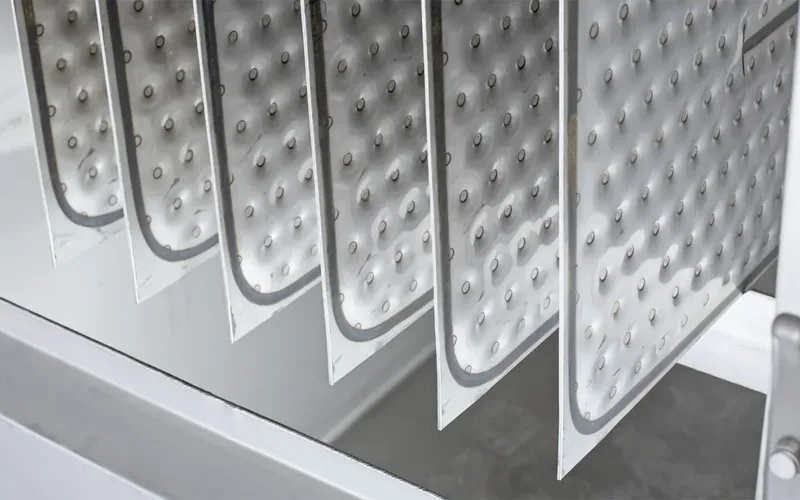
Embossed Plate
Dimple Plate
How a dimple jacket is built onto a tank, how it compares with a pillow jacket and a half-pipe, and what steam and glycol each need from it.
+ Learn More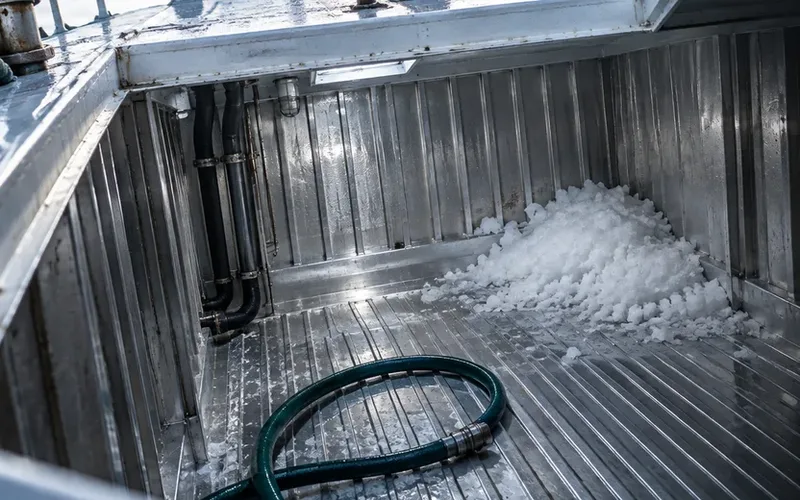
Embossed Plate
316L Stainless
Which sheet of an embossed plate has to be 316L, how far its chloride and acid resistance reaches, and what the welds need after inflation.
+ Learn More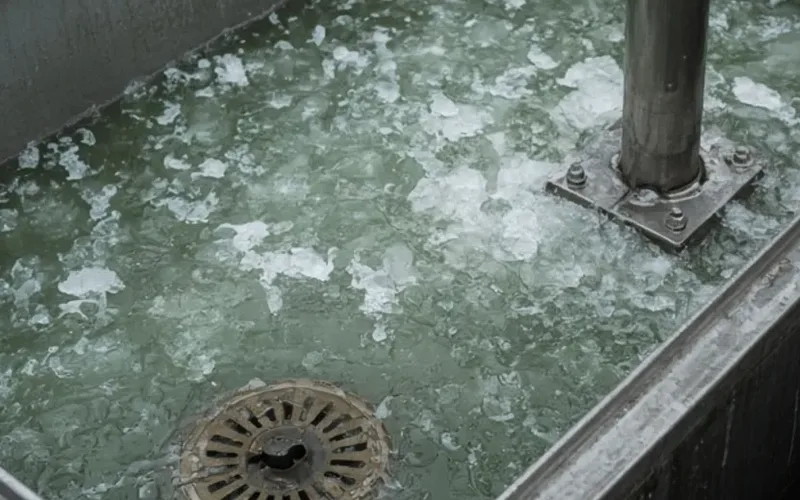
Embossed Plate
Pillow Plate
How a laser-welded pillow plate is made, what sheet gauge and weld pitch do to its rating, and where an inflated plate beats a tube coil or loses to one.
+ Learn More