
1-805-484-2992
Quotes - Engineering - SalesWhere 316L earns its place in a pillow plate
A 316L pillow plate is specified for the face that meets something aggressive: a food or beverage product, a chlorinated washdown, a rinse carrying salts from the stage before it, tower water, or a dilute acid bath. The 2 to 3% molybdenum in 316L is what holds off pitting where 304L would start to pit, and on an embossed plate that resistance has to hold in three places at once: the flat sheet, the hundreds of spot welds, and the laser seam around the edge.
Product face, utility face, weld zone
Which sheet needs it depends on the form. An immersion plate hangs in the bath, so both sheets are wetted and both are 316L. A welded dimple jacket or a single-embossed wall plate puts only the tank shell or the flat sheet against product, while the inflated sheet sees steam or glycol. Pairing a 304L inflated sheet with a 316L flat sheet is a legitimate build for clean utility, but an autogenous laser weld between the two ends up with a molybdenum content somewhere between the grades, so that weld is the first place to pit if the utility side ever carries chlorides.
The inside of a pillow deserves the same attention as the outside. Every spot weld leaves a ring where the two sheets touch, and that ring is a crevice. Water that stands in a low pillow between shifts concentrates whatever chloride it carries right at those rings, so the utility chemistry and the drain point are part of the grade decision, not an afterthought.
Use 316L on every embossed sheet wetted by product, washdown, rinse water or tower water, and move to 2205 duplex or 6-moly once that face runs hot and salty. Material & Construction explains how the grade is chosen.
What a 316L plate order should state
- Dual-certified 316/316L sheet on each wetted sheet, with MTRs where the order requires
- Which face meets product and which carries steam, glycol or water
- Chloride, pH and maximum metal temperature on both faces, not only the product side
- Heat-tint removal on all welds by pickling or mechanical cleaning
- Passivation to ASTM A967 after inflation and stub welding
- Product-face finish: mill, 32 µin Ra polish or electropolish as specified
- Hydrostatic test pressure and a test certificate where the specification calls for one
metal temperature where SCC risk beginsAbove about 140°F metal temperature a chloride-wetted 316L plate under stress can crack, so a steam-heated plate in salty liquor is reviewed for 2205 duplex.
Chemistry to send with a 316L plate inquiry
Grade questions on embossed plates are settled by numbers, and most of them come from a water or product analysis the plant already has. Send them with the thermal duty and we will confirm 316L or name the alloy the duty needs.
- Chloride in ppm on each face, measured where the fluid actually runs, not at the makeup
- pH range across the cycle, including any acid or caustic cleaning step
- Highest face temperature: steam pressure inside the plate or the hottest bath
- Sanitizer type and strength, contact time and the rinse that follows it
- Salt content of the product, if any, and the temperature it is processed at
- Whether the plate drains completely between runs or holds liquid in low pillows
Call and talk it through with an engineer: 1-805-484-2992
The straw, blue or brown oxide film left on stainless steel beside a weld, with a thin chromium-depleted layer under it. It resists corrosion worse than the parent metal, so it is removed by pickling or mechanical cleaning before the part is passivated.
How 316L behaves on an embossed plate
Chloride guidance for 316L is about 1,000 ppm at ambient temperature, and that is typical for clean, flowing, near-neutral water; temperature, pH, crevices and deposits move it. A steam plate is the hard case, because its face runs near the steam temperature, 250°F at 15 psig and 338°F at 100 psig. On a hot wall like that the tolerable chloride falls to a few hundred ppm, and above about 140°F chloride stress corrosion cracking becomes a real risk. Short-contact food products processed hot in 316L with daily CIP, milk at around 1,000 ppm chloride or a lightly salted sauce, are normal practice. Above about 3% salt, roughly 18,000 ppm chloride, at cooking temperature the product face is reviewed for 2205 duplex, 6-moly or higher.
Acids split in to two groups. Dilute phosphoric and citric acid at moderate temperature usually suit 316L, and nitric passivation baths are routine. Hydrochloric acid, hot concentrated sulfuric acid and pickling liquors are off the stainless map altogether and are reviewed case by case for nickel alloys or non-metallic construction. 904L is a sulfuric acid grade; it is not a chloride upgrade over 2205.
Welding is where a good sheet can be let down. Laser welds put little heat into thin sheet and keep the heat-affected zone narrow, and the L grade's 0.03% maximum carbon keeps chromium carbides out of it. What the weld does leave is heat tint, a straw-to-blue oxide with a chromium-depleted layer beneath it that pits well before the parent metal. It is removed by pickling or mechanical cleaning, and the plate is then passivated to ASTM A967 in citric or nitric acid. Passivation removes free iron; it does not polish or hide a heavy tint.
Free iron arrives from the shop as well as the weld. Carbon-steel wire brushes, grinding dust from a neighboring job, or a plate dragged across forklift tines leave embedded iron that rusts within days of the first washdown and looks like a failed grade. Dedicated stainless tooling and passivation as the last step before crating keep 316L looking like 316L when it is installed.
The failure we see most is a plate bought for its product face and then run with careless utility. A 316L wall plate gets a clean product side and tower water inside, and that water stands in the low pillows over each weekend. Tower water can reach 600 to 900 ppm chloride from a 150 ppm makeup, it concentrates further as it dries in the weld rings, and the plate can pit through from the inside. The product side shows nothing until it leaks. A closed glycol loop, or treated water with a written chloride limit and a bottom drain, prevents it.
On a pillow plate, 316L has to hold at the sheet, the spot welds and the seam.
A heat-tinted weld ring left unpickled is usually where pitting on a 316L plate begins, long before the flat sheet shows a mark.
Request a Quote316L pillow plate questions
From dual-certified 316/316L sheet, which meets the strength of 316 and the 0.03% carbon limit of 316L in one material. The low carbon matters on an embossed plate because every spot weld and the perimeter seam is a heat-affected zone, and keeping carbon low keeps chromium out of grain-boundary carbides there. The MTR shows both designations where the order asks for certified material.
Yes. Welding, inflation and handling disturb the passive film at every spot weld, along the seam and wherever tooling touched the sheet. Heat tint is removed first, then the finished plate is passivated to ASTM A967 so the chromium-rich surface is continuous again. Skipping that step is the usual reason a new 316L plate shows rust spots at its welds within weeks.
Brine chloride runs to tens of thousands of ppm, far beyond the roughly 1,000 ppm guidance for 316L, and the crevice at every spot weld makes a plate the worst place to stretch that limit. Inhibited propylene glycol is the usual answer. Where brine is unavoidable, the plate is reviewed for titanium or another higher alloy before we quote it.
It helps at the surface. Electropolishing removes 0.0005 to 0.001 in., drops Ra by roughly half and raises the chromium-to-iron ratio of the outer layer, so a product face sheds deposits and resists sanitizer attack better. It does not change the alloy, so a duty beyond 316L's chloride or temperature range still needs a different grade, polished or not.
Related
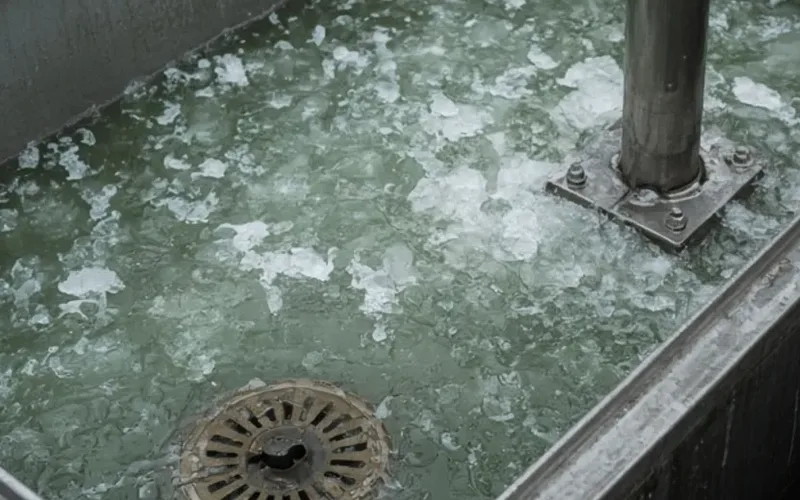
Embossed Plate
Pillow Plate
How a laser-welded pillow plate is made, what sheet gauge and weld pitch do to its rating, and where an inflated plate beats a tube coil or loses to one.
+ Learn More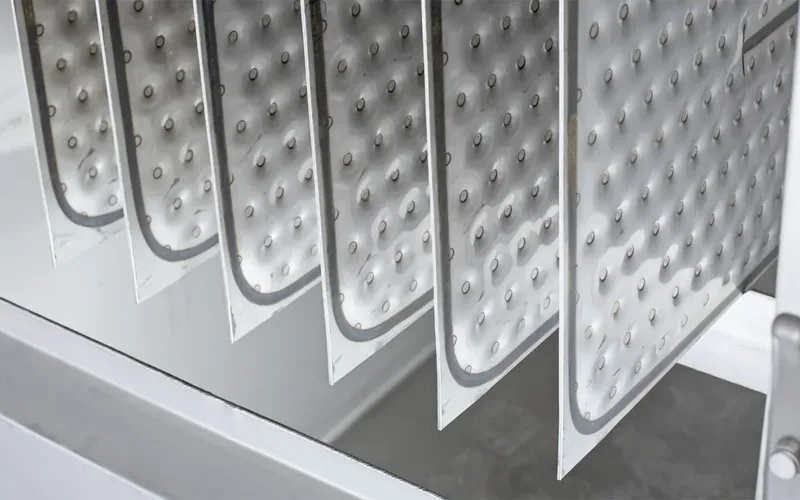
Embossed Plate
Dimple Plate
How a dimple jacket is built onto a tank, how it compares with a pillow jacket and a half-pipe, and what steam and glycol each need from it.
+ Learn More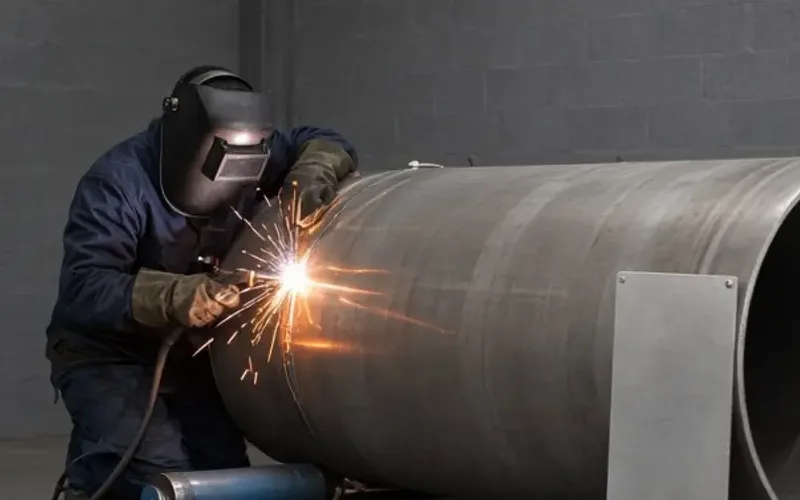
Embossed Plate
304L Stainless
When 304/304L sheet is the sensible choice for a jacket or plate, which fluids it handles, and the water, insulation and washdown conditions that rule it out.
+ Learn More