
1-805-484-2992
Quotes - Engineering - SalesSizing a jacket or immersion plate from the batch
Pillow plate heat exchanger sizing starts with the batch, not a flow rate. The heat needed is the batch mass times its specific heat times the temperature change; the time allowed turns that into a duty; the overall coefficient U and the mean temperature difference between utility and product turn the duty into area. The last step is the one most often skipped: checking that the area fits on the tank below the smallest batch.
Duty, U, temperature difference, area
U is built from three resistances in series. On the utility side, condensing steam gives a high film coefficient, and glycol gives a lower one that depends on its velocity in the channel. The stainless wall adds a small, fixed resistance: 0.075 in. sheet at about 9.4 Btu/h-ft-°F contributes roughly 0.0007 h-ft2-°F/Btu, about a tenth of the total at a U of 150 Btu/h-ft2-°F. The product side usually governs, and agitation and viscosity set it.
Holding temperature is a separate, smaller load: losses from the tank surface and the open top, plus any make-up liquid fed in cold. A jacket sized for heat-up covers it easily; one sized only for holding will not heat a batch in any useful time.
Sizing runs the same in 304L or 316L, since both conduct about 9.4 Btu/h-ft-°F; the grade follows the fluids, and a thicker sheet adds only a little resistance. Grade limits are set out on Material & Construction.
What sets the area
- Batch mass, specific heat and the temperature change
- Time allowed for heat-up or cool-down
- Utility temperature: steam saturation, or glycol supply and return
- Agitator type and speed, and product viscosity
- Fouling or burn-on, carried as extra area
- Wetted wall actually available below the minimum fill
- Allowable pressure drop and available flow on the utility side
clean area for the worked exampleThe 1,000 gallon example needs about 42 sq ft clean and about 50 sq ft with margin, which fits on the lower 3.2 ft of a 60 in. tank.
Data we size a jacket or plate from
Send what you know and mark what you are estimating. A missing agitator speed or viscosity is better flagged than guessed, because the product film usually decides the answer.
- Product, batch volume or mass, specific heat if it is not water-like, and viscosity
- Start temperature, target temperature and the time allowed for each step
- Tank diameter, straight side, head style and the minimum and maximum fill
- Agitator type and speed, or a note that the tank is unstirred
- Steam pressure at the tank, or glycol and hot water supply temperature and flow
- Whether the product scorches or fouls a hot face, and how the tank is cleaned
Call and talk it through with an engineer: 1-805-484-2992
The effective average temperature difference between utility and product used in the area calculation. For a stirred batch heated by steam it equals the starting difference minus the final difference, divided by the natural log of their ratio, and it sits below the simple average.
Worked example: a 1,000 gallon batch on 15 psig steam
Take a 1,000 gallon batch of a water-like product in an agitated stainless tank, to be heated from 60°F to 160°F in 1 hour with 15 psig steam, which condenses at 250°F. The batch weighs 1,000 × 8.34 = 8,340 lb, and with a specific heat of 1.0 Btu/lb-°F it needs 8,340 × 1.0 × 100 = 834,000 Btu. Delivered in 1 hour, that is an average of 834,000 Btu/h.
The temperature difference shrinks as the batch warms, from 250 - 60 = 190°F at the start to 250 - 160 = 90°F at the end. For a stirred batch heated by a utility at constant temperature, the right mean is the log mean: (190 - 90) / ln(190/90) = 100 / 0.747 = about 134°F.
For steam in a dimple or pillow jacket against an agitated water-like batch through a stainless wall, a U of 150 Btu/h-ft2-°F is a reasonable planning figure. The clean area is 834,000 / (150 × 134) = about 42 sq ft. A fouling factor of 0.001 h-ft2-°F/Btu drops U from 150 to about 130, which is the same as 15% more surface; allowing about 20% for fouling and some burn-on brings the jacket to about 50 sq ft.
Now the fit check. 1,000 gallons is about 134 cubic ft, so in a 60 in. diameter tank the liquid stands about 6.8 ft deep, and each foot of straight side gives about 15.7 sq ft of wall. The 50 sq ft jacket occupies the lower 3.2 ft of the shell, which a half batch still covers. At the start the clean jacket sees the full 190°F difference and draws about 150 × 50 × 190 = 1,425,000 Btu/h, roughly 1,500 lb/h of steam at about 945 Btu/lb, against an hourly average near 880 lb/h. The control valve and trap are sized for the start, not the average.
Change the utility and the answer changes sharply. Hot water held at 180°F gives a log mean of only about 56°F over the same heat-up, and with a U nearer 100 the area climbs to about 150 sq ft, more than the roughly 107 sq ft of wetted side wall in this tank. The choices are then more time, steam, or an immersion plate added inside.
This example is illustrative. A real selection is run on rating software against the actual product properties, agitator, jacket channel and utility conditions, and the result is a predicted performance, not a promise.
Batch time, not flow, sizes a jacket; the wall the tank offers decides whether it fits.
Size the steam valve and trap for the first minutes of heat-up, when the temperature difference is largest.
Request a QuoteQuestions on jacket and plate area
A great deal, because the product film is usually the largest resistance. An unstirred, viscous batch can need several times the area of the same batch under a turbine or anchor agitator, and a slow anchor in a thick product sits in between. If agitation is planned but not yet chosen, tell us and we will size for the likely range and show the difference.
Usually not. Steam at 250°F against a 60°F batch gives 190°F of driving force; glycol at 25°F cooling the same batch from 160°F to 40°F gives far less near the end, and glycol's film coefficient is lower than condensing steam's. Cool-down is often the step that sets the jacket area, so send both times.
For clean water-like products, 10 to 20% extra area is common. Products that scorch or deposit on a hot face, such as dairy, sugar syrups and sauces, warrant more, and the better cure is often a lower face temperature, using lower-pressure steam or hot water, rather than a larger jacket. We state the margin used on the selection so it can be checked.
The method is the same: duty from the batch, log mean temperature difference, U and area. The differences are that a double-embossed plate works on both faces, so it gives twice its outline area in surface, and it can sit where the agitator flow is strongest. When the tank wall can not hold enough jacket, an immersion plate makes up the shortfall.
Related
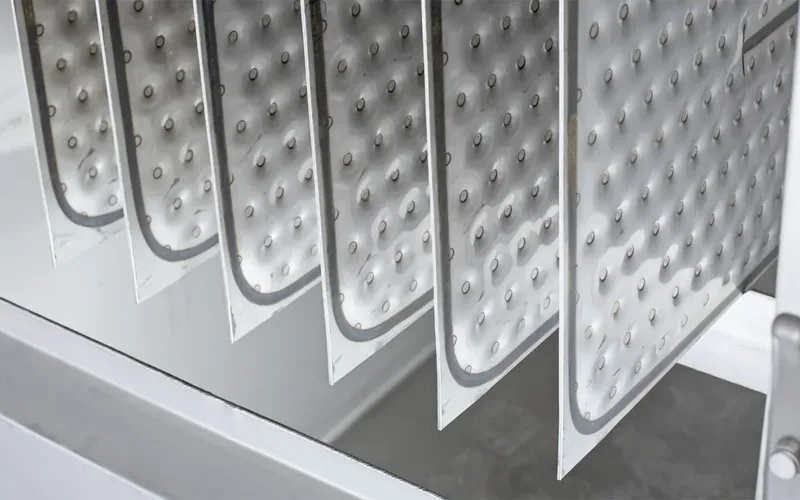
Embossed Plate
Dimple Plate
How a dimple jacket is built onto a tank, how it compares with a pillow jacket and a half-pipe, and what steam and glycol each need from it.
+ Learn More
Embossed Plate
316L Stainless
Which sheet of an embossed plate has to be 316L, how far its chloride and acid resistance reaches, and what the welds need after inflation.
+ Learn More
Embossed Plate
304L Stainless
When 304/304L sheet is the sensible choice for a jacket or plate, which fluids it handles, and the water, insulation and washdown conditions that rule it out.
+ Learn More