
1-805-484-2992
Quotes - Engineering - SalesHow a laser-welded pillow plate is built
A pillow plate heat exchanger starts as two flat stainless sheets laid together. A laser welds them to each other in a grid of spot welds, then seals the perimeter with a continuous seam. Connection stubs are welded on, and water is pumped between the sheets at a pressure well above the design rating, so the metal between the welds yields and lifts into the cushioned channel the utility will flow through.
Sheet, weld pitch and inflation
The weld pattern is the design. Round spot welds on a regular pitch make the familiar quilted plate; straight line welds added to the grid steer the flow into passes so glycol or water sweeps the whole face instead of running straight from inlet to outlet. Pitch and sheet thickness together set how far each pillow rises, how much pressure the plate carries and how much the channel resists flow. Laser welding keeps the heat input low and the heat-affected zone narrow; resistance spot welding is the older method and is still used for simple patterns.
Single-embossed plates combine a thick sheet that stays flat with a thinner sheet that inflates, so one face can lie against a tank wall, a trough or a cold-room ceiling. Double-embossed plates use two sheets of equal thickness that both inflate, so both faces carry heat and the plate hangs free in a liquid or stands in a bank.
Pillow plates are formed from dual-certified 304/304L or 316/316L sheet, chosen by the fluid on each face, since inflation and welding work the same in either grade. See Material & Construction for the grade comparison.
Construction choices on the drawing
- Sheet thickness on each side, typically 0.05 to 0.12 in.
- Spot-weld pitch and any line welds that divide the channel into passes
- Single-embossed for a mounting face, double-embossed for immersion
- Connections: threaded, flanged or tri-clamp stubs, with the drain at the low point
- Forming after inflation: flat, rolled to a radius, or bent into a trough
- Hanging lugs, standoffs and a stiffening frame on tall plates
- Hydrostatic test pressure and certificate, and a code stamp where specified
thinnest common pillow plate sheetSheet as light as 0.05 in. inflates deepest and moves heat best, so it suits glycol plates that stay clear of baskets, agitators and forklifts.
Typical gauges and ratings, and what moves them
Pressure ratings and gauges for embossed plates are application-dependent. The figures below are typical ranges for stainless pillow plates; each design is rated by calculation for its own sheet, weld pitch and size, then proved by hydrostatic test, and the rating on your drawing is the one that applies.
- 0.05 in. sheet, about 18 gauge: glycol, chilled and hot water, typically to about 100 psig
- 0.075 in. sheet, about 14 gauge: low-pressure steam, typically about 150 psig
- 0.10 to 0.12 in., about 12 to 11 gauge: heavy handling and higher ratings by design
- A tighter weld pitch raises the rating and shrinks the channel the utility flows in
- Refrigerant plates are designed to the refrigerant's own design pressure
- Steam at 150 psig puts the plate face near 366°F, which the product must tolerate
Call and talk it through with an engineer: 1-805-484-2992
A pillow plate made from two sheets of equal thickness that both inflate between the welds, so the utility channel bulges outward on both faces and both faces transfer heat. It is the form normally hung in a tank or stacked in a bank.
Pillow plate against a coil, and the details that decide performance
Inside the plate, the utility runs through a channel a fraction of an inch deep and is forced around every spot weld it meets. Each weld breaks up the boundary layer, so a pillow plate reaches a good inside film coefficient at a modest flow rate. The cost is pressure drop: hundreds of small restrictions add up, and the circulating pump or the steam supply has to be sized to the plate's channel, not to a guess.
Against a tube coil in a tank, a pillow plate usually wins on surface per square foot of floor or wall, because a flat panel packs more face into the space than a helix. It holds very little utility, so it responds quickly to a control valve. Its flat face has no crevice under a tube for product to bake into, and it can be formed to a tank radius, a trough or a cone, where a coil can only be bent.
A coil still wins some duties, and we say so. Thick-wall tube carries steam pressures well above what a thin embossed sheet is rated for. A coil can be fed through a small nozzle or a manway that a rigid plate will not pass, and for a small duty in a small tank a single loop of tube is simpler and cheaper than a fabricated panel.
Thermal growth is easy to forget on a plate that hangs in a tank. Stainless expands about 0.0000096 in. per inch per °F, so a 6 ft plate heated from 60°F to 300°F grows about 0.17 in. Hang it from fixed lugs at the top, guide it with slotted brackets lower down, and leave the stubs a flexible connection, or the plate bows and the pipework takes the strain at the stub welds.
The mistake we see is a pillow plate ordered by area and pressure alone. A glycol plate is designed around a circulating flow, and when that flow is short, the channel runs laminar, the glycol takes the shortest path through the pattern, and half the face does little work. Send the flow and supply temperature you can deliver, or let us size them with the plate, and the pass arrangement is set to suit.
The weld pattern is the design: it sets the rating, the channel and the flow path.
A pillow plate holds very little utility, so it answers a control valve faster than a jacket or coil of the same duty.
Request a QuotePillow plate construction questions
For most stainless plates, yes. A laser puts less heat into thin sheet, so the weld zones distort less, the heat-affected zone stays narrow and heat tint is lighter to remove. It also welds any pattern the drawing calls for, including line welds that divide the channel into passes. Resistance welding remains sound for simple grids and some heavier sheet combinations.
Every plate is inflated at a pressure above its design rating as part of manufacture, which proves the welds once. After the stubs are fitted, the finished plate is hydrostatically tested to the pressure the design or the applicable code sets, and a test certificate is supplied where the order requires it. Plates built to ASME Section VIII carry the stamp where it is specified.
More than an open jacket and usually less than a long coil of small tube, but it depends entirely on the weld pitch, the pass arrangement and the flow. We calculate it for the plate we quote and state it on the selection, so the circulating pump can be checked against it before the order is placed rather than after start-up.
Yes. Line welds can divide a single panel into two independant channels, each with its own stubs, so one plate can carry steam in one zone and glycol in another, or two glycol circuits at different temperatures. Each circuit is rated and tested on its own, and the division is drawn so that a leak across the line weld is detected rather than hidden.
Related
Embossed Plate
316L Stainless
Which sheet of an embossed plate has to be 316L, how far its chloride and acid resistance reaches, and what the welds need after inflation.
+ Learn More
Embossed Plate
304L Stainless
When 304/304L sheet is the sensible choice for a jacket or plate, which fluids it handles, and the water, insulation and washdown conditions that rule it out.
+ Learn More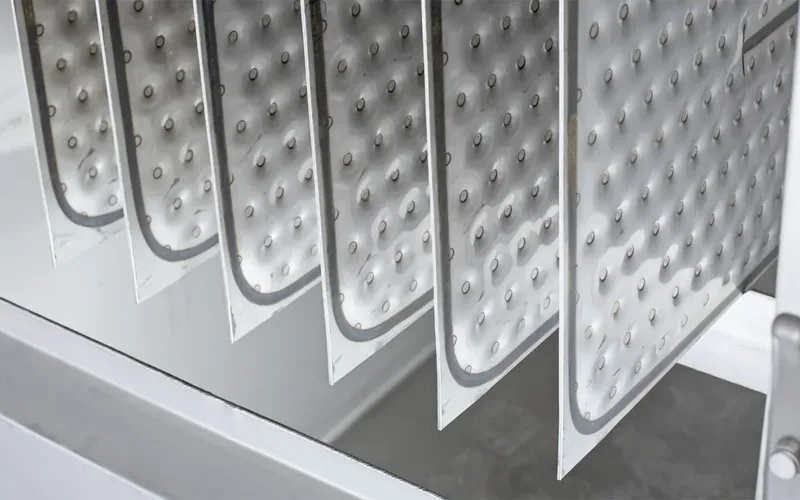
Embossed Plate
Dimple Plate
How a dimple jacket is built onto a tank, how it compares with a pillow jacket and a half-pipe, and what steam and glycol each need from it.
+ Learn More
