
1-805-484-2992
Quotes - Engineering - SalesWhere 316L is enough and where it is not
Chloride, temperature, pH and crevices, in that order
Stainless resists corrosion through a chromium oxide film a few nanometers thick, and every corrosive duty is a question of what breaks that film and whether it can heal. Chloride ions break it locally, which is pitting; a crevice under a deposit or at a tube-to-tubesheet joint starves the film of oxygen, which is crevice attack; and chlorides plus tensile stress plus heat above about 140°F (60°C) can crack the austenitic grades outright. Acids and caustics work differently, dissolving the film over the whole surface once concentration and temperature cross a line that is specific to each acid.
The grades are a ladder ranked by pitting resistance number, PREN = Cr + 3.3 Mo + 16 N. 304 sits near 19 and holds to about 200 ppm chloride at ambient; 316L, with 2–3% molybdenum, reaches 24–25 and about 1,000 ppm; 2205 duplex at about 35 covers 3,000–5,000 ppm and is highly resistant to chloride cracking; 904L at about 34 is a sulfuric acid grade, not a chloride upgrade; the 6-moly alloys at 43–45 reach roughly 20,000 ppm; titanium Grade 2 handles 19,000 ppm seawater at cooling temperatures. Every one of those limits falls with heat, low pH, stagnation and evaporation.
316L to about 1,000 ppm chloride at ambient, 2205 duplex for warm brackish water and chloride cracking, 6-moly for hot chlorides and acids, titanium for seawater and wet chlorine. See Material & Construction for the grade comparison.
On a corrosive duty we put the expensive alloy only where the fluid touches it and size for its conductivity, which for titanium is slightly better than 304's.
Shell & Tube Construction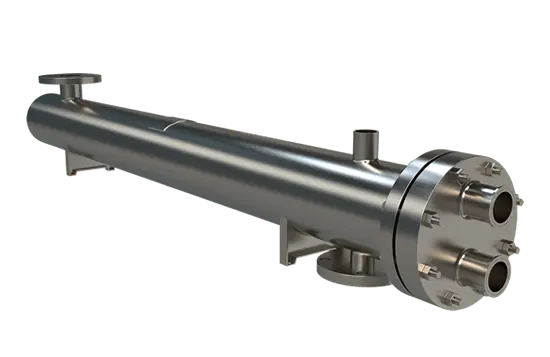
Fluid by fluid: the grade that holds
Guidance for clean, flowing conditions at near-ambient temperature unless stated. Deposits, crevices and heat move every row up the ladder.
| Condition | Typical value |
| Chloride water, pH 6–8, ambient | 304 to about 200 ppm; 316L to about 1,000 ppm; 2205 to 3,000–5,000 ppm; 6-moly to about 20,000 ppm; titanium for seawater |
| Chloride water above 140°F | 304 and 316 can crack under tensile stress; 2205 duplex, 6-moly or titanium |
| Seawater and brine | Titanium Grade 2 tubes at normal cooling temperatures, Grade 7/12 above about 160°F; 6-moly cool and flowing; 316L only where exposure is brief and flushed |
| Caustic soda | 304L and 316L to about 50% at CIP temperatures; hot concentrated caustic reviewed case by case |
| Nitric acid | 304L is the better grade; molybdenum adds nothing in nitric and 316L is not an upgrade |
| Sulfuric acid | 316L holds only in narrow concentration bands; most duties go to 904L or 6-moly, and some leave stainless altogether |
| Hydrochloric acid, wet chlorides | No stainless grade; titanium handles wet chlorine and hypochlorite but not HCl, which is reducing |
| Organic acids (acetic, citric, lactic) | 316L generally good, hot concentrated duty reviewed; 304L marginal above about 150°F |
| Crevices and deposits | Tube-to-tubesheet joints and baffle holes attack first; strength-welded joints, higher velocity and clean shutdowns extend any grade |
Pitting resistance equivalent number: a rating calculated from an alloy's chromium, molybdenum and nitrogen content that ranks stainless grades against chloride pitting. A higher number usually means more resistance, but temperature, crevices and deposits still set the real limit in service.
The four questions that place a corrosive duty on the ladder
Chlorides: the limit that moves with temperature
Pitting is a race between the chloride breaking the film and the film healing. Molybdenum slows the breakdown, which is the whole difference between 304 and 316L, and nitrogen in duplex and 6-moly slows it further. Temperature speeds the breakdown: the 1,000 ppm that 316L tolerates at 70°F shrinks to a few hundred at 150°F and to almost nothing in a crevice at that temperature. Chloride stress corrosion cracking is the second mechanism and the more dangerous one, because it runs through the tube wall as a branched crack with no visible pitting, and it needs only three things: chlorides, a tensile stress such as a rolled tube joint, and a metal temperature above about 140°F.
Duplex 2205, with its ferrite fraction, is the first upgrade for hot brackish water and heated chlorinated process water.
- 316L: tower water, softened water, chlorinated rinse water under 140°F
- 2205 duplex: brackish water, warm brines, hot chlorinated streams
- 6-moly: hot concentrated chlorides, acid-chloride mixtures
- Titanium: seawater, wet chlorine, hypochlorite at normal process temperatures
Acids and caustics: each one has its own map
There is no single acid rating for a stainless grade. Nitric acid is oxidizing and keeps the chromium film intact, so 304L outperforms 316L in it. Sulfuric acid is reducing across most of its concentration range and attacks 316L except in narrow bands; 904L was developed for exactly that duty and 6-moly extends it. Phosphoric acid is manageable in 316L when pure and not when it carries the fluorides and chlorides of wet-process acid. Acetic, citric and lactic acids are generally mild on 316L outside hot concentrated duty. Hydrochloric acid is off the stainless map entirely.
Caustic soda is benign to stainless at the 1–3% and 160–185°F of a CIP step and at storage concentrations near ambient; hot, concentrated solutions risk caustic cracking and are reviewed before we quote.
Seawater and brackish water
Seawater at about 19,000 ppm chloride is usually a titanium duty for the tubes and tubesheet; 316L can pit in stagnant seawater within weeks and 2205 is marginal where biofouling settles. The shell, which sees the process side, can be 316L or duplex. Titanium's thermal conductivity, about 12 Btu/h-ft-F against 9.4 for 304, matters less than its thin wall. Brackish water and estuary cooling water between about 1,000 and 5,000 ppm is where 2205 duplex earns its place, provided the water keeps moving and the cooler is drained when idle.
The mistake: trusting a bulk analysis and a clean surface
Most corrosion failures we replace were specified correctly for the fluid as analyzed and failed for a condition the analysis did not show. Tower water that evaporates to several times its makeup chloride; a deposit under which the chloride concentrates and the oxygen runs out; an exchanger left full of chlorinated sanitizer over a weekend at 100°F; a tube wall running 30°F hotter than the bulk because steam was on the other side. We size for the surface condition and the wall temperature, and we ask about shutdowns, cleaning chemicals and the warmest the metal will get before settling on a grade.
Questions on chloride water and acids
At ambient, near-neutral pH and clean flowing conditions, about 1,000 ppm. Cut that in half if the fluid is warm, and again if it sits stagnant or carries solids that settle. If the metal temperature passes 140°F, cracking rather than pitting becomes the risk and the tolerable chloride on 316L falls to a few hundred ppm; above that, 2205 duplex is the grade that resists it.
For the tubes and tubesheet in stagnant or warm seawater, usually; 6-moly can serve cool, flowing duty. The shell does not touch seawater and stays 316L or duplex, which is how a titanium exchanger is kept affordable. Titanium is not a general-purpose upgrade: it fails in hydrochloric acid, dry chlorine and hot concentrated caustic, so a seawater cooler that also sees an acid wash needs that step reviewed.
The rolled joint leaves a crevice between the tube and the hole on the shell side, and the rolling leaves tensile stress in the tube. Oxygen cannot reach the crevice, chlorides concentrate in it, and the stressed metal beside it is the first place a crack starts. On duplex, 6-moly and titanium bundles we specify welded joints plus near full-depth expansion so the shell-side crevice is closed as far as practical.
Low pH and chloride together are worse than either alone, because the acid keeps the film from healing while the chloride breaks it. At pH 2 and 500 ppm, 316L is already past its comfortable range at anything above room temperature; 6-moly is the usual selection and 2205 is a candidate only if the fluid stays cool. Tell us the acid, since a nitric background behaves very differently from a sulfuric or hydrochloric one.
Related
Shell & Tube
Fluid Heating
Shell-and-tube heaters that warm oils, syrups, brines and chemical streams with a liquid utility, built in stainless where the product touches metal.
+ Learn More
Shell & Tube
Process Cooling
Shell-and-tube coolers for product streams, lube and hydraulic oil, with the water side in a grade that outlasts the cooling tower's chloride cycle.
+ Learn More
Shell & Tube
Clean-in-Place
A shell-and-tube CIP solution heater in 316L: the grade, the finish and the steam side chosen for hot caustic, acid and chlorinated sanitizer cycles.
+ Learn More
