
1-805-484-2992
Quotes - Engineering - SalesPast 316L
When the product tube has to move beyond 316L
Three kinds of stream send a tube-in-tube order past 316L. The first is salt with heat: pickling and cheese brines, soy and fish based sauces, salted vegetable and meat products cooked or cooled in the tube. Every 1% of salt is about 6,000 ppm chloride, and above about 3% salt at cooking temperature the product side is reviewed for 2205 duplex, 6-moly or higher. The second is industrial effluent above about 1,000 ppm chloride, often with sulfide, run warm through a heat recovery loop. The third is abrasive slurry where grit wears the bottom of every horizontal pass and corrosion finishes what the wear starts.
2205 duplex, 22% chromium, 5% nickel and 3% molybdenum with nitrogen, has a PREN of about 35 against 24–25 for 316L, handles about 3,000–5,000 ppm chloride at ambient, and is highly resistant to the chloride stress corrosion cracking that limits 316L above 140°F. Its yield strength is about twice that of 316L. 6-moly, PREN 43–45, carries chloride to roughly 20,000 ppm and takes the warmer, saltier duty where 2205 runs out of margin. Hot hydrochloric acid and pickling liquors sit off the stainless map entirely and are reviewed case by case.
Only the product tube and its bends change; the annulus stays in the cheaper grade.
2205 duplex is the first step past 316L for hot salted product and chloride effluent; 6-moly covers hotter, saltier brine, and titanium needs its own construction. Material & Construction explains how the grade is chosen.
Salt plus heat on the tube wall decides the alloy
2205 duplex, with a PREN near 35 and about twice the yield strength of 316L, is the first step; 6-moly at PREN 43–45 carries chloride to roughly 20,000 ppm on warmer duty.
Streams that outrun 316L
Count chloride from salt, not from the water supply. A 3% brine is near 18,000 ppm and a soy-based sauce runs several times that, so the question is never whether such a product is salty but how hot the tube wall gets and how long product stands in it. A cooler section at 50°F on a heavily salted product may stay in 316L, while the final heating passes, where the wall is hottest, need duplex or 6-moly. Low pH from vinegar or lactic fermentation lowers every threshold further.
Effluent adds sulfide and deposits: a brackish or industrial stream above 1,000 ppm chloride at loop temperature is usually reviewed for 2205, and the wastewater page covers the bore and rodding side of it. Abrasive slurries such as mineral-laden process water, lime and grit-bearing sludge favor duplex for a different reason: its higher strength and hardness slow the wear that strips the passive film off the bottom of the tube.
Building the tube in duplex or 6-moly
Duplex welding is about phase balance. Heat input is held within a window, the filler is the over-alloyed 2209 type, and ferrite readings on the welds confirm the austenite-ferrite split that gives the alloy its resistance. ASME pressure design limits 2205 to about 600°F because longer exposure higher up embrittles it, far above any food or effluent duty. Sanitary tubing in duplex with a polished bore is stocked in fewer sizes than 316L, so we confirm the tube early in the quote.
6-moly tubing is welded with an over-alloyed nickel-base filler, because a matching filler leaves molybdenum-poor zones in the weld that pit first. The annulus usually stays 316L or 304L on clean utility, joined to the high-alloy tube by a dissimilar weld with a filler chosen for both metals. Titanium for seawater-diluted streams cannot be fusion welded to a stainless jacket, so a titanium product tube needs its own end construction and is engineered separately.
What decides duplex versus 6-moly
The alloy is chosen on the worst point in the unit, which is usually the hottest wall in contact with the saltiest product, so we need the figures for that point.
- Chloride in ppm or salt percentage, measured, not estimated from the recipe
- pH and the acid present: vinegar, lactic, citric or mineral acid
- Highest product temperature and the utility temperature on the tube wall
- Sulfide, ammonia and solids content for effluent and slurry streams
- Shutdown practice: drained and rinsed, or left full over a weekend
- Code and documentation: ASME stamp, MTRs, ferrite readings where specified
Call and talk it through with an engineer: 1-805-484-2992
Before you move past 316L
Not for chloride. 904L, with a PREN near 34, is an austenitic grade built for sulfuric and phosphoric acid duty and is not a chloride upgrade over 2205, which matches its pitting resistance with about twice the yield strength of 316L. For salt and heat the sequence is 316L, then 2205, then 6-moly. 904L earns its place when the product stream carries sulfuric acid.
Yes, and on long heaters it is often the economic answer. The final heating passes see the hottest wall and the most concentrated attack, while regeneration and cooling sections run cooler. Mixing grades in one unit is routine provided each section is identified, the dissimilar welds are qualified, and the plant's spare-parts list records which return bends are duplex. We show the split on the drawing.
Very little. The thermal conductivity of 2205 is close to that of 316L, and in a tube-in-tube the product film usually controls the overall coefficient, not the wall. The higher strength can allow a thinner wall at the same rating, which helps slightly, but most orders keep the standard wall for erosion margin. The length and section count normally match the 316L selection.
It raises the threshhold; it does not remove the mechanism. Under a sludge deposit the chemistry at the wall is more concentrated and lower in oxygen than the bulk stream, and duplex tolerates far more of that than 316L. Holding velocity, rodding on schedule and draining the tube before a long stop still decide how long the tube lasts.
Related
Tube-in-Tube
Polished & Electropolished
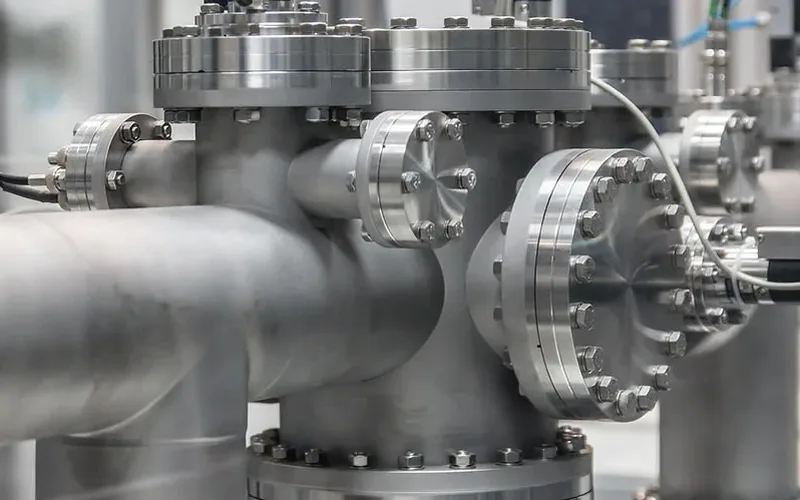
Ra on the bore of a long product tube is set at the mill, at the weld and at the bend. What to specify for sticky, viscous and aseptic products.
+ Learn More
Tube-in-Tube
316L Stainless
Why 316L is the standard product tube in a stainless double pipe unit, when the annulus can drop to 304L, and the salt and heat that move it to duplex.
+ Learn More
Tube-in-Tube
Solids in Suspension
Pieces, chunks and grains carried in a liquid need a bore they cannot bridge and a velocity that keeps them moving. Here is how the tube is chosen.
+ Learn More