
1-805-484-2992
Quotes - Engineering - SalesWhich surfaces of a shell and tube get a finish
Product contact first: tube bore, tubesheet face, heads
In a shell and tube, finish matters where product touches metal. On sanitary units the product usually runs in the tubes, so the surfaces that count are the tube bores, the tubesheet faces with their tube-end welds, the bonnets or heads, and the product nozzles and connections. The shell side carrying steam, hot water or glycol normally stays mill finish. An inquiry that says only polished, without naming the surfaces and the Ra, is the most common gap we see on sanitary work.
Tube bores are finished at the tube mill on straight lengths, mechanically polished and, where required, electropolished, and they are not reworked inside a finished bundle. The fabricator finishes what it welds and machines: tube-end welds ground flush, tubesheet faces, heads, ferrules. Results are read with a profilometer and stated as Ra in microinches.
316L for polished and electropolished product surfaces, since finish aids cleaning without raising the grade's chloride limit; mill-finish 304L on a clean utility shell side. The Material & Construction page compares the grades.
The common product-contact finish for dairy and food is 32 µin Ra (0.8 µm); pharmaceutical work runs to 20 and 15 µin Ra. Electropolishing removes about 0.0005–0.001 in. of metal, cuts Ra by roughly half and raises the chromium-to-iron ratio at the surface. Passivation removes free iron and restores the passive film; it does not polish.
Shell & Tube Construction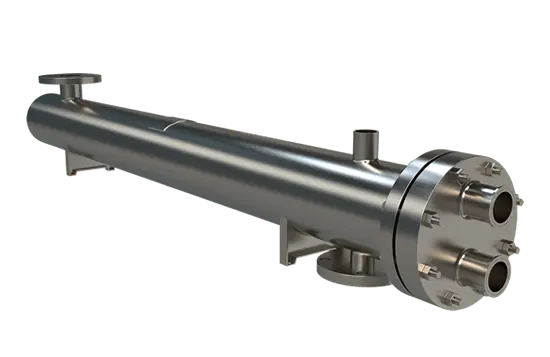
Finishes for a stainless shell and tube
Ra values are maximums on the surfaces named in the order. ASME BPE designations apply where the order calls for BPE.
| Condition | Typical value |
| Mill finish | As-produced tube and plate with no Ra requirement; shell sides and most industrial units |
| Mechanically polished | 32 µin Ra on product contact for dairy and food duty |
| ASME BPE SF1, SF2, SF3 | Mechanically polished, 20, 25 and 30 µin Ra max |
| ASME BPE SF4 | Electropolished, 15 µin Ra max, the finest BPE designation |
| ASME BPE SF5, SF6 | Electropolished, 20 and 25 µin Ra max |
| Electropolishing | Removes about 0.0005–0.001 in., roughly halves Ra, enriches surface chromium |
| Passivation | ASTM A967 citric or nitric after fabrication, with cleaning to ASTM A380; Ra unchanged |
| Verification | Profilometer readings and a finish certificate where the order requires |
The arithmetic mean of the absolute height of a surface's peaks and valleys measured from its center line with a profilometer, stated in microinches for stainless product surfaces. A 32 µin Ra surface is about 0.8 µm; a lower number means fewer sites where soil and bacteria can hold.
What a finish buys, and what it does not
Cleanability and product hold-up
A smoother bore releases protein, fat and sugar films under CIP at lower chemical strength and in less time, and leaves fewer microscopic pockets where a biofilm can establish. That is the reason for a polished bore. Thermal performance changes little; a finish is bought for cleaning and inspection, not for heat transfer.
Electropolishing over a mechanical polish
Mechanical polishing cuts the peaks down but can fold and smear metal and embed abrasive. Electropolishing dissolves the surface anodically, taking the peaks first, removing smeared metal and embedded iron, and leaving a chromium-enriched passive layer. It does not level a rough surface: an electropolished poor base finish is a shiny rough surface. The base is mechanically polished to the target first, then electropolished.
- Specify the base polish and the electropolish seperately
- Name every surface: bores, tubesheet faces, heads, nozzles
- Ask for profilometer readings at stated locations
Corrosion: a smaller gain than buyers expect
A smooth, electropolished surface has fewer pit initiation sites and a richer chromium film, so it resists pitting somewhat better than mill finish of the same grade. It does not change the grade. A polished 316L bore is still judged against about 1,000 ppm chloride at ambient, and a hot chloride duty still needs the grade that resists cracking. The grade choice is covered on the 316L shell and tube page.
The mistake: finishing the wrong surfaces, or in the wrong order
Two errors recur. One is paying to polish a steam shell side that no product touches while the tube-end welds on the product tubesheet are left as welded. The other is welding, grinding or adding a fitting after electropolishing and returning the unit to service without passivating the disturbed area, which leaves free iron exactly where the surface was meant to be best.
Finish questions from sanitary and pharma buyers
On the electropolished areas it leaves a passive, chromium-enriched surface, so a separate passivation is often unnecessary there. Any weld, grind or machining done afterward breaks that layer, and those areas are passivated to ASTM A967. Many pharma orders specify a final passivation of the whole product side after assembly, which costs little and documents the surface.
Not mechanically in any practical way; small-bore tubes are polished and electropolished on straight lengths at the mill before the bundle is built. An assembled unit can be cleaned and passivated by circulation, and the fabricator can finish the tubesheet faces and welds by hand, but the bore finish is fixed by the tube that was bought.
Not usually. 32 µin Ra is the common product-contact benchmark for dairy and food and is what most specifications for those plants call for. The 20 and 15 µin Ra finishes, and electropolishing, belong to pharmaceutical, biotech and high-purity water service, where the order normally names an ASME BPE designation.
Not measurably in the clean condition. Where it helps is in how fast the surface fouls and how completely it cleans, which affects the fouling allowance the duty needs over time. The sizing still rests on the fluids, flows, temperatures and wall resistance of the stainless tube.
Related
Shell & Tube
304L Stainless
When 304L tubes, tubesheets and shells do the job at lower cost: clean steam, glycol, low-chloride water and nitric service, and the duties that need 316L.
+ Learn More
Shell & Tube
Duplex & High Alloy
The alloys that take over from 316L in a tube bundle: 2205 and super duplex, 904L, 6-moly and titanium, with what each one demands of the tubesheet and welds.
+ Learn More
Shell & Tube
Double Tubesheet
How a double tubesheet sends a tube-joint leak to atmosphere instead of into the other fluid, where it is specified, and the tube-wall risk it leaves in place.
+ Learn More
