
1-805-484-2992
Quotes - Engineering - SalesWhen the bundle moves past 316L
Strength, PREN and weldability, alloy by alloy
2205 duplex is the first step up. About 22% chromium, 5% nickel and 3% molybdenum with added nitrogen, its microstructure is a roughly even mix of ferrite and austenite, which gives it a PREN of about 35 against about 24–25 for 316L, more than twice the yield strength of 316L, and high resistance to chloride stress corrosion cracking. Chloride guidance is about 3,000–5,000 ppm at ambient, so it covers brackish cooling water and hot chloride process water that could crack a 316L tube. ASME limits its use to about 600°F because the ferrite embrittles with long exposure above that.
Above 2205 the alloys divide by job. Super duplex, about 25% chromium, 7% nickel and 4% molybdenum, carries a PREN above 40 for hotter or saltier chlorides. 6-moly, PREN 43–45, reaches roughly 20,000 ppm chloride and handles warmer chloride duty and cool, flowing seawater. 904L, PREN about 34, was developed for sulfuric acid and is not a chloride upgrade over 2205.
2205 duplex for warm brackish water and chloride cracking risk, super duplex or 6-moly for hotter or saltier chlorides, 904L for sulfuric acid, titanium for seawater. Material & Construction explains how the grade is chosen.
Titanium Grade 2 takes seawater and brine at normal cooling temperatures, with Grade 7 or 12 where crevices run above about 160°F. Its conductivity, about 12 Btu/h-ft-°F, is slightly better than the 9.4 of 304 and 316. It is not for hydrochloric acid, dry chlorine or reducing acids.
Shell & Tube Construction
Alloy by alloy in the tube bundle
Chloride figures are typical for clean, flowing, near-neutral water; temperature, pH, crevices and deposits move them. PREN ranks pitting resistance and promises nothing on its own.
| Condition | Typical value |
| 2205 duplex (UNS S32205) | 22% Cr, 5% Ni, 3% Mo plus nitrogen; PREN about 35; about 3,000–5,000 ppm chloride at ambient; tube to ASTM A789 |
| Super duplex (2507 type) | About 25% Cr, 7% Ni, 4% Mo; PREN above 40; hotter and saltier chloride duty than 2205 |
| 904L (UNS N08904) | About 20% Cr, 25% Ni, 4–5% Mo with copper; PREN about 34; sulfuric acid duty |
| 6-moly (UNS S31254, N08367) | 6% Mo plus nitrogen; PREN 43–45; to roughly 20,000 ppm chloride, warm chlorides, cool flowing seawater |
| Titanium Grade 2 | Seawater and brine at normal cooling temperatures; tube to ASTM B338; titanium or titanium-clad tubesheet |
| Titanium Grade 7 or 12 | Crevice-prone duty above about 160°F |
| Off this ladder | Hydrochloric acid, hot concentrated sulfuric and pickling liquors: reviewed case by case for nickel alloys or non-metallics |
A tubesheet built from a thick steel backing plate with a thinner layer of titanium or another alloy bonded to the face that meets the tube-side fluid, usually by explosion bonding. The tubes are welded to the cladding, so a titanium bundle gets titanium joints without the cost of a solid titanium sheet.
Building a high-alloy bundle that holds
Duplex: strength with conditions attached
The strength of 2205 often lets the tube wall come down a gauge for the same pressure, which recovers part of the alloy premium and slightly improves heat transfer. The conditions are on the fabrication side: weld procedures are qualified to keep the ferrite-austenite balance in the weld and heat-affected zone, heat input is controled, and the tubesheet, shell and heads are duplex or a compatible grade. A duplex tube expanded into a 316L tubesheet leaves the crevice at the joint, the most vulnerable spot in the unit, in the weaker alloy.
6-moly, super duplex and 904L: three different jobs
6-moly is the austenitic answer to hot chlorides and acid-chloride mixtures; it is welded with an over-alloyed nickel-base filler because molybdenum segregates in an autogenous weld and the weld would otherwise pit before the tube. Super duplex brings duplex strength with a higher PREN. 904L belongs on sulfuric and phosphoric acid duty, and choosing it for a chloride water because its PREN sounds close to 2205 is a common misreading.
Titanium tubes and what they demand of the tubesheet
Titanium cannot be fusion-welded to stainless steel, so a titanium bundle takes a solid titanium or titanium-clad tubesheet, and the channel or bonnet on the seawater side is titanium or titanium-lined. The shell, which sees the process fluid, can stay 316L or duplex if that fluid allows. Titanium tubes are usually thinner-walled than stainless, which helps heat transfer; the design check is strength at temperature, where titanium falls off faster than stainless. The duty view of these choices is on the corrosion resistant heat exchanger page.
The mistake: upgrading the tubes and nothing else
The failure we see most on high-alloy duty is a bundle with 2205 or 6-moly tubes in a 316L tubesheet, with 316L baffles and a 316L channel. The tubes hold up; the tubesheet ligaments and joint crevices pit instead, and the baffle holes wear open.
- Tubesheet in the tube grade, or clad with it
- Channel and heads matched to the tube-side fluid
- Baffles and tie rods matched to the shell fluid
- Weld filler qualified for the alloy, not borrowed from 316L work
Questions on alloys beyond 316L
No. 904L has a PREN of about 34 against about 35 for 2205, lower strength and less resistance to chloride stress corrosion cracking. Its value is in sulfuric and phosphoric acid, where its high nickel and copper content help. For chloride water the path runs from 316L to 2205, then to super duplex or 6-moly, then titanium.
Not in a build we would quote. Titanium and stainless cannot be fusion-welded, so the joint could only be expanded, leaving a crevice between dissimilar metals on exactly the fluid that needed titanium. The tubesheet is solid titanium or explosion-clad with titanium on the tube-side face, with the tubes welded to that face.
Titanium is excellent in seawater, brine and wet chlorine, but it is attacked by hydrochloric acid, dry chlorine and other reducing acids, and it loses strength faster than stainless as temperature rises. It also costs more and needs titanium or clad tubesheets. Where 2205 or 6-moly covers the chemistry, they are usually the better value.
Its toughness falls off at cryogenic temperatures more than that of the austenitic grades, so 2205 is not the choice for deep refrigeration or liquefied gas duty, where 304L and 316L stay tough. For brine or glycol chillers at ordinary process temperatures, duplex is used; we confirm the design minimum temperature and impact test requirements against the code.
Related
Shell & Tube
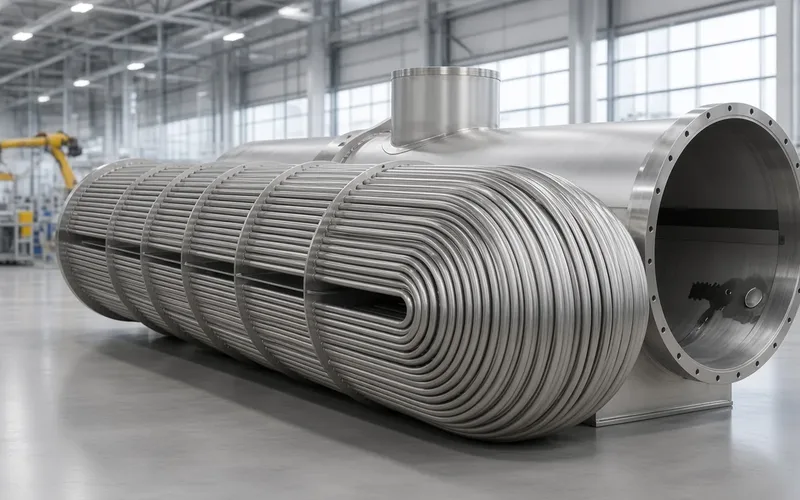
Fixed & Removable Bundles
Fixed tubesheet, U-tube or floating head: how each stainless bundle copes with thermal growth, which side it lets you clean, and what it asks of the plant layout.
+ Learn More
Shell & Tube
Polished & Electropolished
Which surfaces of a stainless shell and tube need a finish, what 32, 20 and 15 microinch Ra mean, and how electropolishing and passivation differ.
+ Learn More
Shell & Tube
316L Stainless
Where 316L belongs in a shell and tube, part by part: tubes, tubesheet, shell and heads, with the chloride and temperature limits that decide each one.
+ Learn More