
1-805-484-2992
Quotes - Engineering - SalesWhy the gasket sets the limits of a plate pack
A 316L or titanium plate tolerates temperatures far above anything a gasketed pack is asked to run. The elastomer in the groove does not, so the design temperature on the nameplate is the gasket's figure, and the fluid list is filtered through the gasket's chemistry before the plate grade is considered. Each plate gasket seals its own channel and also rings the ports that carry the other fluid past it, so one compound touches both streams and has to suit both, plus every cleaning chemical the pack sees.
Four families cover nearly all stainless plate duty. Nitrile (NBR) handles water, glycol, mineral oil and fatty products to about 230°F. EPDM handles hot water, steam flushing, caustic and dilute nitric or phosphoric acid to about 275–300°F, but swells in oils and fats. Fluoroelastomer (FKM) handles oils, many solvents and some acids to about 350°F, but does poorly in hot caustic and steam. Hydrogenated nitrile (HNBR) carries nitrile's oil resistance to roughly 300°F. Steam-resistant special EPDM compounds, typically peroxide cured, serve UHT and sterilizing circuits.
Every one of those figures is typical and compound-dependent. The rating uses the data for the exact compound fitted, and a pack running near the top of its range all day ages faster than one with margin.
Plates stay 316L or titanium whichever gasket is fitted; the compound, EPDM, NBR, HNBR or FKM, is chosen against the hottest fluid, any oils and the cleaning chemicals. The Material & Construction page compares the grades.

Three questions that pick the gasket compound
- The highest temperature either fluid or the cleaning cycle reaches
- Whether oil, fat or solvent touches the pack
- Which caustic, acid or sanitizer cleans it, and how hot
Gasket compound by duty
The left column is the duty as the plant describes it; the right is the compound we fit first. Where the two streams point to different compounds, the more demanding stream decides, and occasionally the answer is a different construction rather than a compromise gasket.
Duty
- Hot water and glycol: Closed loops and process water to about 275°F
- Oils and fats: Lube oil, hydraulic oil, cream, vegetable oil
- Hot oil: Lube or quench oil running above about 230°F
- Acids and solvents: Dilute mineral acids, many solvents and fuels
- CIP and pasteurizing: Caustic at 160–185°F, acid step, hot water
- UHT and SIP: Product at 280°F and steam sterilizing at 250–275°F
Compound we fit
- Hot water and glycol: EPDM, clip-on
- Oils and fats: NBR, food-grade where product touches it
- Hot oil: HNBR or FKM, checked against the oil additive package
- Acids and solvents: FKM, once the chemistry and caustic exposure are confirmed
- CIP and pasteurizing: Food-grade EPDM; food-grade NBR where fat dominates
- UHT and SIP: Steam-resistant special EPDM, peroxide cured
List every fluid
product, utility and each cleaning chemical
Find the peak
hottest temperature, including cleaning and sterilizing
Pick the compound
EPDM, NBR, HNBR or FKM to suit both
Choose the fitting
clip-on or glued for how often it opens
Fitting, food contact and gasket life
Clip-on or glued
A clip-on gasket is held in the groove by tabs that hook over the plate edge, so it can be changed on site without adhesive, solvent or cure time. A glued gasket is bonded into the groove, sometimes with an oven-cured adhesive, and stays put when a pack is opened often or hangs plates that must be handled one at a time. Clip-on fitting dominates new industrial frames; glued gaskets are still specified on some sanitary and heavy-duty units. Changing from glued to clip-on is a plate-and-gasket question, since the groove and plate edge must be made for the tabs.
Food-grade compounds
A food-contact gasket is a specific compound, formulated to FDA 21 CFR 177.2600 for rubber articles in repeated use, with EU 1935/2004 declarations where the product is exported and 3-A conformance where the order requires it. Color is not proof; the compound certificate is. Within food duty the fat content often decides between the families: EPDM for milk, juice, beer and the hot caustic of CIP, food-grade NBR for cream, butter oil and vegetable oils, where EPDM would swell.
Tightening, temperature and gasket life
A plate pack is closed to a tightening dimension calculated from the plate count, not to a bolt torque. Pulling past it crushes the gaskets and can crack plates at the ports; stopping short leaves the pack weeping at the edges. Gasket life falls with temperature cycling and with running close to the compound's limit, through compression set: the rubber takes a permanent squash and stops pushing back. When gaskets are replaced, the grooves must be cleaned of old rubber and adhesive and the compound matched to the duty as it now runs, which may differ from the duty the pack was bought for.
- Close to the tightening dimension on the nameplate, evenly across the bolts
- Hard, flattened or cracked gaskets point to compression set or heat
- Swollen, soft gaskets point to a fluid the compound does not suit
- Replace the full set rather than single gaskets on an aged pack
The mistake: a new fluid through an old pack
Plants reuse plate packs, and the gasket is the part nobody re-checks. A pack bought for hot water with EPDM gaskets is moved to cooling vegetable oil; within weeks the gaskets swell, lift out of their grooves and weep at the edges. Another pack is fitted with FKM for a solvent duty and then cleaned with hot caustic on the same schedule as the rest of the line, and the FKM hardens and cracks. Before a pack changes service, send the new fluid list and the cleaning program so the compound can be checked against both.
Gasket compound questions
Because the elastomer, not the metal, limits the pack. A 316L plate is fine far above any gasket's range, so the nameplate design temperature is set by the compound: about 230°F for NBR, 275–300°F for EPDM, about 350°F for FKM, all typical and compound-dependent. The pressure rating depends on the frame, the plate pattern and thickness and the gasket together, which is why a pack cannot be rerated upward by changing any one of them alone.
On a standard pack, effectively no. Each plate's gasket seals one channel and also rings the ports of the other fluid, so a single piece of rubber touches both streams. When the hot side wants FKM for oil and the cold side wants EPDM for hot caustic cleaning, the choice is a compromise compound, a diffrent cleaning chemistry, or a construction without gaskets on the difficult side.
No. FKM resists oils, many solvents and some acids, but it does poorly in steam and in hot caustic, so it is the wrong compound for SIP or for a circuit cleaned with caustic at 160–185°F. Steam sterilizing at 250–275°F calls for a steam-resistant special EPDM, and even that compound is checked against the hold time and the number of cycles the plant runs.
At the dilute strengths used in CIP, yes; EPDM handles dilute nitric and phosphoric acid and the caustic step that comes before them. Concentrated nitric acid attacks EPDM, so the acid is dosed to the supplier's dilution and rinsed out. The usual damage comes from an acid step run hotter or stronger than written, which shows as gaskets that harden and lose their seal.
Related
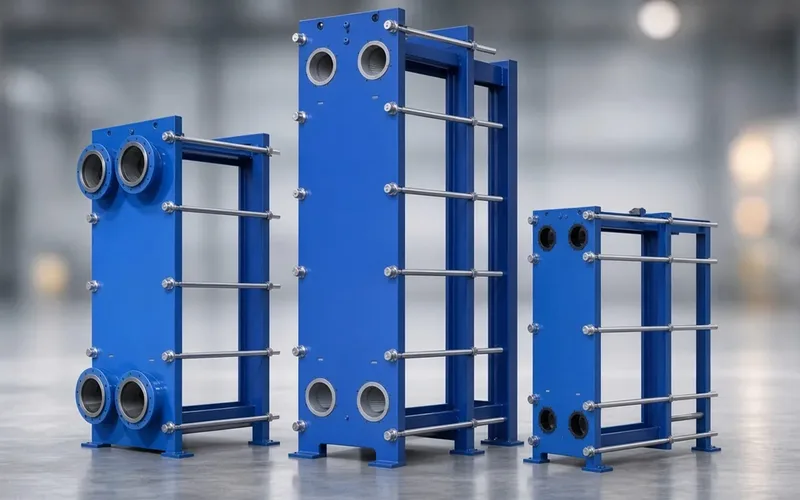
Plate & Frame
316L Plates
Why 316L is the standard pressing for gasketed plates, where 304 still serves, and how thin plates and gasket crevices pull the chloride figure down.
+ Learn More
Plate & Frame
Titanium & High-Alloy Plates
Plate grades past 316L: titanium Grade 1 and 2 for seawater and brine, palladium grades for hot crevices, 6-moly and nickel alloys for acid with chlorides.
+ Learn More
Plate & Frame
Double-Wall Plates
Where a gasketed double-wall pack is called for, how a leak shows at the plate edge, and how much extra surface the second plate costs on a water duty.
+ Learn More