
1-805-484-2992
Quotes - Engineering - SalesHow to pick the grade before you pick the exchanger
Stainless steel is a family, not a material, and the grade is the first decision on any heat exchanger we size. Most of the difference between 304/304L and 316/316L comes down to 2–3% molybdenum, which is what resists pitting once chlorides are present. Above about 1,000 ppm chloride, or above about 140°F with chlorides and tensile stress, the austenitic grades start to lose the argument and 2205 duplex, 904L, 6-moly or titanium take over. The fluid chemistry, not the catalog, settles it.
The questions that settle the grade
Start with the worst water or process stream the unit will ever see, not the design-day average. Tower water that enters at 150 ppm chloride can reach 600–900 ppm at 4–6 cycles, and the same water left stagnant in a shut-down bundle sits there for weeks with the oxygen depleted under every deposit. A 304 bundle that pits through in six months on 400 ppm tower water did not fail because 304 is bad; it failed because somebody chose the grade from the makeup water analysis.
Chloride is the headline, but pH, temperature, oxygen, deposits and crevices move every limit on this page. Under-deposit and crevice attack at tube-to-tubesheet joints and in gasket grooves arrives long before general wastage, so a clean, drained 316L unit often outlasts a 904L unit left half full. Grade buys margin; layout and operation decide whether you spend it.
Work through these in order
- Chloride on each side at the concentration the exchanger actually sees, cycled and evaporated, not at makeup.
- Metal temperature at the hottest wetted surface: chloride stress corrosion cracking of 304 and 316 becomes a risk near 140°F.
- pH of each stream, and whether an acid cleaning step or a caustic CIP cycle changes it for part of the day.
- Whether the unit drains dry at shutdown or sits wet; stagnant, oxygen-starved water is where crevice attack begins.
- Which side needs stainless contact: a 316L product side with a 304L utility side is a legitimate, cheaper answer.
- Weld-zone exposure: specify the L grade (0.03% carbon max) wherever a weld or braze sits in corrosive fluid.
where chloride cracking becomes a riskAbove about 140°F with chlorides and tensile stress, 304 and 316 can crack rather than pit; that single threshold moves more duties to 2205 duplex than any other number here.
Grades ranked by pitting resistance
PREN (Cr + 3.3 Mo + 16 N) is a ranking tool, not a guarantee; the chloride columns assume ambient temperature, near-neutral pH and a clean, drained surface, and every figure falls with heat, acid, crevices and deposits.
| Grade | Cr / Ni / Mo | PREN (about) | Chloride guidance | Where it fits |
| 304 / 304L | 18% / 8% / none | 19 | to about 200 ppm, ambient | Dry gas, steam, glycol, soft or treated water, utility sides, duct banks and clamp-on jackets |
| 316 / 316L | 16–18% / 10–14% / 2–3% | 24–25 | to about 1,000 ppm, ambient | The default product-contact grade: food, dairy, pharma, most process liquids, dilute chloride solutions below 140°F; most brines need duplex or higher |
| 2205 duplex | 22% / 5% / 3% | 35 | to about 3,000–5,000 ppm | Hot chloride water, brackish cooling, CO2-rich produced water; twice the yield strength of 316L |
| 904L | 20% / 25% / 4–5% | 34 | sulfuric acid duty; not a chloride upgrade on 2205 | Dilute sulfuric and phosphoric acid, hot organic acids, where duplex cracks on the acid step |
| 6-moly (AL-6XN type) | 20% / 24% / 6% | 43–45 | to about 20,000 ppm at modest temperature | Hot chlorides and acids, scrubber water, pulp bleach lines, brines where titanium is impractical |
| Titanium Grade 2 | not stainless | off the scale | seawater (about 19,000 ppm Cl) at normal cooling temperatures; Grade 7/12 above about 160°F | Seawater, wet chlorine, high-chloride tower water; thin plates and tubes, galvanically isolate any carbon steel piping |
| Copper or nickel braze | filler, not plate | n/a | copper: no ammonia, no DI water | Brazed plate joints: copper standard, nickel for ammonia and deionized water, iron-based filler when nothing but stainless may be exposed |
Before a grade goes on the quote
- Chloride level and the hottest metal temperature it meets
- Every cleaning and sanitizing chemical the surface will see
- Which side needs stainless, and whether all wetted parts must match
Finish, passivation and the paperwork behind the grade
Passivation and electropolishing are different operations and buyers mix them up on nearly every sanitary quote. Passivation per ASTM A967, with citric or nitric acid, strips free iron left by tooling and welding so the chromium oxide film can reform evenly; it changes nothing a profilometer can measure. ASTM A380 covers the cleaning that comes first. Every welded stainless exchanger should be passivated, and a unit that pits along a weld in its first month usually still had its heat tint.
Electropolishing is an electrochemical removal of 0.0005–0.001 in. of surface metal. It drops the roughness by roughly half, rounds off the peaks that trap product, and raises the chromium-to-iron ratio at the surface, which is why bioprocess specs call for it. It is not a substitute for mechanical polish; an electropolished rough surface is a shiny rough surface. Specify the mechanical Ra first, then the electropolish.
Surface finish is specified as Ra in microinches. 32 µin Ra (0.8 µm) is the common dairy and food product-contact finish, 20 µin Ra (0.5 µm) and 15 µin Ra appear on pharmaceutical and biotech duty, and ASME BPE assigns SF1 through SF6 designations that fix both the Ra and whether electropolish is required. Industrial units carry mill finish; polishing the utility side of a steam-to-water exchanger adds cost and nothing else.
Brazed plate units are 316L plates with a filler metal in every joint, and the filler decides the chemistry. Copper braze is the standard and the cheapest, and it is wrong for ammonia, for deionized water, and for any fluid that attacks copper. Nickel braze solves those three at a price. An iron-based stainless filler leaves no copper or nickel exposed at all, for pharma, high-purity water and all-wetted-parts-stainless specifications.
Material test reports are the only proof that the grade on the drawing is the grade in the unit. We supply MTRs and heat traceability where the order requires them, and an ASME BPE unit, or any unit ordered with traceability, arrives with a package that ties each pressure-containing part to its heat number. Code stamps work the same way: ASME Section VIII Div 1, TEMA class, 3-A, PED and CRN are applied as specified, none is on every unit, and none says anything about corrosion; a U-stamped 304 shell pits exactly as fast as an unstamped one.
Passivation removes free iron. Electropolishing removes metal. Only one changes Ra.
A profilometer reading before and after is the only honest way to confirm either finish was done.
Request a QuoteWhich stainless construction wins for which duty
Grade fixes what the metal survives; construction fixes what the exchanger can do with it. The same 316L bought as a shell and tube, a plate pack, a tube-in-tube, a brazed unit or an embossed plate behaves differently on pressure, fouling, cleaning and footprint.
- Shell and tube wins on pressure and temperature: 150 psig at 350°F standard, 300 psig and higher to order, rodded tubes, and a double tubesheet so a tube-joint leak vents to atmosphere.
- Plate and frame wins on close approach and footprint: 2–5°F approaches, plates added later, but gaskets typically cap it near 275–300°F for EPDM and 350°F for FKM on oils.
- Tube-in-tube wins on solids and viscosity: pieces up to half the inner tube bore in a full-bore layout, true counterflow, 150–300 psig on the product side.
- Brazed plate wins on compact high pressure with clean fluids: 435–650 psig as a matter of course, no gaskets, but a 1–3 mm channel that plugs on fibers or grit.
- Embossed plate wins where there is no room for a vessel: 100–150 psig steam or glycol inside a plate that clamps on a tank wall or lines a duct, 304L for dry gas, 316L for wet service.
- Coils win on simplicity inside the tank: a welded 304L or 316L tube coil to 150 psig steam, all stainless for ammonia, no gaskets and no shell, at the lowest heat transfer coefficient of any construction here.
Call and talk it through with an engineer: 1-805-484-2992
Grade and construction pages by exchanger type
Each exchanger type has its own pages on the grades and constructions that matter for it, written for that type rather than for stainless in general.
| EXCHANGER TYPE | PAGE | WHAT IT COVERS |
| Shell & Tube | 316L Stainless | 316L tubes, tubesheets and shells; chloride limits |
| Shell & Tube | 304L Stainless | where 304L is enough in a shell-and-tube |
| Shell & Tube | Duplex & High Alloy | 2205, 6-moly and titanium tubes |
| Shell & Tube | Double Tubesheet | leak path protection at the tube joints |
| Shell & Tube | Fixed & Removable Bundles | fixed, U-tube and pull-out bundles |
| Shell & Tube | Polished & Electropolished | surface finish, Ra and passivation |
| Tube-in-Tube | 316L Stainless | 316L product tubes for foods and slurries |
| Tube-in-Tube | Duplex & High Alloy | salty, abrasive and sulfide duty |
| Tube-in-Tube | Polished & Electropolished | product-tube finish for sticky products |
| Plate & Frame | 316L Plates | 304 vs 316L plates and frames |
| Plate & Frame | Titanium & High-Alloy Plates | seawater, brine and warm chloride duty |
| Plate & Frame | Gaskets | EPDM, NBR and FKM limits and fit |
| Plate & Frame | Double-Wall Plates | vented double plates for leak protection |
| Embossed Plate | 316L Stainless | 316L pillow and dimple plates |
| Embossed Plate | 304L Stainless | where 304L jackets and plates fit |
| Embossed Plate | Pillow Plate | laser-welded pillow plate construction |
| Embossed Plate | Dimple Plate | dimple jackets on tanks and vessels |
| Brazed Plate | 316L Plates | the 316L plate and the braze filler |
| Brazed Plate | Nickel Brazed | nickel braze for ammonia and pure water |
| Brazed Plate | All-Stainless | no copper or nickel braze in the wetted path |
| Brazed Plate | Single Phase | liquid-to-liquid plate patterns |
| Brazed Plate | Two Phase | evaporating and condensing construction |
| Brazed Plate | Double Wall | vented double plates for potable water |
Before you pick the grade
No. 316L buys roughly five times the chloride tolerence of 304 at ambient temperature and costs more per pound, but it can crack at the same 140°F chloride threshold and is no better in nitric acid, where 304 is preferred. On steam, dry gas, glycol and treated water, 304L is the correct grade and the savings belong in more surface or a thicker tube.
Carbon held to 0.03% maximum. Welding a standard-carbon grade lets chromium carbides form along grain boundaries in the heat-affected zone, which strips chromium from the metal beside them and leaves a corrosion path next to every weld. Dual-certified 304/304L and 316/316L plate and tube is the norm now, so you lose nothing in strength by specifying it.
Two situations: hot chloride water above about 140°F, where austenitic grades can stress-crack, and chloride levels of 3,000–5,000 ppm that 316L cannot hold at any temperature. Duplex also has about twice the yield strength of 316L, so a shell or tubesheet can be thinner at the same rating. It is a poorer choice than 904L in reducing acids.
It tells you how the grades rank against each other, nothing more. A 316L unit at PREN 24–25 will outlast a 2205 unit at PREN 35 if the 316L drains dry every night and the duplex sits half full of warm, stagnant water under a layer of silt. Use PREN to shortlist, then use the operating description to decide.
Yes, and we quote it often. A tube-in-tube or shell and tube with 316L on the product side and 304L on a steam or glycol utility side puts the molybdenum where the fluid demands it and saves it where it does not. The two grades weld together without difficulty; the only caution is a utility water carrying chlorides the 304L side cannot tolerate.
Because seawater and wet chlorine are beyond any chloride guidance for stainless once temperature rises, and titanium resists them well within its temperature limits. Conductivity of about 12 Btu/h-ft-F against 9.4 for 304 means the surface penalty is small; the cost is in the metal, the thin plates and tubes it is rolled to, and galvanic attack on carbon steel piping bolted to it. Isolate the flanges.
Related
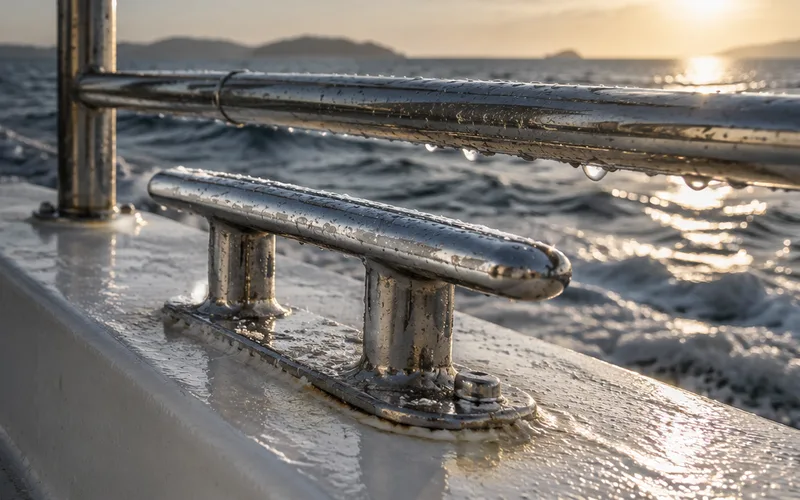
Shell & Tube
Corrosive Service
The grade ladder for aggressive fluids: 316L, 2205 duplex, 904L and 6-moly, and titanium, with the chloride, temperature and pH limits that move a duty up a rung.
+ Learn More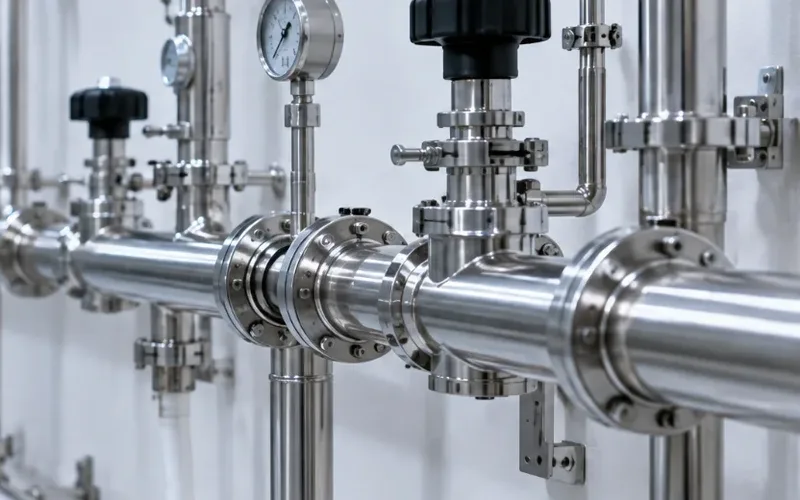
Brazed Plate
All-Stainless
Every wetted surface stainless, joints included. When corrosive, high-purity or copper-free food liquids rule out copper and nickel braze, this is the plate pack.
+ Learn More
Certifications
Certifications
What each code stamp and sanitary standard covers on a stainless exchanger, which one your jurisdiction demands, and how to put it on the order.
+ Learn More