
1-805-484-2992
Quotes - Engineering - SalesWhat 316L does inside a shell and tube
Molybdenum where the tube wall and tubesheet meet the fluid
In a shell and tube, 316L is specified part by part rather than as one blanket choice. The tubes carry most of the surface on the thinnest metal, commonly 0.049 or 0.065 in. wall (18 or 16 BWG), so a pit goes through there first. The tubesheet holds every tube joint and its crevice. The shell, channel and heads each see one fluid only. 316/316L carries 16–18% chromium, 10–14% nickel and 2–3% molybdenum, and the molybdenum is what holds the passive film against chloride pitting, lifting PREN from about 19 for 304 to about 24–25.
The L matters as much as the 316. With carbon held to 0.03% max, the heat-affected zone beside each tube-end weld and shell seam keeps its chromium during welding, so the weld zone resists attack like the parent metal. Tube and plate arrive dual-certified 316/316L as a matter of course.
316L tubes and tubesheet for chloride water to about 1,000 ppm at ambient and most food and process liquids; 304L or carbon steel shell where the shell fluid allows. Material & Construction explains how the grade is chosen.
Where 316L fits: cooling and process water to about 1,000 ppm chloride at ambient, softened and deionized water, glycol, most food products under daily CIP, dilute organic acids and clean steam. Where it does not: seawater, strong brines and hot chloride water on a steam-heated wall. Above roughly 140°F metal temperature, chlorides plus the residual stress of a rolled tube joint can crack 316L, and the chloride it tolerates on that hot wall drops to a few hundred ppm.
Shell & Tube Construction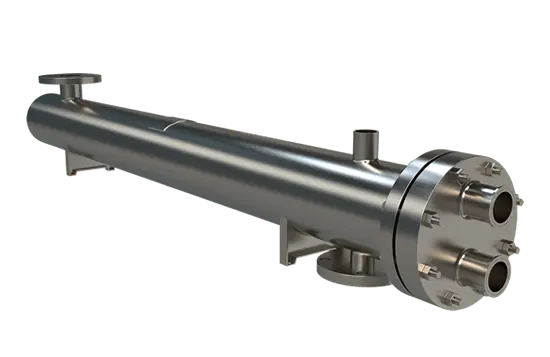
Part by part: a 316L shell and tube
The usual 316L build, component by component. Any line can change when the shell fluid is benign or the tube-side fluid is harsher than 316L tolerates.
| Condition | Typical value |
| Tubes | 316/316L dual-certified, welded (ASTM A249) or drawn with no weld (ASTM A213), 3/4 in. or 1 in. OD, 18 or 16 BWG |
| Tubesheet | 316L plate (ASTM A240) or forging (ASTM A182 F316L); tubes expanded, or expanded and seal-welded |
| Shell | 316L pipe (ASTM A312) or rolled plate; 304L or carbon steel where the shell fluid allows |
| Channel, bonnet and heads | 316L wherever the tube-side fluid wets them |
| Baffles and tie rods | Matched to the shell fluid; baffle holes are crevices and pit first in a mismatched grade |
| Weld filler | ER316L on 316L joints; ER309L where a carbon steel shell meets a stainless tubesheet |
| Design rating | 150 psig at 350°F common standard rating; 300 psig and higher to order |
| Chloride guidance | About 1,000 ppm at ambient; a few hundred ppm on a wall hotter than about 140°F |
| Documentation | MTRs to EN 10204 3.1, hydrotest record and passivation certificate where the order requires |
Stainless tube or plate whose chemistry and mechanical tests satisfy two grades at once, most often 316 and 316L: carbon held to the 0.03% maximum of the L grade while strength meets the higher minimum of straight 316. The designer gets the 316 allowable stress and keeps weld-zone corrosion resistance.
Specifying 316L through the bundle and shell
Tubes: where the chloride limit is set
The number that matters is chloride at the tube wall, at the wall temperature, in the worst week of the year. Open tower water is the usual trap: it can reach 600–900 ppm from a 150 ppm makeup once the tower runs at 4–6 cycles, which is within 316L guidance when the water is cool and moving and outside it when the same water sits in the tubes over a shutdown.
On a steam-heated 316L tube the wall runs close to steam temperature, not water temperature. At 50 psig that is 298°F, well inside the range where chloride stress corrosion cracking can start, so chloride-bearing water heated by steam is reviewed for 2205 duplex before we quote it in 316L.
Carbon steel shell, stainless bundle
When the shell fluid is clean steam, treated closed-loop water or a hydrocarbon oil, a carbon steel shell on a 316L bundle is a sound industrial build and saves a large share of the stainless weight. The shell-to-tubesheet weld becomes a dissimilar joint made with ER309L filler. On a fixed tubesheet unit, note that the stainless tubes expand about a third more per degree than the carbon steel shell around them, so the expansion check uses both coefficients, not one.
- Carbon steel shell: clean steam, oxygen-controlled closed loops, oils
- 304L shell: glycol, condensate, low-chloride water where rust staining matters
- 316L shell: tower water, process fluids, any sanitary or product-side shell
Food, salt and the hot wall
Milk carries about 1,000 ppm chloride and is processed hot in 316L every day; short contact, daily CIP and a clean surface make that normal practice. The line is drawn higher: a product above about 3% salt, roughly 18,000 ppm chloride, at cooking temperature has its product side reviewed for 2205 duplex, 6-moly or higher.
The mistake: leaving the bundle full on shutdown
A 316L bundle that tolerates 800 ppm tower water while it flows can pit under deposits within weeks of standing full and stagnant. Draining and flushing the water side for any idle period longer than a few days protects the grade more than any upgrade does, and costs nothing at the design stage beyond a drain at the low point.
What engineers ask about 316L bundles
Write 316/316L dual-certified for tube and plate. That gives the fabricator material with the 0.03% carbon of the L grade, which protects every weld zone, while the ASME calculation can use the higher allowable stress of straight 316. A drawing that says only 316 invites high-carbon material into a welded bundle, and that is where intergranular attack can start.
Yes, when the shell fluid would not attack carbon steel: clean steam, treated closed-loop water or oil. The tubesheet stays 316L because it carries the tube joints, and the shell joins it through an ER309L weld. On open tower water or aerated water the shell would rust and foul the bundle, so the shell goes to 304L or 316L.
Guidance of about 1,000 ppm applies at ambient. Once the metal passes roughly 140°F, chloride stress corrosion cracking can begin wherever there is tensile stress, and the chloride a hot wall tolerates falls to a few hundred ppm. A steam-heated tube sees close to steam temperature, so judge it by the wall, not the outlet water.
They should match the shell fluid. Baffle holes are tight crevices around every tube, and a 304 baffle on 600 ppm chloride water can pit at the holes, loosen and let the tubes vibrate. On a steam or glycol shell side, 304L baffles are fine; on tower water or product, 316L.
Related
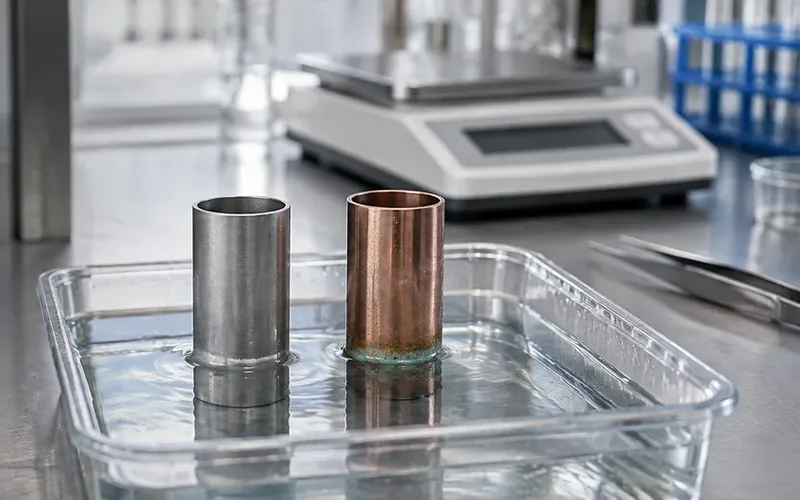
Shell & Tube
Duplex & High Alloy
The alloys that take over from 316L in a tube bundle: 2205 and super duplex, 904L, 6-moly and titanium, with what each one demands of the tubesheet and welds.
+ Learn More
Shell & Tube
Double Tubesheet
How a double tubesheet sends a tube-joint leak to atmosphere instead of into the other fluid, where it is specified, and the tube-wall risk it leaves in place.
+ Learn More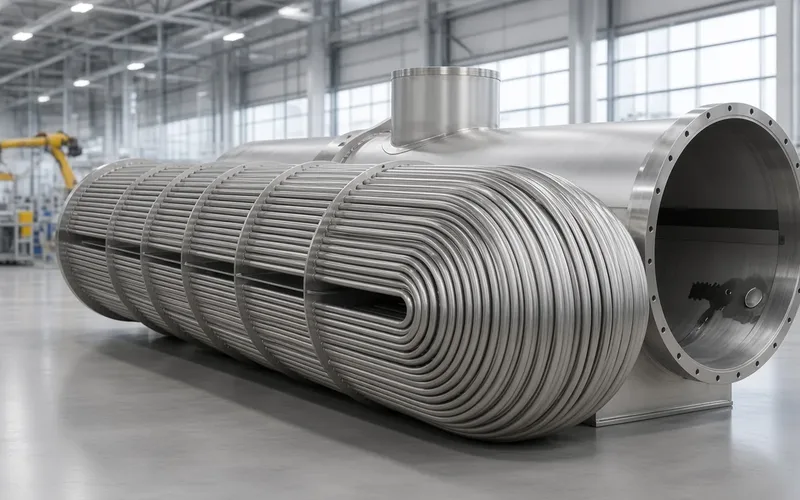
Shell & Tube
Fixed & Removable Bundles
Fixed tubesheet, U-tube or floating head: how each stainless bundle copes with thermal growth, which side it lets you clean, and what it asks of the plant layout.
+ Learn More
